












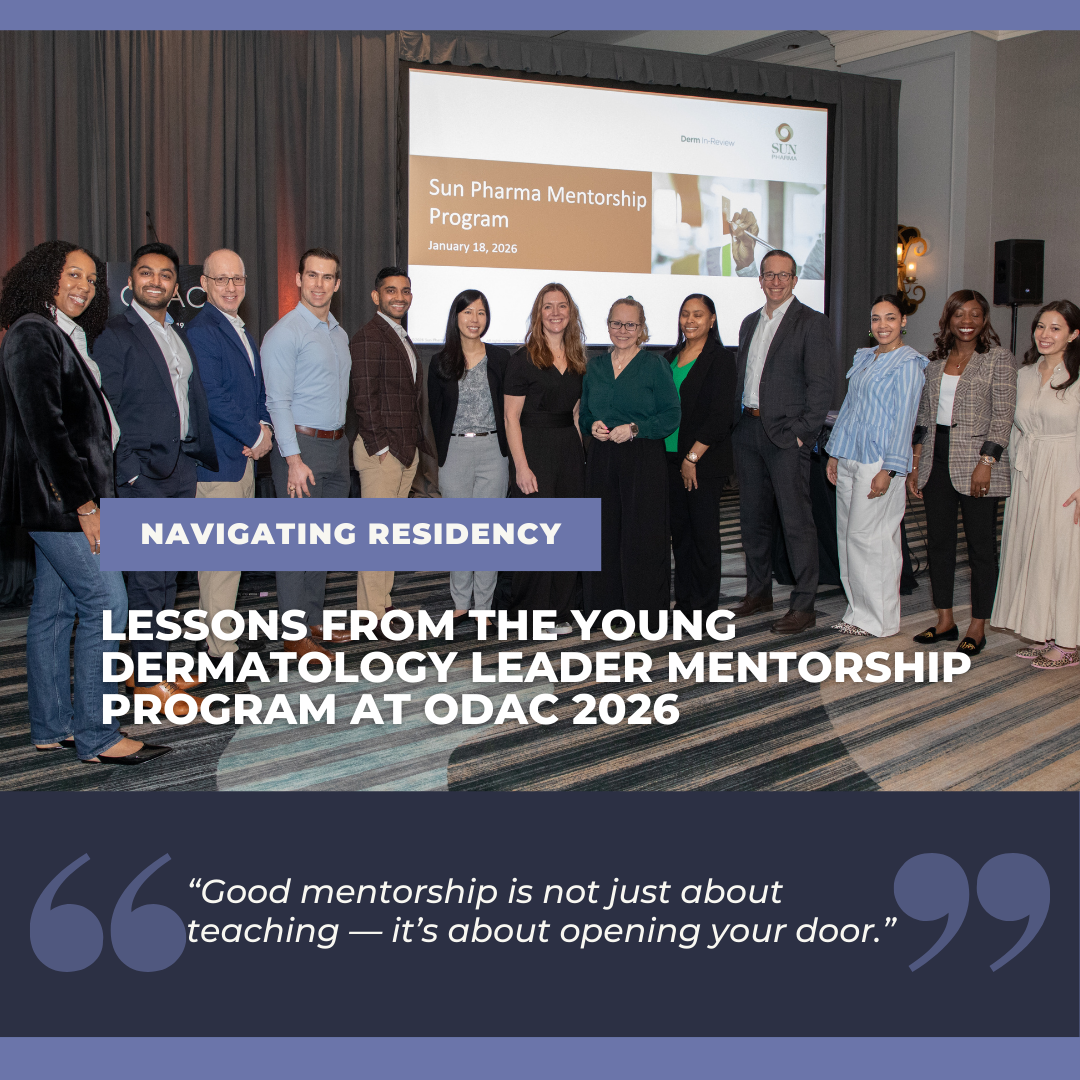
In dermatology, mentorship extends far beyond career advice. At ODAC 2026, the Young Dermatology Leader Mentorship Program organized by Dermatology In-review and supported by Sun Pharma, highlighted the importance of mentorship and relationship-building early in one’s career. The program brought together five dermatology resident mentees with established leaders in the field to discuss and reflect on mentorship.
As Dr. Adam Friedman noted, “Good mentorship is not just about teaching — it’s about opening your door.” With many subspecialties and pathways within dermatology, panelists emphasized the value of having multiple mentors at different stages of training and career development. The concept of “collecting mentors” resonated strongly with attendees, underscoring how each mentor can offer a unique perspective, skill set, or opportunity.
For residents early in training, the learning curve can feel overwhelming. “As a resident, you have no idea what half the acronyms, like MSL, even mean,” one attendee shared. Panelists discussed how industry sponsors and professional partners can help trainees better understand the broader dermatology ecosystem beyond academia.
The conversation also addressed the challenge of balancing responsiveness with burnout as professional demands increase. Dr. Hadar Lev-Tov offered perspective: “You have to remember where you are in your trajectory. Saying yes helps more when you’re young, and as you grow, you start narrowing your focus to what truly advances your career.”
Dr. Friedman shared a practical communication strategy: “Email baskets can be overwhelming. Recognize you don’t need a full reply immediately — just a quick response acknowledging the email buys you time to respond thoughtfully. Early in your career, first impressions matter and response times are noted. And if you can, use AI tools to check your tone.”
Dr. Vishal Patel also described his approach to managing volume: “I make a to-do list and block off time just for emails.” Others referenced “pajama time,” describing how messages are often answered after hours while balancing patient care and life outside the clinic.
When discussing how to approach mentors, panelists encouraged residents to move past hesitation. “You miss 100% of the shots you don’t take,” advised Dr. Olayemi Sokumbi. Dr. Misty Eleryan added, “Don’t be afraid if someone says no. They might connect you with someone who’s a great fit. There’s a mentor for every stage and situation.”
Dr. Patel emphasized the fluid nature of mentorship: “You can be both a mentor and a mentee at any time in your career — just come with purpose and know your why.”
The session concluded with reflections on professionalism and boundaries. “Stand up for yourself,” advised Dr. Patel. “Never respond with emotion,” added Dr. Friedman. Dr. Lev-Tov closed with a reminder to trust one’s instincts: “If something feels off, trust your gut — your antenna will go up.”
Overall, the panel captured the spirit of mentorship in dermatology, reinforcing the value of guidance, connection, and growth while bringing residents and faculty together in a meaningful small group setting.