












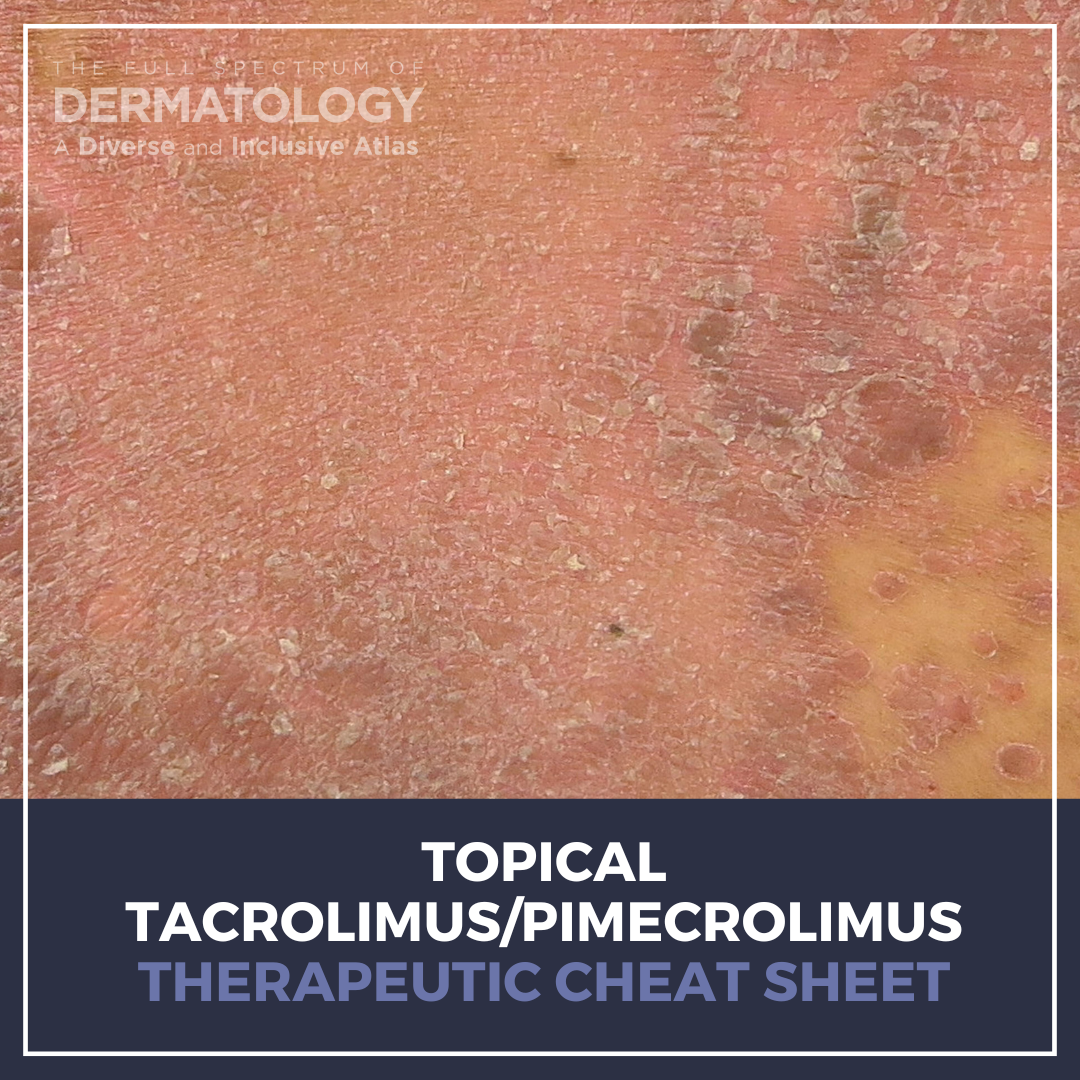
Tacrolimus and Pimecrolimus are both calcineurin inhibitors FDA-approved for atopic dermatitis. However, their topical use offers steroid-sparing benefits for a wide variety of other inflammatory dermatologic conditions. Tacrolimus was discovered in 1984 from the soil bacterium Streptomyces tsukubaensis and was originally FDA approved in 1994 as a systemic immunosuppressant for organ transplantation.1 Pimecrolimus was developed later as part of a research program into ascomycin derivatives, specifically designed for topical dermatologic use.2,3 Both compounds belong to the macrolactam class of calcineurin inhibitors and are thought to have evolved as a bacterial “smart bomb” against fungi in their natural environment.2 The transition to topical use occurred in the 1990s when researchers demonstrated that topical calcineurin inhibitors had highly anti-inflammatory action using a newly developed model of allergic contact dermatitis in pigs, providing the first pharmacologic evidence that this novel class could treat inflammatory skin diseases and represent the first topical alternative to topical corticosteroids in more than 40 years.1,3 We continue our series, Therapeutic Cheat Sheet, with a closer look at topical tacrolimus and pimecrolimus.
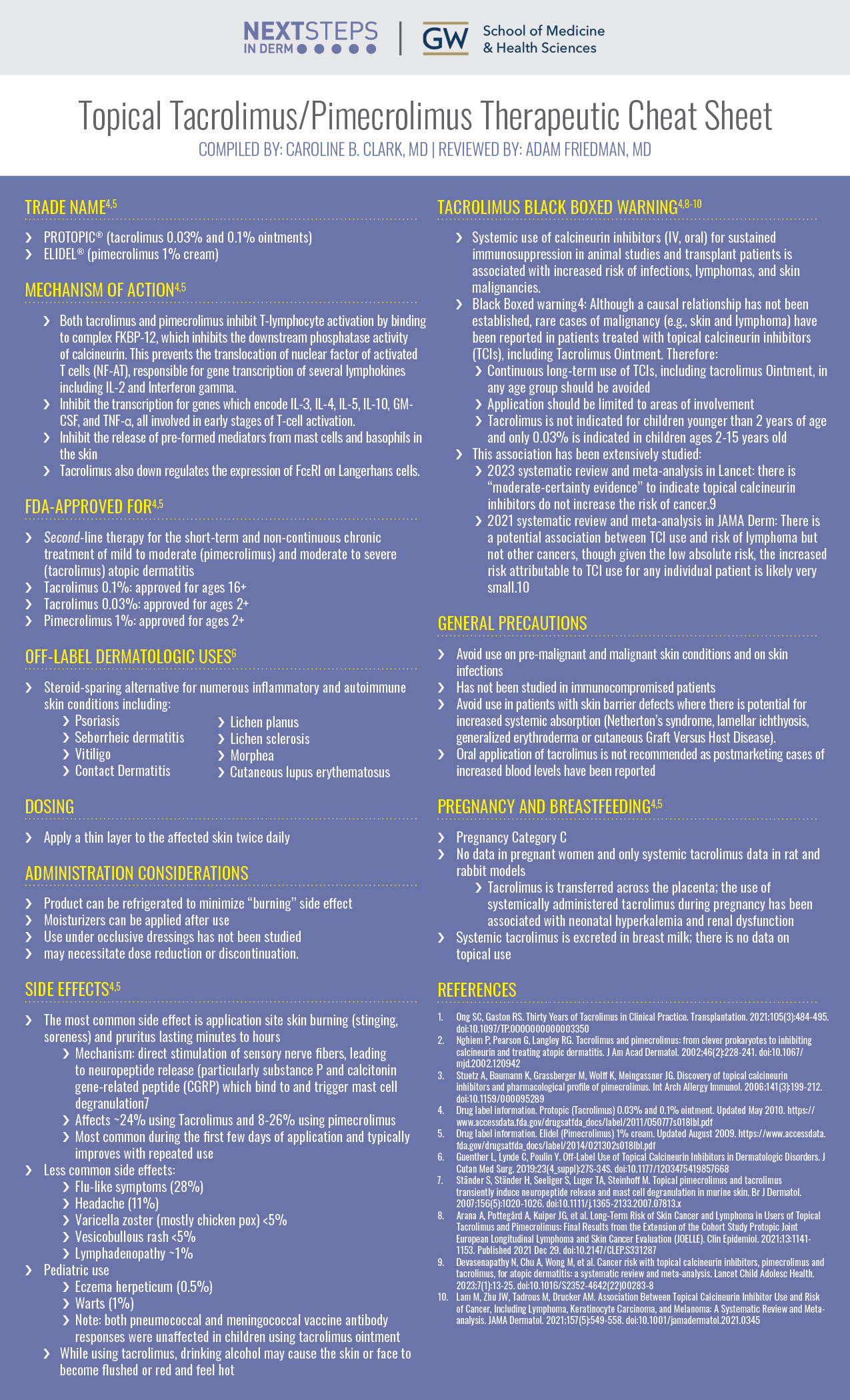
Topical Tacrolimus/Pimecrolimus Therapeutic Cheat Sheet
Compiled by: Caroline B. Clark, MD | Reviewed by: Adam Friedman, MD
TRADE NAME4,5
-
- PROTOPIC® (tacrolimus 0.03% and 0.1% ointments)
- ELIDEL® (pimecrolimus 1% cream)
MECHANISM OF ACTION4,5
-
- Both tacrolimus and pimecrolimus inhibit T-lymphocyte activation by binding to complex FKBP-12, which inhibits the downstream phosphatase activity of calcineurin. This prevents the translocation of nuclear factor of activated T cells (NF-AT), responsible for gene transcription of several lymphokines including IL-2 and Interferon gamma.
- Inhibit the transcription for genes which encode IL-3, IL-4, IL-5, IL-10, GM-CSF, and TNF-α, all involved in early stages of T-cell activation.
- Inhibit the release of pre-formed mediators from mast cells and basophils in the skin
- Tacrolimus also down regulates the expression of FcεRI on Langerhans cells.
FDA-APPROVED FOR4,5
-
- Second-line therapy for the short-term and non-continuous chronic treatment of mild to moderate (pimecrolimus) and moderate to severe (tacrolimus) atopic dermatitis
- Tacrolimus 0.1%: approved for ages 16+
- Tacrolimus 0.03%: approved for ages 2+
- Pimecrolimus 1%: approved for ages 2+
OFF-LABEL DERMATOLOGIC USES6
-
- Steroid-sparing alternative for numerous inflammatory and autoimmune skin conditions including:
- Psoriasis
- Seborrheic dermatitis
- Vitiligo
- Contact Dermatitis
- Lichen planus
- Lichen sclerosis
- Morphea
- Cutaneous lupus erythematosus
- Steroid-sparing alternative for numerous inflammatory and autoimmune skin conditions including:
DOSING
-
- Apply a thin layer to the affected skin twice daily
ADMINISTRATION CONSIDERATIONS
-
- Product can be refrigerated to minimize “burning” side effect
- Moisturizers can be applied after use
- Use under occlusive dressings has not been studied
SIDE EFFECTS44,5
-
- The most common side effect is application site skin burning (stinging, soreness) and pruritus lasting minutes to hours
- Mechanism: direct stimulation of sensory nerve fibers, leading to neuropeptide release (particularly substance P and calcitonin gene-related peptide (CGRP) which bind to and trigger mast cell degranulation7
- Affects ~24% using Tacrolimus and 8-26% using pimecrolimus
- Most common during the first few days of application and typically improves with repeated use
- The most common side effect is application site skin burning (stinging, soreness) and pruritus lasting minutes to hours
-
- Less common side effects:
- Flu-like symptoms (28%)
- Headache (11%)
- Varicella zoster (mostly chicken pox) <5%
- Vesicobullous rash <5%
- Lymphadenopathy ~1%
- Less common side effects:
-
- Pediatric use
- Eczema herpeticum (0.5%)
- Warts (1%)
- Note: both pneumococcal and meningococcal vaccine antibody responses were unaffected in children using tacrolimus ointment
- While using tacrolimus, drinking alcohol may cause the skin or face to become flushed or red and feel hot
- Pediatric use
TACROLIMUS BLACK BOXED WARNING4,8-10
-
- Systemic use of calcineurin inhibitors (IV, oral) for sustained immunosuppression in animal studies and transplant patients is associated with increased risk of infections, lymphomas, and skin malignancies.
- Black Boxed warning4: Although a causal relationship has not been established, rare cases of malignancy (e.g., skin and lymphoma) have been reported in patients treated with topical calcineurin inhibitors (TCIs), including Tacrolimus Ointment. Therefore:
- Continuous long-term use of TCIs, including tacrolimus Ointment, in any age group should be avoided
- Application should be limited to areas of involvement
- Tacrolimus is not indicated for children younger than 2 years of age and only 0.03% is indicated in children ages 2-15 years old
- This association has been extensively studied:
- 2023 systematic review and meta-analysis in Lancet: there is “moderate-certainty evidence” to indicate topical calcineurin inhibitors do not increase the risk of cancer.9
- 2021 systematic review and meta-analysis in JAMA Derm: There is a potential association between TCI use and risk of lymphoma but not other cancers, though given the low absolute risk, the increased risk attributable to TCI use for any individual patient is likely very small.10
GENERAL PRECAUTIONS:
-
- Avoid use on pre-malignant and malignant skin conditions and on skin infections
- Has not been studied in immunocompromised patients
- Avoid use in patients with skin barrier defects where there is potential for increased systemic absorption (Netherton’s syndrome, lamellar ichthyosis, generalized erythroderma or cutaneous Graft Versus Host Disease).
- Oral application of tacrolimus is not recommended as postmarketing cases of increased blood levels have been reported
PREGNANCY AND BREASTFEEDING4,5
-
- Pregnancy Category C
- No data in pregnant women and only systemic tacrolimus data in rat and rabbit models
- Tacrolimus is transferred across the placenta; the use of systemically administered tacrolimus during pregnancy has been associated with neonatal hyperkalemia and renal dysfunction
- Systemic tacrolimus is excreted in breast milk; there is no data on topical use
Further Reading
If you would like to learn more about topical tacrolimus and pimecrolimus, check out the following articles in the Journal of Drugs in Dermatology:
Adult patients with moderate atopic dermatitis: tacrolimus ointment versus pimecrolimus cream
Abramovits W, Fleischer AB Jr, Jaracz E, et al.
The objective of this study was to compare the efficacy and safety of tacrolimus ointment and pimecrolimus cream in adults with moderate atopic dermatitis (AD). A randomized, investigator-blinded, 6-week, multicenter study enrolled patients (> or =16 years) with mild to very severe AD. Patients with moderate AD at baseline were analyzed. At study completion, tacrolimus ointment-treated patients had significantly greater improvement in Eczema Area Severity Index score compared with pimecrolimus cream-treated patients (59% versus. 43% reduction, respectively; P=.01). Significantly more tacrolimus ointment-treated patients than pimecrolimus cream-treated patients improved by 1 or more grades on the Investigators’ Global Atopic Dermatitis Assessment (P<.02). A total of 5 pimecrolimus cream-treated patients discontinued the study early due to lack of efficacy compared with no tacrolimus ointment-treated patients (P=.02). Overall, reported adverse events occurred at a similar frequency for both treatment groups. Tacrolimus ointment is more effective than pimecrolimus cream in the management of adults with moderate AD.
J Drugs Dermatol. 2008;7(12):1153-1158.
Fleischer AB Jr, Boguniewicz M.
Persistent pruritus, or itch, is one of the earliest symptoms of atopic dermatitis (AD). When pruritus is untreated, the incessant scratching response by the patient can increase the inflammatory response, resulting in aggravation of disease symptoms and severity, increasing flares and worsening patient quality of life. Therefore, it is essential that pruritus be treated effectively, rapidly and safely for optimal management of AD. In this article, the authors review clinical trials using tacrolimus ointment, a topical calcineurin inhibitor, to treat adult and pediatric patients with AD over a wide range of disease severity focusing on its efficacy in rapidly reducing pruritus. Furthermore, the authors evaluate trials in which tacrolimus ointment was directly compared with topical corticosteroids, the mainstay of AD treatment, and pimecrolimus cream, another topical calcineurin inhibitor, as well as long-term safety trials in which patients applied tacrolimus ointment for extended periods.
J Drugs Dermatol. 2010;9(5):488-498.
References
-
- Ong SC, Gaston RS. Thirty Years of Tacrolimus in Clinical Practice. Transplantation. 2021;105(3):484-495. doi:10.1097/TP.0000000000003350
- Nghiem P, Pearson G, Langley RG. Tacrolimus and pimecrolimus: from clever prokaryotes to inhibiting calcineurin and treating atopic dermatitis. J Am Acad Dermatol. 2002;46(2):228-241. doi:10.1067/mjd.2002.120942
- Stuetz A, Baumann K, Grassberger M, Wolff K, Meingassner JG. Discovery of topical calcineurin inhibitors and pharmacological profile of pimecrolimus. Int Arch Allergy Immunol. 2006;141(3):199-212. doi:10.1159/000095289
- Drug label information. Protopic (Tacrolimus) 0.03% and 0.1% ointment. Updated May 2010. https://www.accessdata.fda.gov/drugsatfda_docs/label/2011/050777s018lbl.pdf
- Drug label information. Elidel (Pimecrolimus) 1% cream. Updated August 2009. https://www.accessdata.fda.gov/drugsatfda_docs/label/2014/021302s018lbl.pdf
- Guenther L, Lynde C, Poulin Y. Off-Label Use of Topical Calcineurin Inhibitors in Dermatologic Disorders. J Cutan Med Surg. 2019;23(4_suppl):27S-34S. doi:10.1177/1203475419857668
- Ständer S, Ständer H, Seeliger S, Luger TA, Steinhoff M. Topical pimecrolimus and tacrolimus transiently induce neuropeptide release and mast cell degranulation in murine skin. Br J Dermatol. 2007;156(5):1020-1026. doi:10.1111/j.1365-2133.2007.07813.x
- Arana A, Pottegård A, Kuiper JG, et al. Long-Term Risk of Skin Cancer and Lymphoma in Users of Topical Tacrolimus and Pimecrolimus: Final Results from the Extension of the Cohort Study Protopic Joint European Longitudinal Lymphoma and Skin Cancer Evaluation (JOELLE). Clin Epidemiol. 2021;13:1141-1153. Published 2021 Dec 29. doi:10.2147/CLEP.S331287
- Devasenapathy N, Chu A, Wong M, et al. Cancer risk with topical calcineurin inhibitors, pimecrolimus and tacrolimus, for atopic dermatitis: a systematic review and meta-analysis. Lancet Child Adolesc Health. 2023;7(1):13-25. doi:10.1016/S2352-4642(22)00283-8
- Lam M, Zhu JW, Tadrous M, Drucker AM. Association Between Topical Calcineurin Inhibitor Use and Risk of Cancer, Including Lymphoma, Keratinocyte Carcinoma, and Melanoma: A Systematic Review and Meta-analysis. JAMA Dermatol. 2021;157(5):549-558. doi:10.1001/jamadermatol.2021.0345
Did you enjoy this therapeutic Cheat Sheet? You can find more here.