












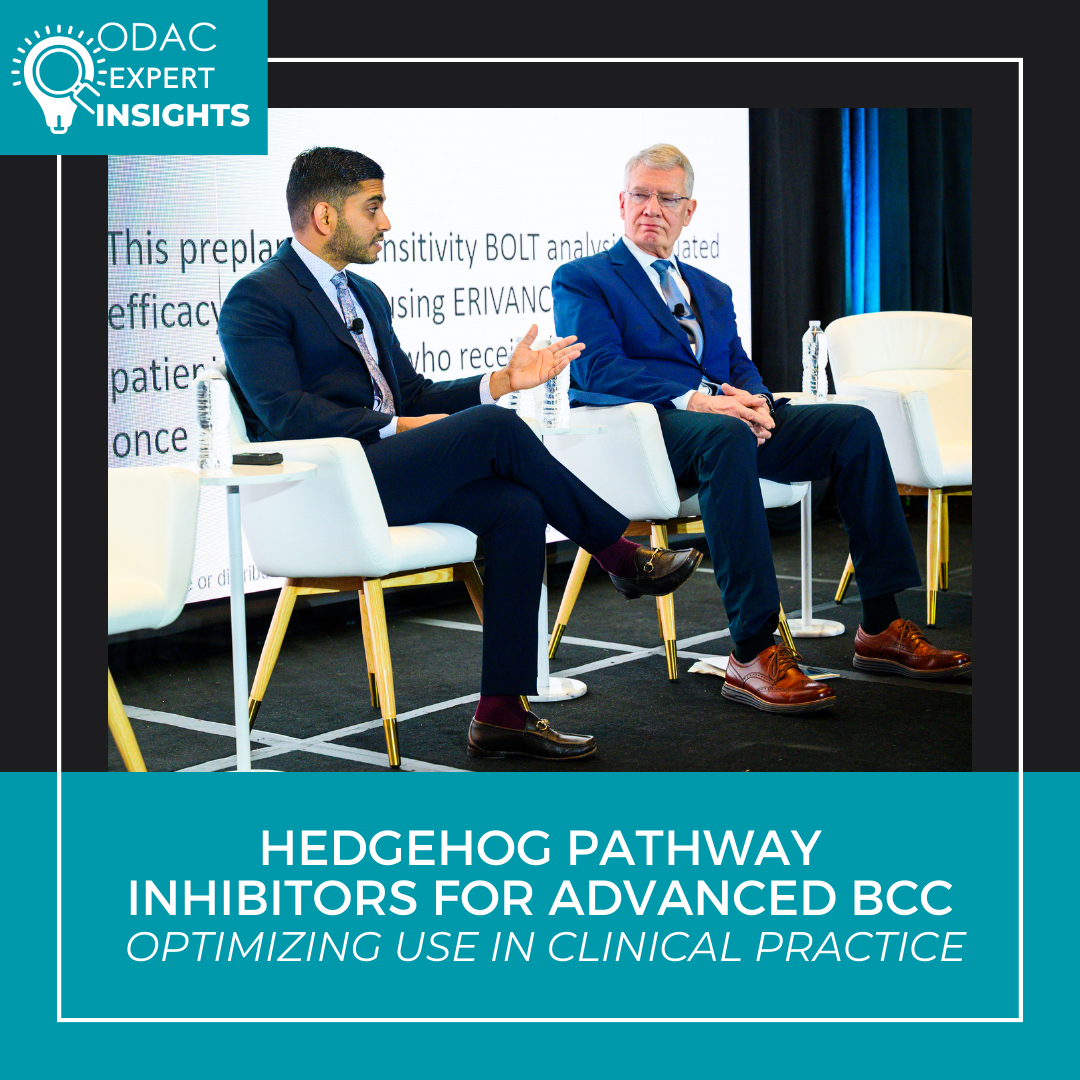
The 2026 ODAC Conference featured an expert panel discussion on evolving strategies for the use of hedgehog pathway inhibitors (HHIs), with a focus on practical clinical decision-making for dermatologists. Dr. Vishal Patel and Dr. C. William Hanke reviewed how HHIs have expanded treatment options for patients with locally advanced and metastatic basal cell carcinoma (BCC).
Background and Rationale
The panel reviewed the two FDA-approved HHIs: vismodegib (Erivedge®), approved in 2012 following the ERIVANCE trial, and sonidegib (Odomzo®), approved in 2015 based on results from the BOLT trial. In these studies, objective response rates were 47% for vismodegib and 56.1% for sonidegib, with median durations of response of 9.5 months and 26 months, respectively. Direct comparisons between agents are limited due to differences in trial design and endpoints. Overall, however, HHIs demonstrated high rates of disease control and durable responses with continued therapy.
Advantages of HHI therapy include significant tumor shrinkage in most patients with advanced BCC and the potential for effective retreatment. Limitations include the lack of curative outcomes for most patients, treatment-limiting adverse effects, and high cost.
Adverse Effects and Monitoring
The most common class-wide adverse effects include muscle cramps, dysgeusia, alopecia, and gastrointestinal symptoms such as weight loss, decreased appetite, and diarrhea. While most toxicities are grade 1-2, they are often chronic and can significantly impact quality of life, leading to treatment interruption or discontinuation. The duration of adverse effects is influenced by the pharmacokinetics of each agent; sonidegib has a longer half-life (28-30 days) compared with vismodegib (4-12 days).
Practical Treatment Considerations
HHIs are effective but generally not curative and should be used selectively in the following settings:
-
- Primary therapy for unresectable or inoperable BCC
- Neoadjuvant therapy to reduce tumor burden prior to surgery or radiation
- Bridge therapy to optimize functional or cosmetic outcomes
Following treatment response, residual hypopigmented or scar-like areas may persist and can resemble skin grafts despite excellent tumor control. Importantly, many long-term survivors achieve meaningful functional and cosmetic improvement even without complete tumor eradication. Treatment selection may be influenced by insurance coverage, access and availability of samples, patient comorbidities, and logistical considerations.
Bottom Line
Hedgehog pathway inhibitors are powerful agents for disease control but are not curative therapies. Their successful use depends on careful patient selection, proactive management of adverse effects, and thoughtful integration with surgery, radiation, and immunotherapy, allowing dermatologists to move confidently beyond the blade.
This information was presented by Drs. Vishal A. Patel and C. William Hanke during the 2026 ODAC conference. The above highlights from their lecture were written and compiled by Dr. Erica Lin. Dr. Lin was one of the five residents selected to participate in the Young Dermatology Leader Mentorship Program sponsored by Sun Pharma and organized by Derm In-Review.