












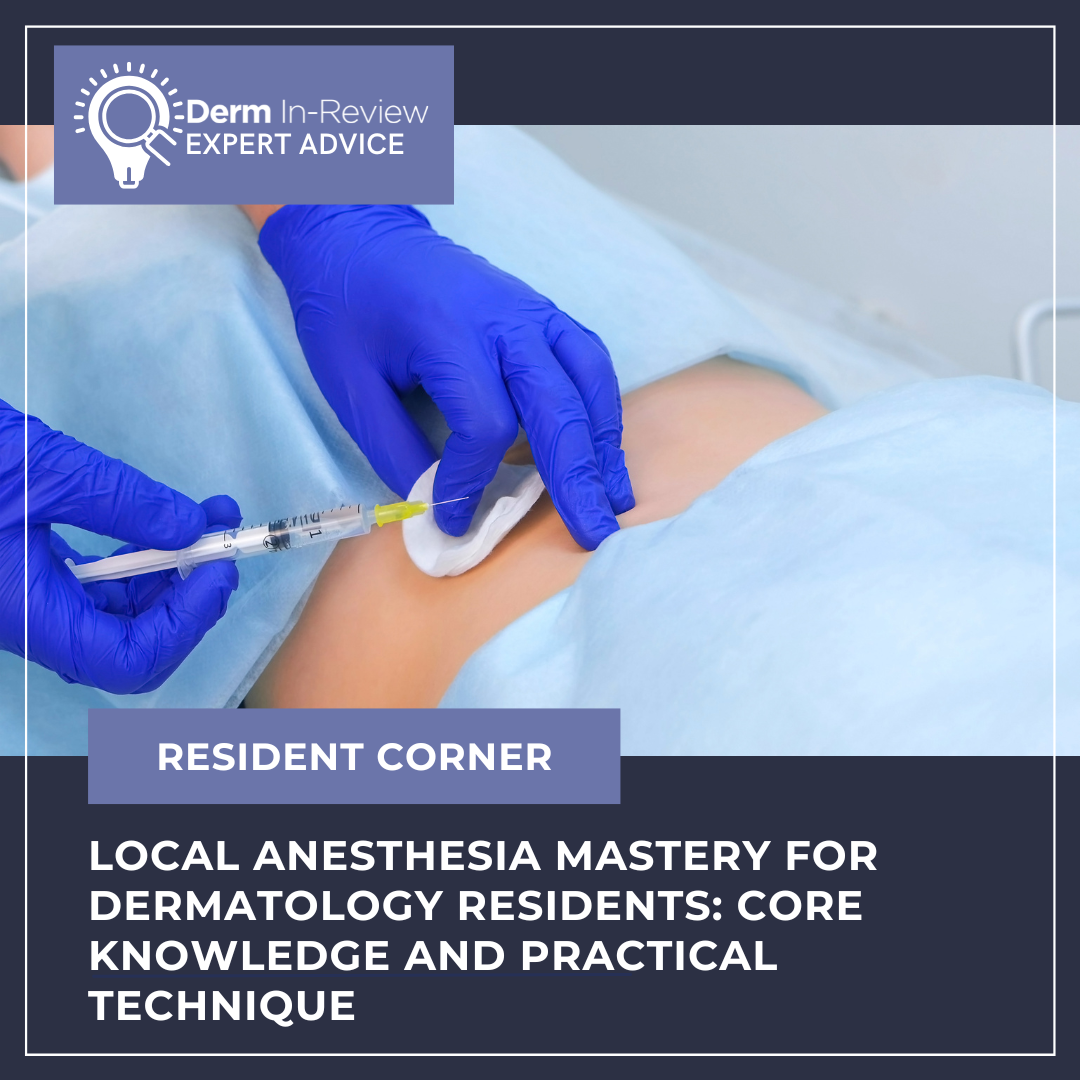
Local anesthesia is a cornerstone of dermatologic practice. From biopsies and excisions to cosmetic and laser procedures, dermatologists rely on local anesthetics daily. Mastery of anesthetic technique not only improves procedural efficiency but also dramatically enhances the patient experience. Patients may not remember every detail of their diagnosis, but they will remember how a procedure made them feel. With thoughtful technique, you may soon hear patients say, “You’re done already?” or “I barely felt that.”
Beyond clinical practice, local anesthetics are a high-yield topic for the dermatologic surgery core exam. Before discussing pain-reduction strategies for improved technique, a review of anesthetic fundamentals is essential.
Mechanism of Action and Chemical Structure
Local anesthetics work by causing reversible inhibition of sodium ion influx into nerve fibers which prevents depolarization and blocks nerve conduction. Structurally, local anesthetics consist of three components: (1) aromatic ring, which is lipophilic and influences potency and duration; (2) intermediate chain, which determines whether the anesthetic is an amide or ester; and (3) amine group, which is hydrophilic and affects onset of action.
Amide vs Ester Anesthetics
Amide Anesthetics are metabolized by CYP3A4 in the liver, so caution is advised in patients with severe liver disease. True allergy to the anesthetic itself is rare. Reactions are more commonly due to preservatives within the anesthetic, such as methylparaben or sodium metabisulfite. In patients with suspected allergy, preservative-free lidocaine should be used.
A helpful mnemonic: amide has an “I,” and amide anesthetics have two “I’s.” Examples include lidocaine, prilocaine, etidocaine, ropivacaine, mepivacaine, and bupivacaine.
Ester anesthetics are metabolized by plasma pseudocholinesterases and renally excreted, requiring caution in patients with renal insufficiency. They are metabolized into para-aminobenzoic acid (PABA), which can cross-react with several contact allergens, including paraphenylenediamine (PPD), para-aminosalicylic acid, ethylenediamine, sulfonamides, thiazides, ester anesthetics, and azo dyes.
These cross-reacting metabolites can be remembered using the mnemonic “PPPESTAA.” Ester anesthetics are contraindicated in patients with a known PABA allergy or pseudocholinesterase deficiency.
High-Yield Anesthetic Facts
Before taking the dermatologic surgery core examination, it is important to be familiar with high-yield, testable facts related to commonly used local anesthetics, as each agent has unique clinical and safety considerations:
-
- Lidocaine has the fastest onset of action and is the anesthetic of choice during pregnancy.
- Prilocaine carries a risk of methemoglobinemia.
- Ropivacaine has the longest duration of action in the absence of epinephrine (up to 6 hours).
- Bupivacaine (Marcaine) has the longest duration of action when combined with epinephrine (up to 8 hours) and carries the highest risk of cardiotoxicity and fetal bradycardia.
Know Your Limits: Maximum Safe Dosing
Calculating maximum allowable anesthetic doses should become second nature early in residency, as local anesthetic toxicity is preventable but potentially serious.
The calculation that is most commonly tested and most relevant to daily dermatologic practice is lidocaine. For this reason, lidocaine dosing is outlined below. It is important to remember that maximum safe doses vary by anesthetic. Additional details can be found in the Journal of the American Academy of Dermatology certified medical education document titled Guidelines for the Use of Local Anesthesia in Office-Based Dermatologic Surgery.
Lidocaine without epinephrine
-
- 4.5 mg per kg with a maximum total dose of 300 mg
- Pediatric dosing is 1.2 to 2 mg per kg
Lidocaine with epinephrine
-
- 7 mg per kg with a maximum total dose of 500 mg
- Pediatric dosing is 3 to 4.5 mg per kg
Stages of Local Anesthetic Toxicity
Recognizing symptoms of lidocaine toxicity early is critical, as management varies by severity.
-
- Mild: restlessness, euphoria, talkativeness, lightheadedness, circumoral numbness, metallic taste
- Management: observation
- Moderate: nausea, vomiting, tinnitus, tremors, blurred vision, slurred speech, confusion
- Management: benzodiazepines and airway support
- Severe: seizures, cardiopulmonary depression
- Management: respiratory support
- Life-threatening: coma, cardiac arrest
- Management: cardiopulmonary resuscitation and advanced life support
- Mild: restlessness, euphoria, talkativeness, lightheadedness, circumoral numbness, metallic taste
Techniques to Minimize Injection Pain
Once anesthetic fundamentals are understood, technique becomes the most powerful tool for improving patient comfort.
-
- Pretreating with ice or topical anesthetics reduces superficial nociceptor activation and blunts the initial needle entry sensation.
- Stimulating adjacent skin via vibration, pinching, rubbing, or tapping activates non-pain sensory fibers and leverages the gate control theory of pain, decreasing transmission of pain signals through ascending nerve pathways.
- Buffering lidocaine with 8.4 percent sodium bicarbonate raises the pH of the solution, reducing the acidic burning sensation associated with injection.
- Warming anesthetic to body temperature decreases discomfort by minimizing the temperature gradient between the solution and surrounding tissue.
- Injecting slowly and with minimal pressure limits rapid tissue distension, which is a major contributor to injection-related pain.
- Injecting from deep to superficial planes allows anesthetic to take effect before superficial tissue distension occurs, improving overall comfort.
- Re-entering through previously anesthetized skin allows subsequent injections to pass through numb tissue, minimizing repeated nociceptor activation.
- Using small-gauge needles (27 to 30 gauge) reduces tissue trauma and pain at the point of needle entry.
- Inserting the needle at a 90-degree angle initially facilitates smoother dermal penetration and reduces dragging or tearing of tissue.
- When visible, inserting the needle through a pore or hair follicle exploits natural openings in the skin and may reduce resistance and nociceptor activation.
- Using distraction techniques such as conversation or music decreases pain perception by diverting patient attention and reducing anxiety-related amplification of pain.
Key Takeaways
Mastery of local anesthesia is a foundational skill that extends across all areas of dermatology, from medical and surgical practice to cosmetic procedures. A strong understanding of anesthetic pharmacology enhances patient safety and prepares residents for board examinations, while refined injection technique directly improves patient comfort. By combining fundamental knowledge with patient-centered technique, dermatology residents can significantly elevate procedural experiences and outcomes. Developing these skills early in training not only builds confidence in the clinic but also establishes habits that will benefit patients throughout a dermatologist’s career.
Did you enjoy this article? Find more Resident Focused content here.