












Suncare Sundays: UV Index Explained
 Do you know what your Ultraviolet Index is today?
Ultraviolet index (UV index) is a measure of the strength of the sun’s harmful rays at a particular place and time. The higher the number, the greater the chance of sun damage.1
UV Index was developed by Canadian scientists in 1992 and standardized by the UN’s World Health Organization and World Meteorological Organization in 1994. U …
Do you know what your Ultraviolet Index is today?
Ultraviolet index (UV index) is a measure of the strength of the sun’s harmful rays at a particular place and time. The higher the number, the greater the chance of sun damage.1
UV Index was developed by Canadian scientists in 1992 and standardized by the UN’s World Health Organization and World Meteorological Organization in 1994. U …
Do you know what your Ultraviolet Index is today?
Ultraviolet index (UV index) is a measure of the strength of the sun’s harmful rays at a particular place and time. The higher the number, the greater the chance of sun damage.1
UV Index was developed by Canadian scientists in 1992 and standardized by the UN’s World Health Organization and World Meteorological Organization in 1994. U …  We all discuss sun protection with our patients. At this point, our recommendations are predictable – “avoidance, protective clothing, SPF 30+, broad-spectrum, water-resistant, and reapplication.” But how can we effectively change patient behavior?
Important note – this discussion has wide arching correlations to all areas of human behavior, medicine, and dermatology that spans more th …
We all discuss sun protection with our patients. At this point, our recommendations are predictable – “avoidance, protective clothing, SPF 30+, broad-spectrum, water-resistant, and reapplication.” But how can we effectively change patient behavior?
Important note – this discussion has wide arching correlations to all areas of human behavior, medicine, and dermatology that spans more th …  A patient in my clinic was recently prescribed 5-fluorouracil for severe photodamage, diffuse actinic keratoses. He is 24 years old and, unfortunately, lacked knowledge about photoprotection. It was sobering to think about how much longer he has to live and the damage already done. Strides have been made over the years in educating our patients about photoprotection, but recently, patients have …
  On this Suncare Sunday: Sunburn Facts, we share newly published data from the CDC showing sunburn incidence in adults and teens, sun exposure behaviors and sun protection basics:
Sunburn incidence in adults remains high:
34% of adults report experiencing at least 1 sunburn each year1
Half were outside for more than 1 hour between 10 and 4 pm2
Only 5% reported they were tryin …
On this Suncare Sunday: Sunburn Facts, we share newly published data from the CDC showing sunburn incidence in adults and teens, sun exposure behaviors and sun protection basics:
Sunburn incidence in adults remains high:
34% of adults report experiencing at least 1 sunburn each year1
Half were outside for more than 1 hour between 10 and 4 pm2
Only 5% reported they were tryin … 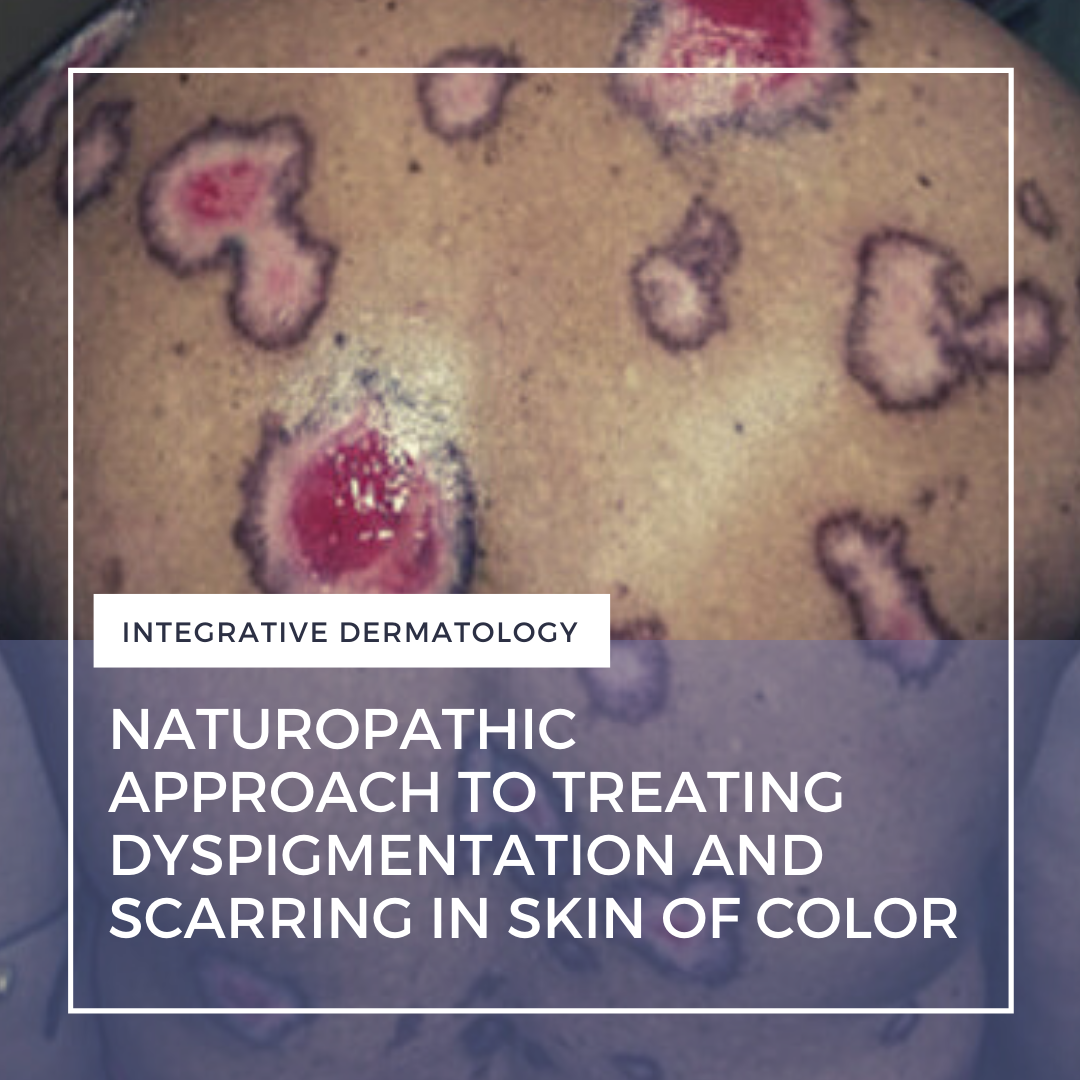 As we know, people of color are more apt to have problems with dyspigmentation and excessive scarring (keloid formation and hypertrophic scars). We probably all use a combination approach for both of these: sun protection, peels, HQ, OTC skin lighteners, injections, lasers, energy-based devices, etc. These are common approaches, but what are the go-to’s for a naturopathic physician? You may ne …