












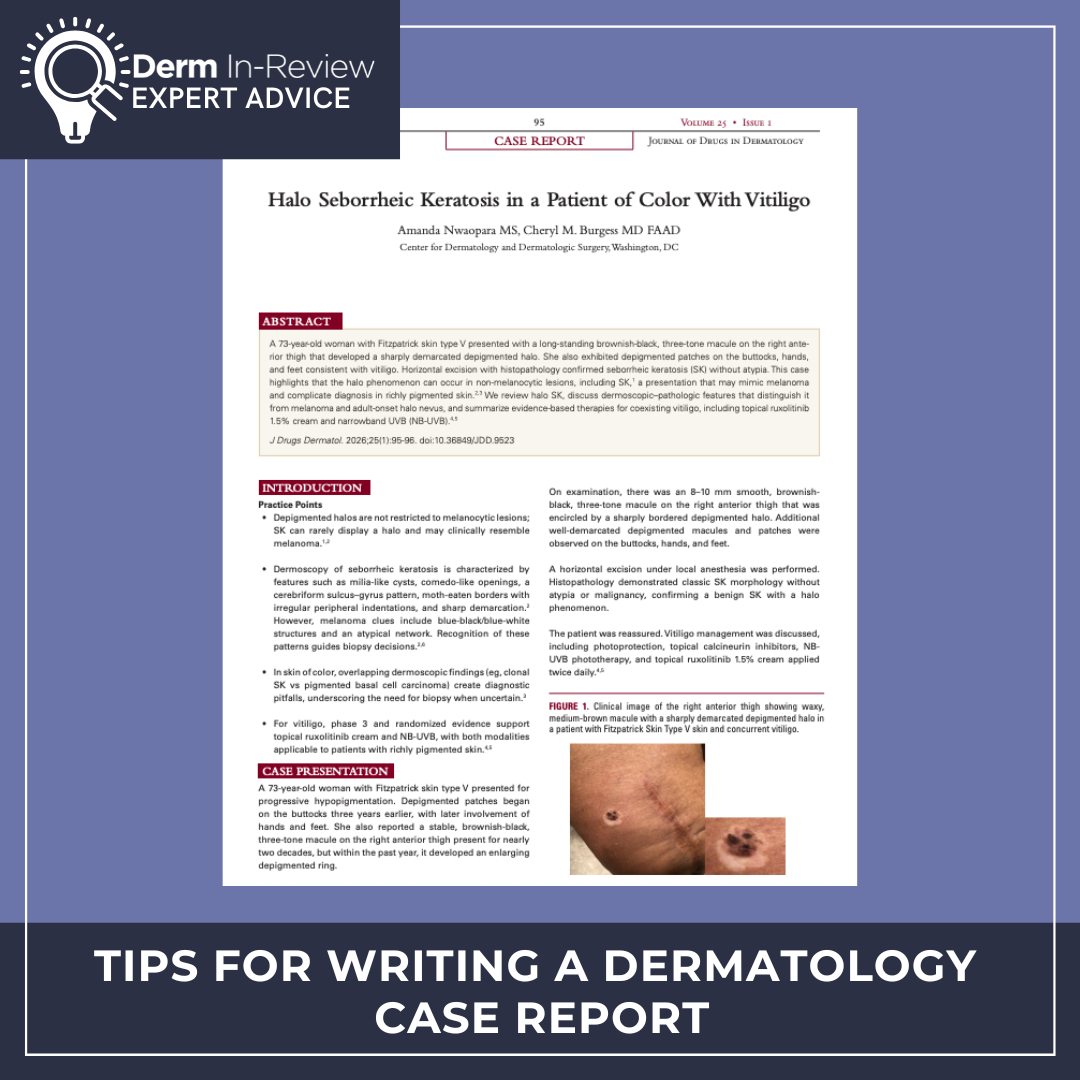
Clinical case reports are a foundational component of research output for those involved in academic dermatology, be it medical students hoping to match into residency, residents applying to fellowship, trainees looking for their first job, and even junior faculty in tenure-track position. Although they are considered to be bottom tier when it comes to the “levels of evidence” (just above expert opinion/anecdotal evidence), case reports and series still have their place as a quick and effective way of sharing new observations with the dermatology community. In describing new presentations of known conditions, novel treatments, or new side effects of medications, case reports can serve as a foundation for larger, “more scientific” studies in the future.
Aside from the potential for scientific impact, case reports can be fun to write! Working on a case can stimulate further learning into a disease condition, its pathology, and treatments. It can lead to discussion about other similar cases, and connect you with other colleagues and mentors with similar interests. It can provide opportunities for presentations at conferences. And ultimately, it can demonstrate willingness and ability to see a project through from inception all the way to publication.
Below are some tips and thoughts on how to effectively and efficiently write a case report.
Be on the lookout, and plan ahead!
We all see multiple patients in clinic every day: Many of these will likely be routine, but you never know when a unique report-worthy case is going to present itself! As a student or resident, it is worth keeping an eye out and asking your attending about whether or not a particular case could be written up. At best, you end up with a new project; you may even find additional cases to compile as a case series. It will demonstrate your interest and initiative, and you may be given a different case to consider.
If you find yourself in clinic with a unique case to report on, a few steps at the outset can make your life a lot easier down the line. First, with your attending or with their blessing, ask the patient if they would be willing to be the subject of a case report. Most will agree, especially when their experience has the potential to help other similar patients in the future.
If your department has a research consent form, it can be helpful to have the patient complete this during the visit itself. Most journals will accept a generic consent form; many do not even require it as part of the submission, but you will need to have it on file.
Prepare your media
Clinical images are a key component of a dermatology case report. If you find yourself having to use pictures from years ago, do your best. But if your patient is in clinic, be mindful to take chart pictures from multiple angles with good lighting and a clear background. If you plan to use before and after pictures, try to capture these in a way that will best reflect the changes you want to convey, whether improvement or worsening. See these tips for good medical photography.
If the case involves dermatopathology, reach out to the dermatopathologist about your intent to write a report and ask for their assistance. They will be best placed to provide images and a description of the pathology, and how it relates to the diagnosis at hand. And of course, it should go without saying, be sure to include them as an author on any publications and presentations from the case!
Do your research
Before starting to write your report, consider several factors. First, how does this case fit within the context of the known literature? Are there other similar cases that have been described? If so, what makes your case stand out? Will it be best suited as a full-length report, a case with review of the literature, or a “grand rounds” or “images in dermatology” format?
Next, think about which journal you want to submit your manuscript to for publication. For a first–ever report, consider a higher impact dermatology journal. If the case relates more broadly, there may be options in pathology, rheumatology, pediatrics, surgery, or even general medicine journals. This choice will significantly impact the manuscript format, word count, figures, and references; be sure to review all the journal requirements at the outset!
Write systematically
Once you have a plan in place, it is time to start writing!
For a seasoned case report writer, it might be possible to finish the manuscript within a day or two, even a few hours. For a first timer, however, the process can be daunting. I recommend starting with the case itself, chronologically highlighting the patient’s past medical history, current presentation, treatment trajectory, and outcomes. This section can be longer and more detailed than required at first; it is easier and more efficient to trim this down rather than trying to add more information later. Writing the case presentation will also help guide the placement of the clinical and pathology figures within the manuscript.
Once the case presentation is complete, work on the discussion section. Start by briefly summarizing the entire case presentation in a sentence or two. Next, place your case within the context of the known literature (this is why your research comes in!) and highlight its unique features. Depending on the case, you can highlight the pathogenesis of the disease condition, mechanism of action and the rationale behind any relevant intervention, and either known or hypothesized reasons for its success, failure, or side effects. If your research has identified reports of other similar cases, creating a table and/or writing a paragraph summarizing the relevant features can make for a more impactful case report.
Now, write the introduction. While it might seem counterintuitive to end at the beginning, you will now have a body of material to briefly summarize as a means of “telling them what you’re going to tell them.” Finally, if your submission requires an abstract (structured or unstructured), you can slice and dice your three sections into an even more succinct summary.
Be persistent, and follow through!
Once your work on the manuscript is complete, be sure to share it with your attending, pathologist, and other members of the team. When requesting edits or comments, it can be helpful to provide a clear timeline to receive this at the outset. Creating a shared document to share and track changes can be helpful, but be aware of your institution’s policy on using online tools (e.g., Google drive) and how this might affect your reference management software if you are using one.
Keep in mind that submission does not mean your work is over! It is more than likely that reviewers will request changes in some form or the other, and you may have to respond to them more than once. (I have had to do up to three revisions before.) It is also possible your manuscript will be rejected, in which case you will need to find a new journal and reformat it as needed. While this may seem demoralizing and set back your ideal timeline, it is part and parcel of the academic publication process. (Here too, I had to do up to three and four submissions before.) Remember: With persistence, it is more likely than not that you will eventually find a home for your work.
Final thoughts
While by no means a magnum opus or summary of your entire life’s work, a case report can be a meaningful small step in your career in dermatology. It may spark an interest in the topic that leads you to additional research on the way to becoming an expert in that field. It may provide opportunities to present at meetings and share this work with other usual colleagues and mentors. And, most importantly, it is an opportunity for the people you collaborate with on the project to remember you!
Happy writing!
References
Elston DM, Sloan B. Case reports and anecdotal evidence. J Am Acad Dermatol. 2020;83(4):1007. doi:10.1016/j.jaad.2019.07.052
Chen E, Kodomudi V, Grant-Kels JM, Sloan B, Waldman RA. What makes a “good” case report? Examining factors affecting case report citations. J Am Acad Dermatol. 2021;85(3):761-762. doi:10.1016/j.jaad.2019.12.045
Waldman RA, Chen E, Finch J, Grant-Kels JM. A case for case reports: A retrospective evaluation of the case reports published in the Journal of the American Academy of Dermatology in 2000. J Am Acad Dermatol. 2019;81(5):1181-1188. doi:10.1016/j.jaad.2018.12.073
Vatkar A, Kale S, Shyam A, Srivastava S. Understanding the Levels of Evidence in Medical Research. J Orthop Case Rep. 2025;15(5):6-9. doi:10.13107/jocr.2025.v15.i05.5534
Did you enjoy this article? Find more on Navigating Residency here.