












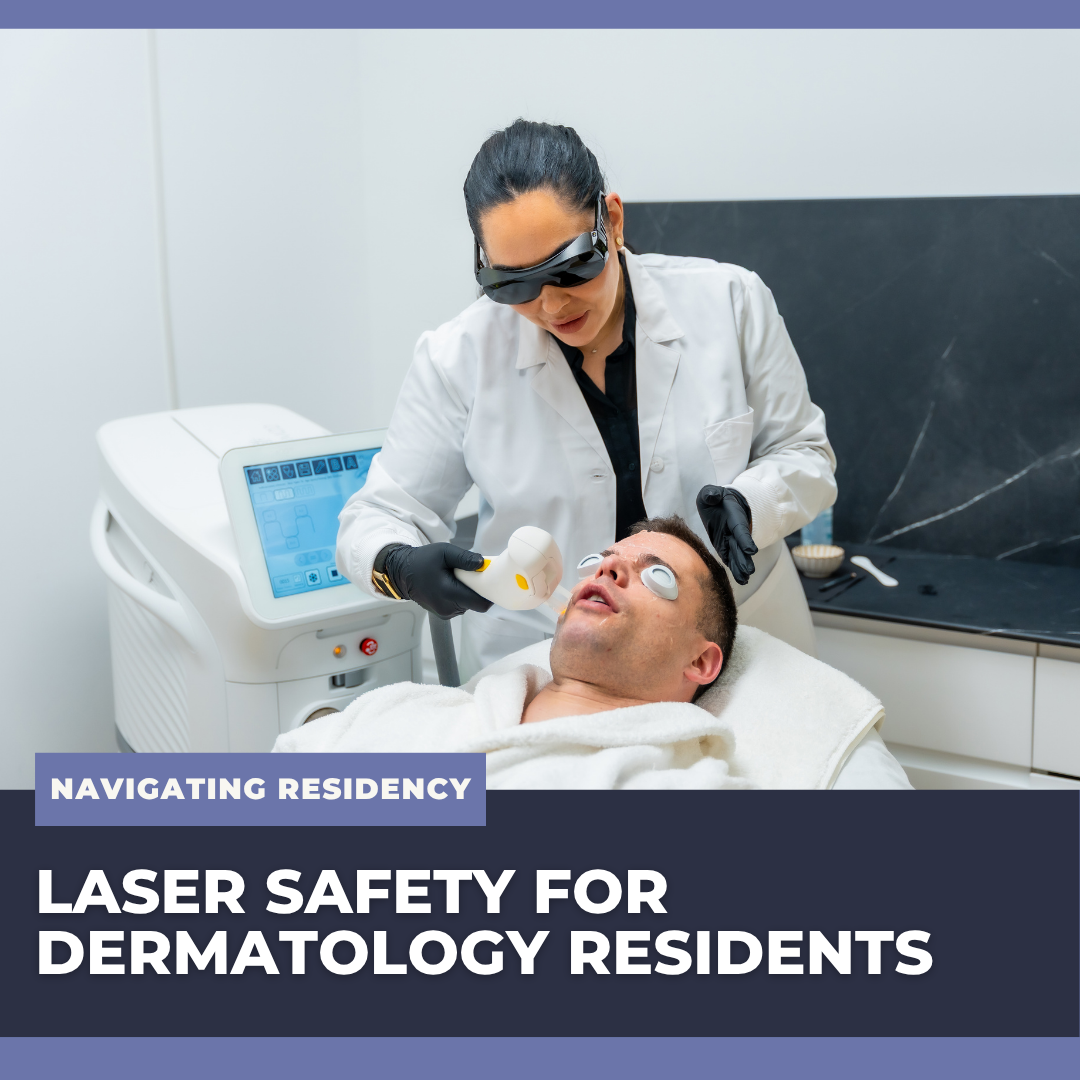
The application of lasers to treat disease and target cosmetic outcomes is an exciting part of dermatology. Just as important as understanding the principles of a treatment plan is understanding the fundamentals of how to keep you and your patient safe when using lasers. It is paramount that every provider approaches a device with a consistent safety algorithm.
There are multiple resources available to review in-depth laser safety guidelines, including the Laser Safety Guide published by the American Society for Laser Medicine and Surgery (ASLMS). This article will serve to provide a quick reference for safety tips when considering any type of laser treatment for a patient.
Ocular Safety
The eye is the structure most classically associated with laser injury. Laser protective eyewear is not interchangeable. It is important that eye protection is selected specifically for the wavelength being used.
As a resident, you should never assume a pair of eye wear handed to you is sufficient for that laser. Always check the eye protection yourself and confirm the wavelength on the laser glasses. Before a procedure begins, it is important to always check which device is being used and which eye protection is appropriate for that wavelength, and ensure the patient is protected with appropriately fitted eyewear, in addition to your own eye protection.
Plume
Laser safety also encompasses the secondary effects of lasers, including plume that is a result of tissue vaporization. The National Institute for Occupational Safety and Health (NIOSH) states that smoke generated during laser or electrosurgical procedures can contain toxic gases and vapors, bioaerosols, cellular material, and viruses, and ASLMS states that plume evacuation or ejected debris barrier apparatus should be provided and used wherever vaporized or ejected tissue is generated.
As a resident, you should expect to have smoke evacuation incorporated into the procedure when tissue vaporization is occurring. It can feel daunting to advocate for yourself and safety, however NIOSH specifically notes that general room ventilation alone is not sufficient for the control of contaminants. Impaired visibility, strong odor, and inadequate smoke evacuation at the source are all safety concerns. Plume control should be normalized as part of the standard safety precautions when treating patients with lasers.
Fire Hazard
Lasers all generate heat in some capacity and are potential fire hazards. This is a particular issue around oxygen, alcohol-based preparations, dry gauze, drapes, and hair-bearing areas. An ASLMS educational primer notes that alcohol should be avoided because of ignition risk and that surrounding materials such as drapes or gauze may need protection since dry materials can ignite when struck by the laser beam.
For residents, it is important to evaluate the entire set up of the room prior to initiation of laser therapy. Is supplemental oxygen involved? Was a flammable prep used and fully dried? Is hair in or near the treatment zone? Are dry materials sitting where they could be struck by the beam? The face, airway region, and periocular area deserve especially deliberate setup.
Patient Selection
Patient factors can significantly impact the risk of complications when performing laser treatments. The American Academy of Dermatology’s public guidance emphasizes that complications such as burns, scarring, and permanent pigmentary change can occur with laser procedures. For dermatology residents, it is important to build a habit of reviewing the features that change risk: skin type, photosensitizing medications, tanned status or recent sun exposure, pigmentary history, scar tendency, active infection or inflammation in the treatment area, and the specific indication being treated.
Programmed Checklist
Creating a standard checklist that is repeated for every visit helps to ensure a standard of safety is upheld. The American National Standard Institute’s health care laser standard exists to support exactly this kind of programmatic approach to safety in medical environments. Residents are often exposed to lasers early on in their training and having a structured safety culture lowers the chance of complications arising from a safety mishap.
A helpful resident-level mental checklist is:
-
- What is the device and wavelength?
- Do staff and patients have the correct protection?
- Will this procedure generate plume, and if so, how is it being controlled?
- Is there any fire risk in the setup?
- Does anything about this patient increase the chance of dyspigmentation, burn, or poor healing?
- What endpoint are we expecting, and what would make us stop?
A checklist does not replace formal training, but it does help residents participate actively rather than passively.
Common Resident Mistakes
Focusing only on the settings: While settings matter, safety starts before the laser is used. If the eyewear is wrong, the prep is flammable, the plume evacuator is not in use, or the patient was just sun-exposed last weekend, complications can arise that put both the laser operator and patient in jeopardy.
Assuming safety belongs to someone else: In many clinics, experienced staff are excellent at setting up the laser, but residents should not outsource their own situational awareness. Knowing who is responsible for what is helpful, but you should not assume someone else has checked everything.
Underestimating plume: ASLMS and NIOSH are both clear that this is an exposure issue worthy of control measures. If your training environment treats plume as optional, it is important to advocate for yourself, fellow laser practitioners, and patients.
Do not forget that skin type and tan status are safety variables: Residents often learn this abstractly, then fail to incorporate it into the real-time pre-procedure conversation.
Lastly, remember that a routine laser session that has been performed many times before can still cause complications due to changes in outside variables. It is important to always check in with your patient as you are performing a laser session and know your endpoints.
How Residents Can Build Laser Safety Skills During Residency
No matter the scope of your laser exposure in residency, there are concrete ways to ensure you are prepared with safety first!
Ask questions to your attending when appropriate. Some tips include: asking about safety features, such as why a particular eye shield was chosen, what they are looking for within the first few pulses as an endpoint, how would a provider change management for various skin types, etc.
Be sure to pay attention to adverse-event prevention and management. It is useful to know how to treat accidental burns or post-laser hyperpigmentation, as well as recognizing the chain of small decisions that attempt to prevent those problems.
Did you enjoy this article? Find more on Navigating Residency here.