












You have spent years in school learning medicine, completed a dermatology residency, and maybe even pursued fellowship training. After all that hard work, it is finally time to sign your first contract. Unfortunately, while residency prepares us to diagnose disease, perform procedures, and care for patients, it often provides little education on physician employment contracts.
As graduation approaches, many residents are suddenly faced with unfamiliar terminology surrounding compensation models, restrictive covenants, malpractice coverage, and productivity expectations. Understanding what to look for in a contract is extremely important, as certain provisions may significantly affect your compensation, future practice opportunities, and long-term career flexibility.
This article is not meant to be an exhaustive review of physician contracts, but rather a collection of practical pearls gathered through personal experience and advice from colleagues.
Understand the Compensation Structure
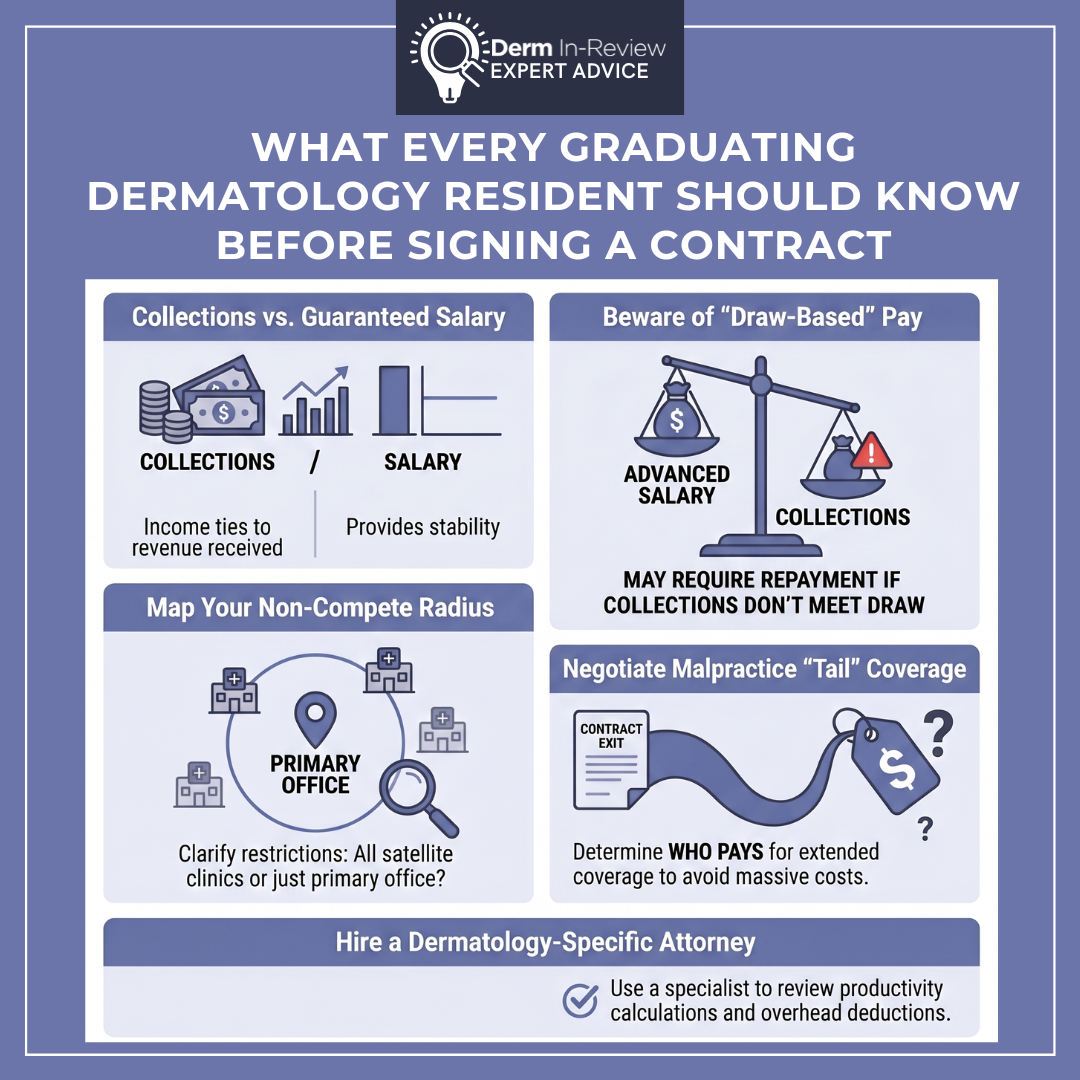
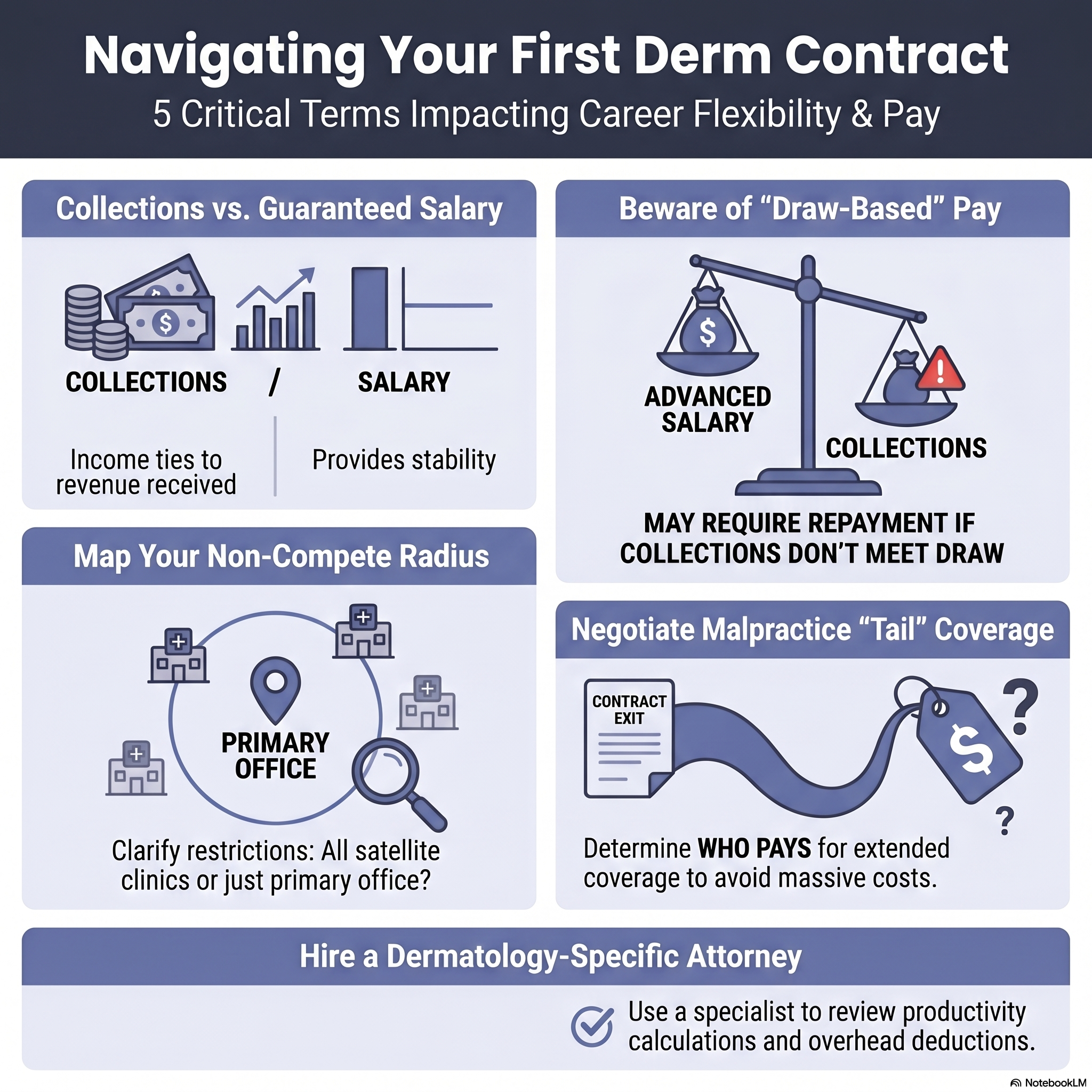
Contracts may offer either a guaranteed base salary or a collections-based compensation model. A base salary means that you receive a guaranteed income regardless of how many patients you see. In contrast, collections-based compensation ties your income directly to the revenue you generate for the practice.
In a collections model, physicians are typically paid a percentage of the money the practice collects from patient care. For example, if you generate $1,000,000 in collected revenue and your contract pays 45% of collections, your compensation would be $450,000. The key word is “collections,” not billings or charges. If you bill $1.5 million but insurance reimbursement totals only $1 million, your compensation is generally based on the amount collected.
Many first-year contracts begin with a guaranteed base salary before transitioning to collections-based compensation. Building a patient panel and becoming efficient with higher patient volumes takes time after residency. For this reason, a reasonable guaranteed salary during the first year can provide financial stability while ramping up your schedule.
Pay Attention to How Productivity Is Calculated
Many dermatologists are compensated based on a percentage of collections, with common ranges falling between 30% and 50% of collected revenue. However, some contracts deduct overhead expenses or “consumables” before calculating physician compensation.
If compensation is based on collections minus expenses, make sure the contract clearly defines what qualifies as an expense or consumable. This may include staffing, lasers, medical supplies, pathology fees, cosmetic products, or other overhead costs. Clearly defining these terms helps eliminate ambiguity and prevent future disagreements.
It is also important to remember that collections-based compensation is directly tied to productivity. Unlike a guaranteed salary model, vacation days, sick leave, parental leave, or administrative time may significantly reduce income because revenue is generated only when patients are being seen.
Be Careful with Draw-Based Compensation
Some contracts advertise a high “guaranteed” salary that is structured as a draw against future collections. For example, a practice may offer a $500,000 salary, but if your collections do not exceed that amount by the end of the year, you may be responsible for repaying the difference. Residents should clarify whether compensation is truly guaranteed or structured as a recoverable draw.
So what does this mean? In some draw-based models, the practice advances your salary throughout the year in the form of monthly paychecks against projected future collections. However, if a physician ultimately generates enough collections to support only $320,000 in compensation, the remaining $180,000 deficit may need to be repaid to the practice or could potentially roll over into the following year depending on how the contract is structured.
Review Non-Compete Clauses Carefully
Non-compete clauses are commonly defined by both geographic radius and duration. Residents should carefully review how far the restriction extends and how long it remains active after leaving a practice. Common restrictions may include a 5–10-mile radius for 1–2 years, although terms vary significantly depending on the practice, state laws, and whether the practice is in a rural or urban setting.
Importantly, residents should clarify whether the non-compete applies only to their primary office or to every satellite clinic associated with the practice. Some contracts may even specify that if a physician spends more than a certain number of days practicing at a satellite location, that office may also become subject to the non-compete clause. Restrictions tied to multiple office locations may significantly limit future employment opportunities within an entire region.
Look Closely at Bonuses and Incentives
Sign-on bonuses often require a time commitment to the practice. If a physician leaves the practice early, partial or full repayment of the bonus may be required. Whenever possible, residents should negotiate prorated repayment terms so that the amount owed decreases over time rather than requiring full repayment regardless of duration worked.
Some practices also offer monthly stipends during residency or fellowship in exchange for a future employment commitment. While these arrangements can provide valuable financial support during training, residents should carefully review repayment obligations and contract terms in the event employment plans change.
Residents should also clarify whether bonuses are structured as guaranteed payments, productivity incentives, relocation assistance, or retention bonuses, as each may carry different expectations or repayment requirements.
Clarify the Partnership Track
If partnership is something you may eventually pursue, make sure the pathway is clearly defined within the contract. Some practices advertise a “partnership track” for associates, but important details may remain vague. Residents should clarify how long partnership typically takes, whether there is a buy-in cost, how ownership is structured, and whether previous associates have successfully become partners. A verbal promise of partnership is not the same as a written agreement.
Do Not Forget Tail Insurance
Tail malpractice insurance is frequently overlooked during contract negotiations. Many practices use claims-made malpractice policies, which only provide coverage while the policy is active. If a physician leaves the practice and is later sued for care provided during their employment, the original policy may no longer cover that claim unless tail coverage is purchased.
For example, a dermatologist may leave a practice and later be named in a lawsuit related to a biopsy, procedure, or clinical decision that occurred while working at their previous job. Tail coverage helps protect physicians in these situations by extending malpractice coverage after employment ends. Depending on the contract, the cost of tail coverage can reach tens of thousands of dollars, making it extremely important to clarify who is financially responsible for this expense before signing.
Have a Specialized Attorney Review the Contract
Before signing, residents should have their contracts reviewed not only by an attorney who specializes in physician employment agreements, but by one with experience reviewing dermatology-specific contracts. Their knowledge and experience can go a long way in helping negotiate terms that work in your favor. Small contract details may carry significant long-term financial and professional consequences.
Conclusion
 Your first contract is more than just a salary offer. It shapes your practice environment, financial structure, geographic flexibility, and long-term career trajectory. Taking time to understand key contract provisions and asking thoughtful questions can help graduating dermatologists enter practice with greater confidence and avoid common early-career pitfalls.
Did you enjoy this article? Find more on Navigating Residency here.