












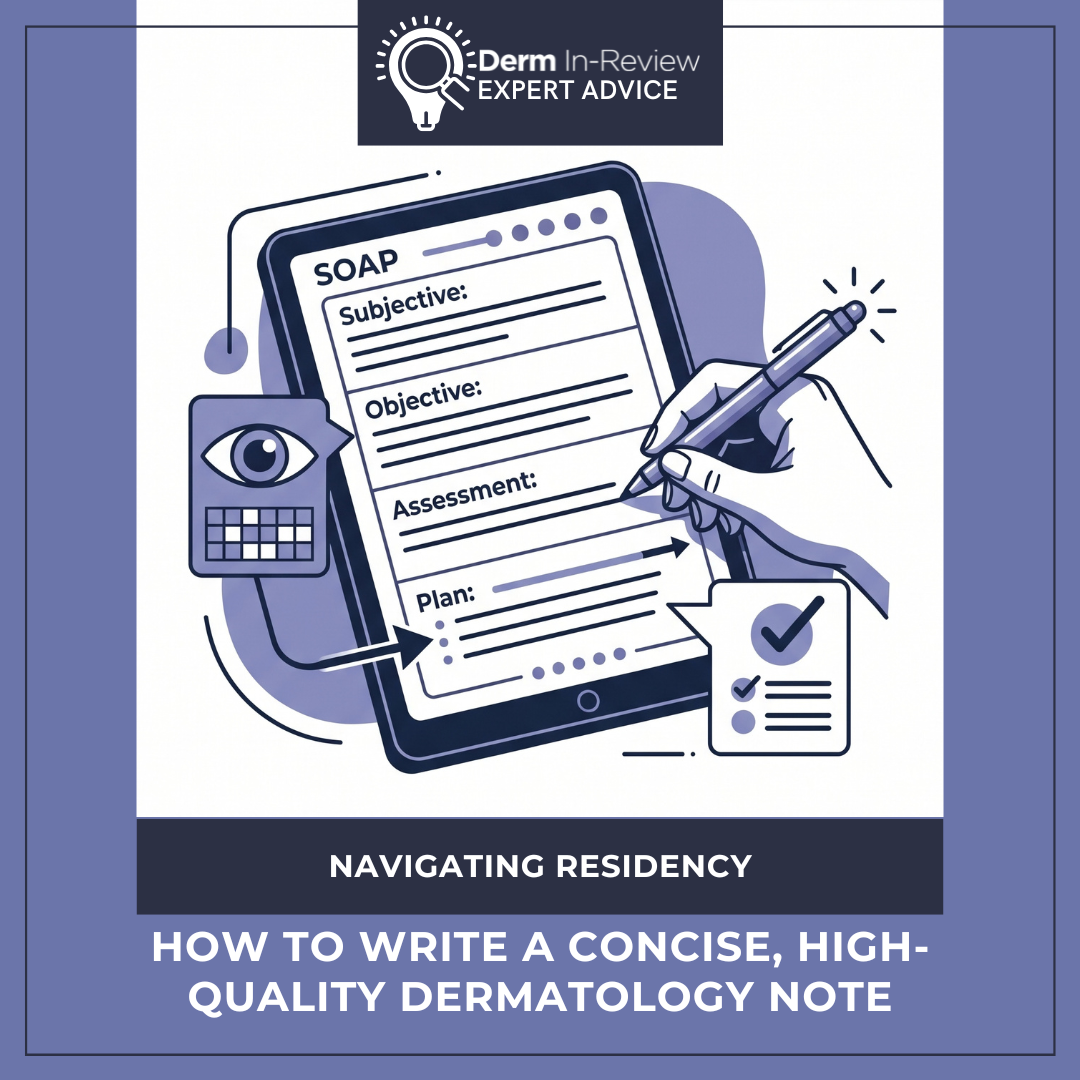
We are taught early in medical school about the SOAP note as the scaffolding for our documentation. In case you need a quick refresher, SOAP stands for Subjective, Objective, Assessment, and Plan. A good note should capture all four components.
As a quick recap:
-
- Subjective: The patient’s history, including the history of present illness and chief complaint, relevant medical and surgical history, medications, and allergies, etc.
- Objective: What you observe or measure, including vital signs, physical examination findings, and relevant labs.
- Assessment: Your diagnosis or differential diagnosis.
- Plan: Your treatment and management plan.
Now let’s make this more specific to dermatology. It’s helpful to think about dermatology notes as falling into two main categories based on the bread-and-butter visits we see: full-body skin examination (FBSE) notes and problem-focused notes (which you can think of as a catch-all for everything else that is not an FBSE). Having a basic template for each type of visit makes documentation a bit faster while still ensuring that you are capturing the information that matters. So let’s talk about each in a bit more detail.
Full-Body Skin Exam Notes
Subjective: For a routine FBSE, consider starting the subjective section with a dermatologic history and skin cancer risk assessment.
At a minimum, it’s helpful to know:
-
- When was the patient’s last FBSE?
- Any prior biopsies?
- Personal history of skin cancer? If so, what type?
- Family history of skin cancer? If so, what type?
- History of blistering sunburns?
- History of tanning bed use?
- Immunosuppressive medications or other relevant risk factors?
Asking whether the patient has any specific spots of concern is also wise. If they do, document the relevant details, such as when they noticed the lesion, whether it has changed, and any associated symptoms such as itching, pain, bleeding, or crusting.
Objective: As expected, this is where you document your physical exam findings and focus on documenting morphologic descriptions. It’s important to photograph any lesions you plan to biopsy. You could even consider doing full-body photographs for patients with multiple atypical nevi for future comparison.
Assessment & Plan: This is where your diagnoses are written and should reflect what you find on examination. For a completely benign routine skin check, this may be relatively straightforward. Even so, it’s good practice to document that you discussed the ABCDEs of melanoma, signs and symptoms of skin cancer, sun protection and sunscreen use, and when to return for another skin examination.
Problem-Focused Dermatology Notes
Subjective: For a problem-focused visit, think about asking and including the following as it relates to the patient’s concern:
-
- Onset: When did the skin findings begin?
- Symptoms: Is there itching, pain, burning, bleeding, etc.?
- Location: Where is the disease occurring?
- Special sites: Is the scalp, groin, nails, palms/soles, face, or another clinically important site involved?
- Current treatments: What are they using now and is it helping?
- Prior treatments: What have they tried previously and did it help?
- Duration of treatment: Ideally, document how long they used previous therapies when known.
- Impact on quality of life: Has the condition affected sleep, work, activities, social interactions, or overall quality of life? This can be particularly important for certain diseases where quality-of-life impact contributes to demonstrating disease burden and help with medication coverage by insurance companies.
Objective: Again, this should focus on morphologic descriptions (not diagnoses). Documenting specific locations help establish disease burden and can become particularly important when certain body sites affect treatment decisions or insurance coverage. When relevant, document total body surface area (BSA) involved. Not only can this help communicate disease severity but it also can be an important part of the criteria used for medication authorizations from insurance companies. Documenting interval change when appropriate can help to convey progress by using phrases like “interval improvement/worsening compared to prior exam.” And don’t underestimate the value of photographs; as they say, a picture truly is worth a thousand words — but it is not a substitute for a thousand words! Photographs are also a great tool for patient buy-in and can help patients objectively track their progress. When taking photographs, think about finding a neutral background and, whenever possible, standardize your method so that you are taking the same angles each time.
Assessment & Plan: Consider structuring your problem list by diagnosis and describing the treatment plan directly under each diagnosis to help you stay organized. Consider first documenting chronicity and progression; for example, you can include whether the condition is acute or chronic and whether it is stable, flaring, or improving but not yet at goal. You may also want to reiterate or highlight the following information for convenience when reviewing prior notes: location, BSA, and severity. It is also good practice to document that you discussed the nature and etiology of the diagnosis and reviewed treatment options, including the risks and benefits of each. Documenting the specific treatment options reviewed is important. You could also use this section to reiterate treatments they have tried and failed. Consider concise phrasing such as “Given that they have tried and failed X, would recommend trialing Y.” For future planning, you could even include potential next steps; for example, you could include “if fails X may consider Y at future visit if clinically indicated.”
Some final thoughts…
In general, when note writing, less can be more. The goal isn’t to write the longest note possible, but to write a note that is concise, clinically useful, and contains the important information needed to understand the patient’s disease, your medical decision-making, and the plan. It would be remiss, however, if we didn’t acknowledge that medical documentation is also important from a legal standpoint, so it is always important to be sure you are appropriately documenting things like the risks and benefits of treatments when relevant. At the same time, over-documenting can be just as unhelpful (and even problematic) as under-documenting. This is just one suggestion, and there are different ways to skin a cat, as they say. You’ll soon develop your own style, too. Happy writing!
Artificial intelligence tools were utilized while editing this article.
Did you enjoy this article? Find more on Navigating Residency here.