












Lamotrigine – Friday Pop Quiz 3/6
 This 20-year-old woman started lamotrigine 3 weeks ago. She takes no other medications, and has no comorbid conditions. Her urine b-HCG is positive. Which of the following treatments has the theoretically lowest fetal risk?
A. Prednisone
B. IVIG
C. Etanercept
D. Cyclosporine
E. Rituximab
To find out the correct answer and read the explanation, click here.
Brought to you by our …
This 20-year-old woman started lamotrigine 3 weeks ago. She takes no other medications, and has no comorbid conditions. Her urine b-HCG is positive. Which of the following treatments has the theoretically lowest fetal risk?
A. Prednisone
B. IVIG
C. Etanercept
D. Cyclosporine
E. Rituximab
To find out the correct answer and read the explanation, click here.
Brought to you by our …
This 20-year-old woman started lamotrigine 3 weeks ago. She takes no other medications, and has no comorbid conditions. Her urine b-HCG is positive. Which of the following treatments has the theoretically lowest fetal risk?
A. Prednisone
B. IVIG
C. Etanercept
D. Cyclosporine
E. Rituximab
To find out the correct answer and read the explanation, click here.
Brought to you by our …  These are the issue highlights from the March issue of the JDD!
Azelaic acid 15% foam may be an efficacious therapy for rosacea while also offering a better side effect profile in Rosacea Treatment Satisfaction: Matching Adjusted Indirect Treatment Comparison Analysis of Metronidazole Gel or Cream vs Azelaic Acid Foam.
Nail Surgery Myths and Truths dispels common myths encount …
These are the issue highlights from the March issue of the JDD!
Azelaic acid 15% foam may be an efficacious therapy for rosacea while also offering a better side effect profile in Rosacea Treatment Satisfaction: Matching Adjusted Indirect Treatment Comparison Analysis of Metronidazole Gel or Cream vs Azelaic Acid Foam.
Nail Surgery Myths and Truths dispels common myths encount … 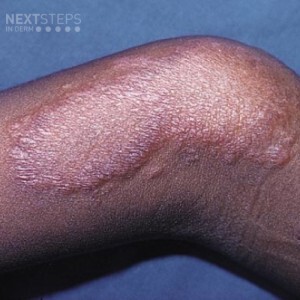 What would this lesion show histologically?
A. A proliferation of basaloid cells with small ducts
B. A grenz zone with a lot of inflammatory cells and globi
C. Well formed tuberculoid granulomas in a linear pattern
D. Scattered comedo-like cysts
E. Acanthosis and neutrophilic infiltrate
To find out the correct answer and read the explanation, click here.
Brought to you by our …
What would this lesion show histologically?
A. A proliferation of basaloid cells with small ducts
B. A grenz zone with a lot of inflammatory cells and globi
C. Well formed tuberculoid granulomas in a linear pattern
D. Scattered comedo-like cysts
E. Acanthosis and neutrophilic infiltrate
To find out the correct answer and read the explanation, click here.
Brought to you by our … 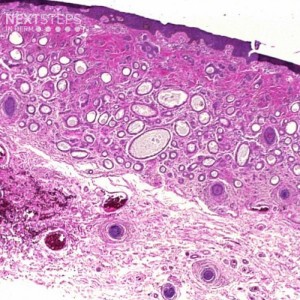 This was excised from the face. What is this neoplasm?
A. Syringoma
B. Trichoblastoma
C. Basal cell carcinoma
D. Desmoplastic trichoepithelioma
E. Microcystic adenocarcinoma
To find out the correct answer and read the explanation, click here.
Brought to you by our brand partner Derm In-Review. A product of SanovaWorks.
…
This was excised from the face. What is this neoplasm?
A. Syringoma
B. Trichoblastoma
C. Basal cell carcinoma
D. Desmoplastic trichoepithelioma
E. Microcystic adenocarcinoma
To find out the correct answer and read the explanation, click here.
Brought to you by our brand partner Derm In-Review. A product of SanovaWorks.
… 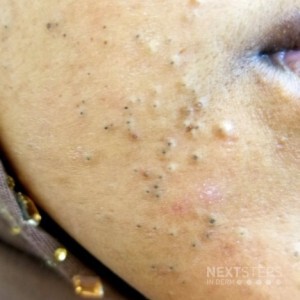 In addition to gentle washing of the face two times a day, what is the most appropriate treatment step for this patient who is prone to dry skin?
A. Start Adapalene 0.1 gel nightly to every other night after wash
B. Aggressive exfoliation daily
C. Start doxycycline 100 mg by mouth two times a day with food and water
D. Monotherapy with clindamycin lotion every morning after wash
…
In addition to gentle washing of the face two times a day, what is the most appropriate treatment step for this patient who is prone to dry skin?
A. Start Adapalene 0.1 gel nightly to every other night after wash
B. Aggressive exfoliation daily
C. Start doxycycline 100 mg by mouth two times a day with food and water
D. Monotherapy with clindamycin lotion every morning after wash
…