












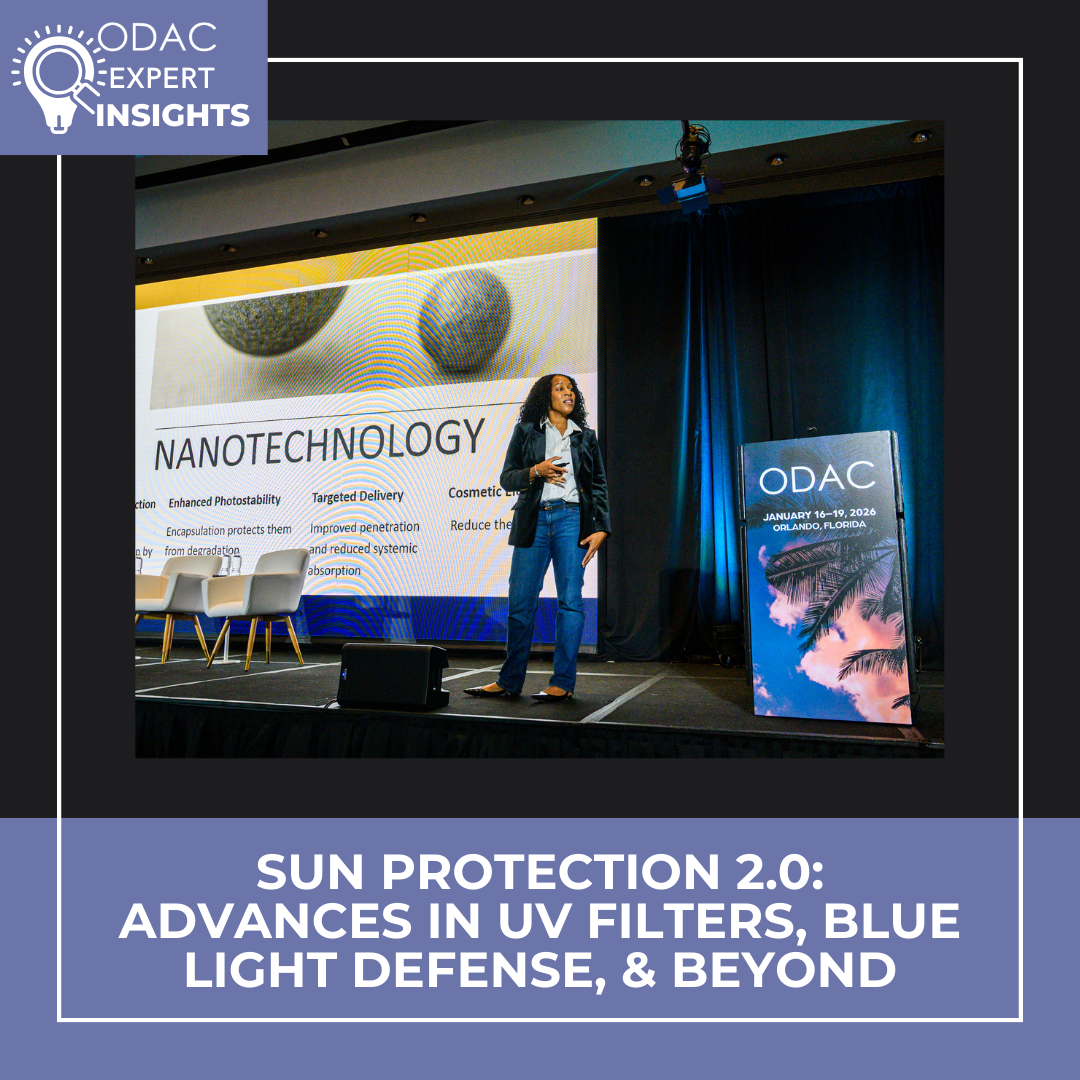
At the 2026 ODAC Dermatology Conference in Orlando, Dr. Misty Eleryan, Clinical Assistant Professor of Dermatology at George Washington University and Director of Mohs Surgery and Cutaneous Oncology at Chosen Dermatology in Los Angeles, California, presented her talk “Sun Protection 2.0: Advances in UV Filters, Blue Light Defense, & Beyond” which detailed new developments in our understanding of sun protection and photodamage and introduced novel innovations being produced to help protect consumers and patients.
Spectrum of Photodamage
Dr. Eleryan starts her discussion by detailing the full spectrum of ultraviolet (UV) radiation including UVA and UVB wavelengths, which are responsible for causing photoaging and sunburns. While many sunscreens only protect from UVB radiation, broad-spectrum mineral sunscreens can effectively protect the skin from both of these wavelengths. However, Dr. Eleryan notes that UV radiation does not fully encapsulate the spectrum of photodamage. She explains that visible light and infrared light can both contribute to photoaging and are not protected for with traditional sunscreens. This is why many patients, who despite practicing diligence with their sun protection, will still experience progression in their photoaging and associated wrinkling and dyspigmentation.
White Cast
On the topic of mineral sunscreens, Dr. Eleryan then transitions to the crucial and dreaded phenomenon of white cast, the white residue seen on the skin after the application of mineral sunscreen. She notes that patients who experience white cast are heavily discouraged from consistently and effectively using sunscreen, impairing their ability to be appropriately protected. In this sense, white cast results in a substantial adherence problem that stems far beyond cosmesis. She further drives this point home by emphasizing that sunscreen is only useful if the patient actually applies it, and thus, optimizing the formulation of sunscreens in order to enhance their appearance, texture, and feel is of the utmost importance.
Advancements in Sunscreen Technology
As the need for improved sunscreen formulations exists, the discussion transitions to how this is being done, with nanotechnology in particular being utilized to achieve this goal. Dr. Eleryan notes that the use of nanotechnology in sunscreens may allow for enhanced UV protection, improved photostability, decreased systemic absorption, and overall improved photoprotection. She also mentions that the addition of antioxidants to sunscreen can carry many benefits; antioxidants neutralize reactive oxygen species generated from UV light, minimizing photodamage, and thus, vitamin C and E have increasingly been incorporated into these products.
Advancements in personalized photoprotection have also occurred. Through the use of high-resolution imaging, genetic testing, and Artificial Intelligence, Dr. Eleryan acknowledges that newer technologies allow for enhanced analysis of patients’ skin and subsequently, can improve the quality and type of products recommended to patients based on his/her individual skin and needs. Additionally, she introduces sunscreen performance boosters, which create a more uniform and longer lasting layer of sunscreen, and other natural sun protection enhancers that can bolster the quality of sunscreen in a multitude of ways. Dr. Eleryan concludes this portion of the discussion by emphasizing the importance of biotechnology in discovering future UV filters i.e. naturally available, photo-absorbing ingredients that are safer, more efficacious, and have less environmental impact and will improve the quality of the ingredients used in sunscreens.
The Development of New Sunscreen
Despite the advancements in science and technology, Dr. Eleryan mentions that no new sunscreen filters have been approved in the United States (US) since 1999. This is in stark contrast to many European countries, where there has been continued the continued development of better and broader spectrum sunscreen ingredients. Dr. Eleryan explains that this difference is due to the way the products are categorized; in the US, sunscreens are considered over-the-counter drugs and are subject to the full regulation and approval of the Food and Drug Administration (FDA) while they are approached as cosmeceutical products in Europe and Korea. The need for millions of dollars of funding for research, clinical trials, and animal studies to study different ingredients has halted their production in the US. Dr. Eleryan illustrates this case with bemotrizinol, a highly effective and safe broad-spectrum UV filter that is widely used in Europe and Australia but has yet to be approved in the US despite 20 years of investigation, $18 million in research costs, and no new safety signals.
Dr. Eleryan notes that this lack of innovation in American sunscreens has long been regarded as a problem. In 2014, the Sunscreen Innovation Act was passed with the aim of providing an alternative process for the review and approval of over-the-counter sunscreen ingredients, but this did not ultimately expedite the timeline or alleviate the costs of introducing new FDA approved ingredients. Thus, in November of 2025, the SAFE Sunscreen Standards Act was passed to allow for the streamlined review of sunscreen ingredients that incorporates the use of global safety data and minimal to zero animal testing. Dr. Eleryan is optimistic that this legislation will improve the production of novel sunscreen ingredients while still upholding safety checks in a more modern and less stringent manner.
Hot Topics in Sun Protection
Dr. Eleryan finishes her presentation by highlighting new and interesting topics she frequently hears mentioned in discussions or presented as questions by patients. She states that the early evidence for cannabidiol cream has demonstrated potential efficacy as a sun protection agent. Additionally, wearable UV sensors are being developed to help provide patients with real time feedback on UV exposure to help them understand and avoid times with high exposure. Lastly, she notes that oral supplementation to aid in sun protection is in demand by patients, and oral polypodium supplementation is effective and safe for reducing UV-induced sun damage and photoaging.
Dr. Eleryan concludes by encouraging dermatologists to be leaders in their discussions with and counseling of patients on sunscreen and sun protection. She emphasizes that effective photoprotection counseling appropriately covers sunscreen, nutrition practices, behavioral measures, and emerging technologies. She states that sunscreen is still the foundation of sun protection and photoprotection should be layered, and she is optimistic about the potential developments in sunscreen ingredients we could be seeing in 2026.
This information was presented by Dr. Misty Eleryan during the 2026 ODAC conference. The above highlights from her lecture were written and compiled by Dr. Milaan Shah. Dr. Shah was one of the five residents selected to participate in the Young Dermatology Leader Mentorship Program sponsored by Sun Pharma and organized by Derm In-Review.