












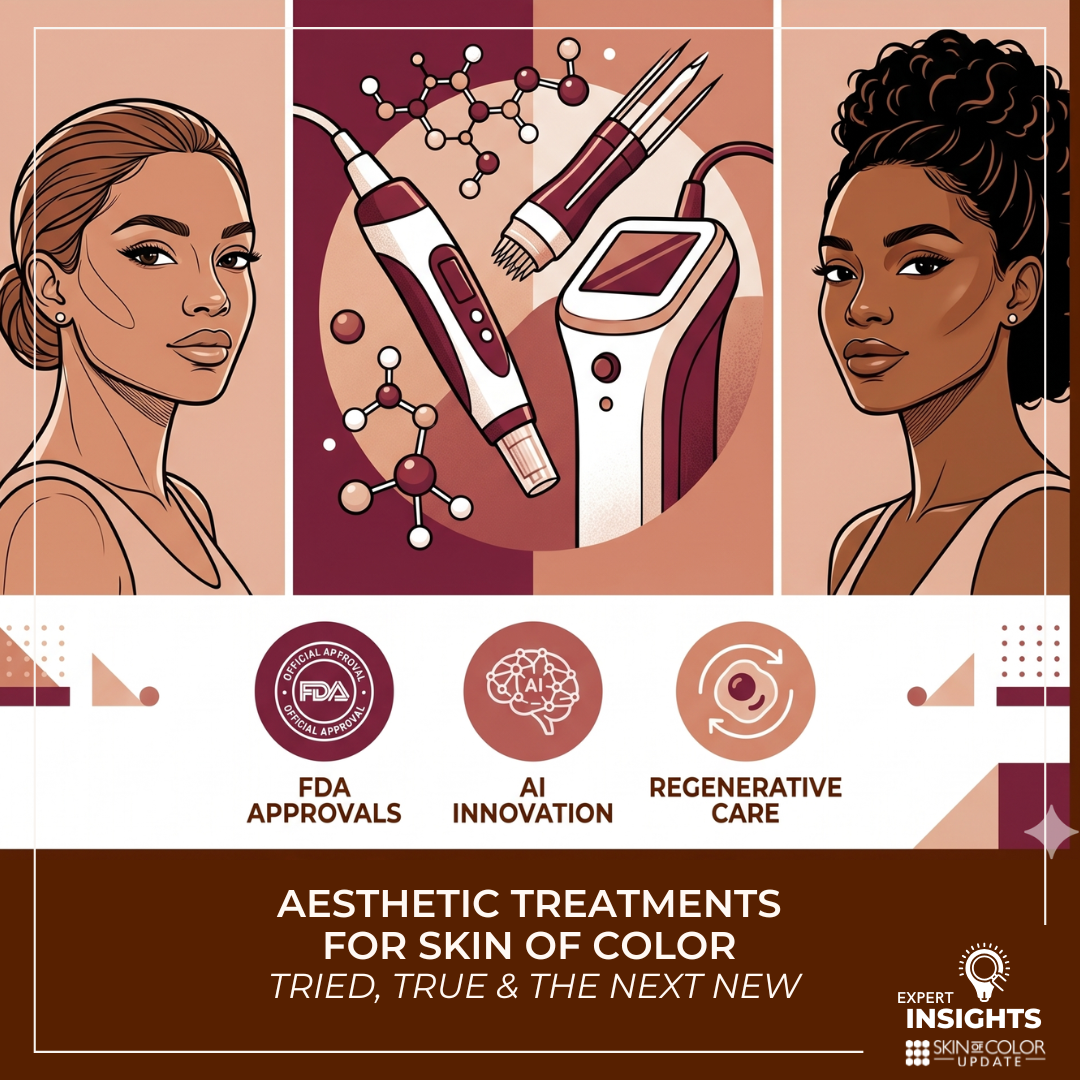
At the most recent Skin of Color Update conference in New York City, Dr. Cheryl Burgess and Dr. Michelle Henry shared their perspectives on the evolving landscape of cosmetic dermatology, highlighting both established treatments and cutting-edge innovations that are reshaping aesthetic care for patients with skin of color.
Expanding Indications and FDA Approvals
Dr. Burgess, who has witnessed the evolution of aesthetic medicine since the 1980s, emphasized the impact of expanding FDA approvals for aesthetic treatments. There have been clearances for Class I and II devices (low to moderate risk) and approvals for Class III devices (high risk). Injectable neuromodulator approvals include new products (eg. LetibotulinumtoxinA) and new indications (eg. OnabotulinumtoxinA for platysmal neck bands). Emerging modalities for soft tissue contraction include fractional radiofrequency microneedling, laser microcoring, and triple-frequency ultrasound, which can improve skin laxity and reduce the appearance of cellulite.
Notable dermal filler approvals now extend to temples, tear troughs, jawline, and chin augmentation. There have been some concerns about the potential for bone resorption or lytic bone lesions following supraperiosteal placement of hyaluronic acid fillers, particularly in the chin and midface (suborbital and paranasal) regions. Imaging studies suggest chronic mechanical pressure, localized inflammation, and repeat injections may be contributing to osteolysis in these regions.
Trends in 2025: AI, Regenerative Approaches, and GLP-1 Challenges
Market trends point to a 12% increase in cosmetic procedures, particularly among patients under 35, men, and those with skin of color. Dr. Burgess highlighted pre-generative and regenerative approaches and addressing GLP-1 inhibitor–associated facial lipoatrophy and skin laxity. While artificial intelligence shows promise in treatment planning, she noted that it has yet to reach practical clinical utility.
Innovations in Skincare Delivery Systems
Advances in biotechnology are enabling more effective topical delivery systems. Tiered Release Vesicles (TRVs), multiphasic vesicles with high versatility, have demonstrated efficient penetration of peptides into the epidermis and dermis, representing a significant step forward in noninvasive skin rejuvenation.
Carboxytherapy: Harnessing the Bohr Effect
Carboxytherapy, which introduces CO₂ into the skin via injection or topical application, leverages the Bohr effect to increase local oxygenation, microcirculation, and tissue perfusion. Dr. Burgess described these effects as similar to hyperbaric oxygen chambers. This modality also provides anti-inflammatory benefits and improves skin hydration, offering an adjunct or alternative to traditional aesthetic treatments.
Laser and Light-Based Acne Treatments
For patients with skin of color, Dr. Burgess highlighted the 650-ms, 1064-nm Nd:YAG laser as an effective treatment for severe acne. In a retrospective study of over 200 patients, clearance of severe acne was seen in 48% of patients with three treatments. A prospective study of patients with skin ranging from Fitzpatrick type I to VI also showed marked improvement after 3 treatments, with maintenance at 90 days and no significant adverse events. Combination with low-dose isotretinoin and to 12 treatments can further improve inflammation.
Radiofrequency and Microneedling Innovations
Dr. Henry, who utilizes eight different RF devices in her practice, emphasized RF’s unique advantages for skin of color patients. Unlike laser therapy, which relies on photothermal effects, RF delivers electrical currents that generate thermal energy, allowing both immediate contraction and long-term stimulation of collagen production.
Modern microneedling devices offer adjustable energy levels and multi-pulse capabilities, minimizing mechanical trauma and hyperpigmentation risks in skin of color patients. The use of insulated needles permits heat delivery at the tip, making procedures safer across all skin types. Non-insulated needles remain suitable for lighter skin types, providing efficient coagulation with fewer passes. Dr. Henry discussed the use of hyper-diluted calcium hydroxyapatite, either before or after microneedling procedures. With lots of patients on GLP-1 inhibitors, she prefers use of biostimulators that work through mechanisms other than stimulating inflammation.
Advances in Periorbital RF Treatments
A significant focus in skin of color patients is under-eye rejuvenation. Fat pseudoherniation and lymphatic stagnation often drive early orbital fat protrusion and periorbital aging. Dr. Henry mentioned this was previously a frequent site for dermal filler treatments. New RF eye applications target the orbicularis muscle, effectively reducing under-eye bags and periorbital lines without reliance on fillers. An unpublished study of 30 patients four treatments of a novel device that incorporates non-invasive, high-intensity facial electromagnetic stimulation (HIFES) plus synchronized RF showed improvement in 86% of patients after four treatments.
Next-Generation RF Devices
Monopolar RF with 6.78 MHz devices remains the gold standard for collagen stimulation as a superficial treatment with great outcomes. Features such as continuous water cooling, vibration, automated curved/tilted tip adjustments, and Hidden Edge Technology to minimize hot spots all contribute to an enhanced safety profile for skin of color patients.
Emerging multifrequency RF devices, including 6.78 MHz monopolar RF combined with 2 MHz energy for deeper penetration, enable treatments at multiple tissue depths with enhanced collagen stimulation. Studies have shown histologic evidence for the depth and efficacy of thermal delivery through this dual-frequency system. These devices are gaining popularity in Canada and Asia and represent the forefront of noninvasive rejuvenation for diverse patient populations.
Summary
The landscape of aesthetic procedures for patients with skin of color is rapidly evolving. FDA approvals, innovative radiofrequency and microneedling technologies, and advanced delivery systems are expanding treatment options while maintaining a robust safety profile for these patients. Both Drs. Burgess and Henry emphasized that high standards of care must be applied universally, ensuring that patients with skin of color have access to the latest advances in cosmetic dermatology while minimizing the risk of adverse effects.
References
-
- Shu KY, Feng WR, Zhao JL. Bone Resorption of Hyaluronic Acid Fillers Injection Induced in Chin Augmentation: A Retrospective Study. J Craniofac Surg. 2025;36(2):633-635. doi:10.1097/SCS.0000000000011033
- Lee T. Bone Resorption in the Midface Due to Hyaluronic Acid Fillers. J Craniofac Surg. Published online March 4, 2025. doi:10.1097/SCS.0000000000011166
- Moradi A, Bhatia AC, Behr K, Napekoski K, Foldvari M. In Vivo and Ex Vivo Evaluation of a Novel Method for Topical Delivery of Macromolecules Through the Stratum Corneum for Cosmetic Applications. Dermatol Surg. 2025;51(4):403-408. doi:10.1097/DSS.0000000000004504
- Shamban A, Roberts WE, Bucay V, Chilukuri S, Simmons-O’Brien E, Orlinsky D. Topical Carboxytherapy for Skin Rejuvenation. J Clin Aesthet Dermatol. 2025;18(1):55-57.
- Olugbade ID, Petty AC, Imahiyerobo-Ip J. Treatment of Acne Vulgaris With a 650-ms, 1064-nm Nd:YAG Laser: A Retrospective Study. J Cosmet Dermatol. 2025;24(2):e16711. doi:10.1111/jocd.16711
- Saedi N, Griffin T Jr, Kelly S. Treatment of Mild to Severe Acne Vulgaris With a 650-Microsecond 1064-nm Nd:YAG Laser. J Drugs Dermatol. 2024;23(11):957-964. doi:10.36849/JDD.8171
- Halaas Y. HIFES Plus Synchronized RF Satisfies Periorbital Treatment Niche. The Aesthetic Guide. Published April 10, 2025. Accessed October 6, 2025. https://www.theaestheticguide.com/energy-based-devices-treatments/hifes-plus-synchronized-rf-satisfies-periorbital-treatment-niche
- Kim J. Evaluating the Efficacy of Continuous Water-Cooling 115-Watt 6.78-MHz Monopolar RF Therapy for Fine Wrinkle Reduction. Plast Reconstr Surg Glob Open. 2024;12(2):e5623. Published 2024 Feb 26. doi:10.1097/GOX.0000000000005623
- Hong J, Ryu HG, Park C, et al. Efficacy of dual-frequency noninvasive monopolar radiofrequency in skin tightening: Histological evidence. Skin Res Technol. 2024;30(6):e13821. doi:10.1111/srt.13821
This information was presented at the 2025 Skin of Color Update conference by Cheryl Burgess, MD, FAAD and Michelle Henry, MD, FAAD. The above highlights from their lecture were written and compiled by Riyad N.H. Seervai, MD, PhD.
Did you enjoy this article? Find more on Aesthetic Dermatology here.