












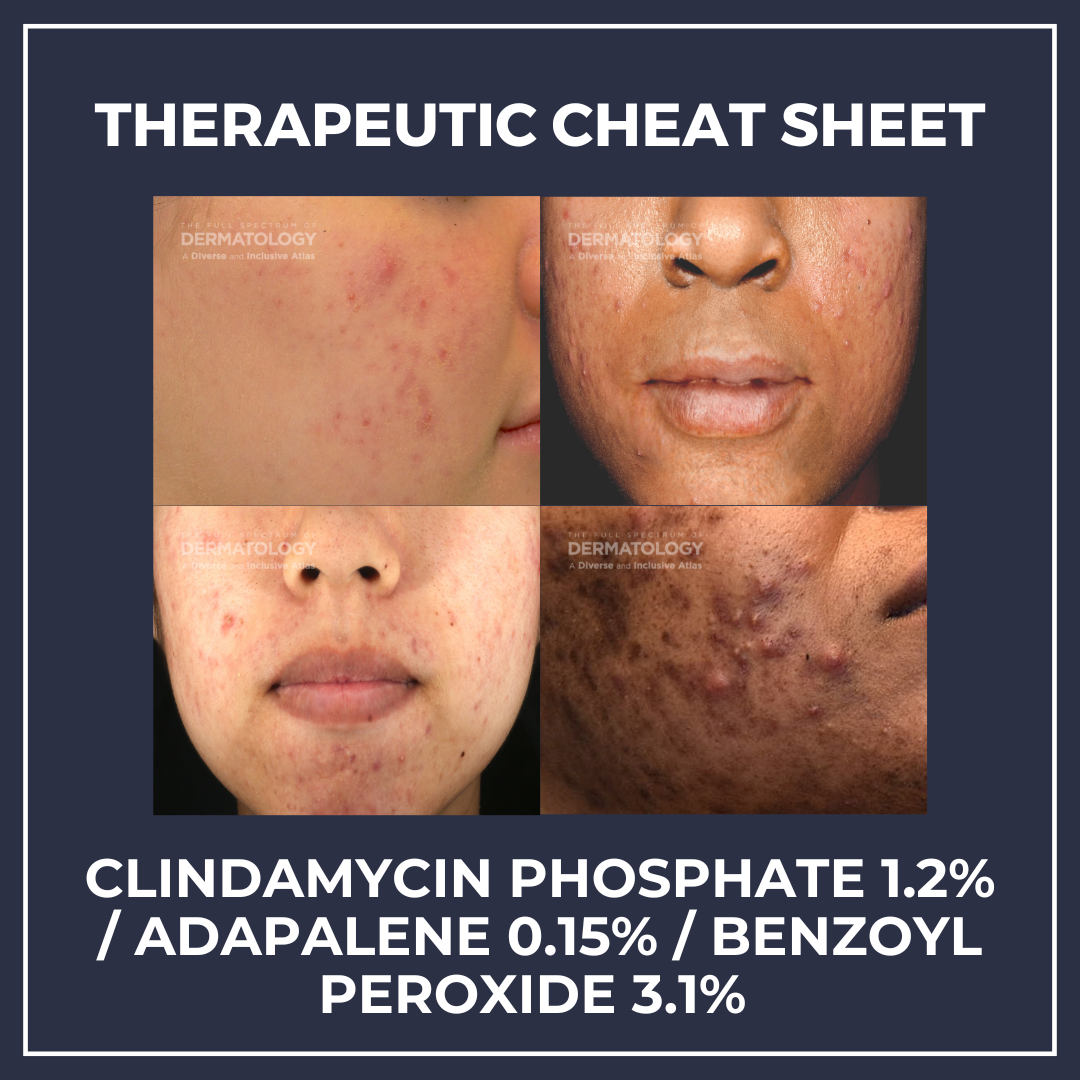
Cabtreo is the first FDA-approved fixed-dose triple-combination topical treatment for acne vulgaris, pairing a lincosamide antibiotic (clindamycin), a synthetic retinoid (adapalene), and a keratolytic oxidizing agent (benzoyl peroxide) into a single once-daily gel. This formulation targets several pillars of acne pathogenesis simultaneously: cutaneous C. acnes proliferation, abnormal keratinization, and inflammation, while improving regimen simplicity and adherence compared to multi-product topical regimens. This product was FDA-approved in 2023 following two multicenter, randomized, double-blind vehicle-controlled trials demonstrating significant reduction in both inflammatory and non-inflammatory acne lesions by Week 121-2. We continue our Therapeutic Cheat Sheet series with a closer look at the unique triple combination topical therapy, Cabtreo.
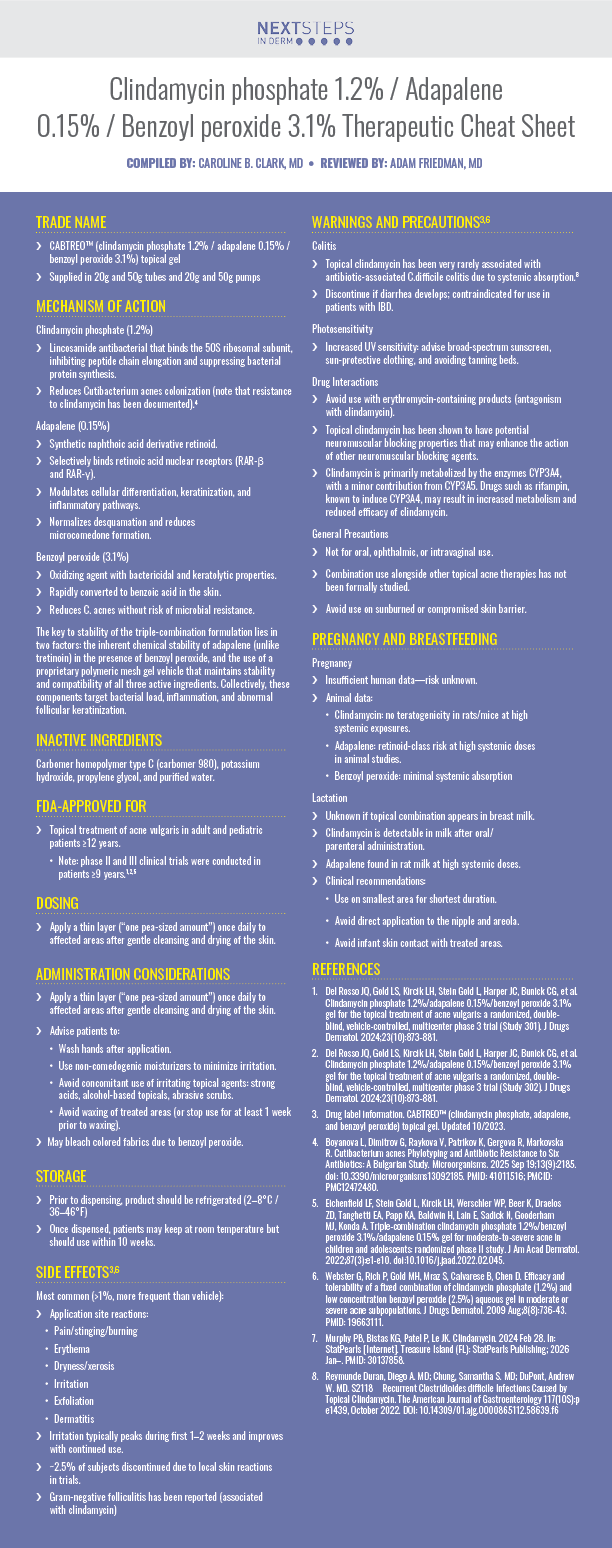
Clindamycin phosphate 1.2% / Adapalene 0.15% / Benzoyl peroxide 3.1% Therapeutic Cheat Sheet
Compiled by: Caroline B. Clark, MD, Reviewed by: Adam Friedman, MD
TRADE NAME
-
- CABTREO™ (clindamycin phosphate 1.2% / adapalene 0.15% / benzoyl peroxide 3.1%) topical gel
- Supplied in 20g and 50g tubes and 20g and 50g pumps
MECHANISM OF ACTION
Clindamycin phosphate (1.2%)
-
- Lincosamide antibacterial that binds the 50S ribosomal subunit, inhibiting peptide chain elongation and suppressing bacterial protein synthesis.
- Reduces Cutibacterium acnes colonization (note that resistance to clindamycin has been documented).4
Adapalene (0.15%)
-
- Synthetic naphthoic acid derivative retinoid.
- Selectively binds retinoic acid nuclear receptors (RAR-β and RAR-γ).
- Modulates cellular differentiation, keratinization, and inflammatory pathways.
- Normalizes desquamation and reduces microcomedone formation.
Benzoyl peroxide (3.1%)
-
- Oxidizing agent with bactericidal and keratolytic properties.
- Rapidly converted to benzoic acid in the skin.
- Reduces C. acnes without risk of microbial resistance.
The key to stability of the triple-combination formulation lies in two factors: the inherent chemical stability of adapalene (unlike tretinoin) in the presence of benzoyl peroxide, and the use of a proprietary polymeric mesh gel vehicle that maintains stability and compatibility of all three active ingredients. Collectively, these components target bacterial load, inflammation, and abnormal follicular keratinization.
INACTIVE INGREDIENTS
Carbomer homopolymer type C (carbomer 980), potassium hydroxide, propylene glycol, and purified water.
FDA-APPROVED FOR
-
- Topical treatment of acne vulgaris in adult and pediatric patients ≥12 years.
- Note: phase II and III clinical trials were conducted in patients ≥9 years.1,2,5
- Topical treatment of acne vulgaris in adult and pediatric patients ≥12 years.
DOSING
-
- Apply a thin layer (“one pea-sized amount”) once daily to affected areas after gentle cleansing and drying of the skin.
ADMINISTRATION CONSIDERATIONS
-
- Avoid application to eyes, lips, paranasal creases, mucous membranes, and broken, eczematous, or sunburned skin.
- Advise patients to:
- Wash hands after application.
- Use non-comedogenic moisturizers to minimize irritation.
- Avoid concomitant use of irritating topical agents: strong acids, alcohol-based topicals, abrasive scrubs.
- Avoid waxing of treated areas (or stop use for at least 1 week prior to waxing).
- May bleach colored fabrics due to benzoyl peroxide.
STORAGE
-
- Prior to dispensing, product should be refrigerated (2–8°C / 36–46°F)
- Once dispensed, patients may keep at room temperature but should use within 10 weeks.
SIDE EFFECTS3,6
Most common (>1%, more frequent than vehicle):
-
- Application site reactions:
- Pain/stinging/burning
- Erythema
- Dryness/xerosis
- Irritation
- Exfoliation
- Dermatitis
- Irritation typically peaks during first 1–2 weeks and improves with continued use.
- ~2.5% of subjects discontinued due to local skin reactions in trials.
- Gram-negative folliculitis has been reported (associated with clindamycin)
- Application site reactions:
WARNINGS & PRECAUTIONS3,6
Colitis
-
- Topical clindamycin has been very rarely associated with antibiotic-associated C.difficile colitis due to systemic absorption.8
- Discontinue if diarrhea develops; contraindicated for use in patients with IBD.
Photosensitivity
-
- Increased UV sensitivity: advise broad-spectrum sunscreen, sun-protective clothing, and avoiding tanning beds.
Drug Interactions
-
- Avoid use with erythromycin-containing products (antagonism with clindamycin).
- Topical clindamycin has been shown to have potential neuromuscular blocking properties that may enhance the action of other neuromuscular blocking agents.
- Clindamycin is primarily metabolized by the enzymes CYP3A4, with a minor contribution from CYP3A5. Drugs such as rifampin, known to induce CYP3A4, may result in increased metabolism and reduced efficacy of clindamycin.
GENERAL PRECAUTIONS
-
- Not for oral, ophthalmic, or intravaginal use.
- Combination use alongside other topical acne therapies has not been formally studied.
- Avoid use on sunburned or compromised skin barrier.
PREGNANCY AND BREASTFEEDING
Pregnancy
-
- Insufficient human data—risk unknown.
- Animal data:
- Clindamycin: no teratogenicity in rats/mice at high systemic exposures.
- Adapalene: retinoid-class risk at high systemic doses in animal studies.
- Benzoyl peroxide: minimal systemic absorption
Lactation
-
- Unknown if topical combination appears in breast milk.
- Clindamycin is detectable in milk after oral/parenteral administration.
- Adapalene found in rat milk at high systemic doses.
- Clinical recommendations:
- Use on smallest area for shortest duration.
- Avoid direct application to the nipple and areola.
- Avoid infant skin contact with treated areas.
FURTHER READING
If you would like to learn more about CABTREO™, check out the following articles in the Journal of Drugs in Dermatology:
Introduction: Topical clindamycin phosphate 1.2%/adapalene 0.15%/benzoyl peroxide 3.1% (CAB) gel is the only fixed-dose, triple-combination formulation approved for acne treatment. In 3 clinical studies of participants with moderate-to-severe acne, CAB demonstrated superior efficacy to vehicle and component dyads, with good safety and tolerability. Detailed efficacy/safety data from individual clinical study participants are presented.
Methods: In two phase 3 (NCT04214652, NCT04214639) randomized, double-blind, 12-week studies, participants aged at least 9 years with moderate-to-severe acne were randomized to once-daily CAB or vehicle gel. Descriptive data – including lesion count changes, treatment success (at least 2-grade reduction from baseline in Evaluator’s Global Severity Score and clear/almost clear skin), compliance, treatment-emergent adverse events (AEs), and cutaneous safety/tolerance assessments – were summarized from 6 CAB-treated cases.
Results: By week 12, all cases achieved lesion reductions, 4/6 achieved treatment success, and 1/6 achieved a 2-grade reduction in severity. All cases were compliant with CAB treatment. No cases reported serious AEs. Transient increases occurred on cutaneous safety and tolerability assessments, with scores generally decreasing back to/below baseline levels by week 12.
Conclusions: In two phase 3 clinical trials, fixed-dose, triple-combination CAB demonstrated good efficacy/safety. All 6 CAB-treated cases achieved substantial lesion reductions, with 5/6 achieving treatment success or 2-grade reduction in severity by week 12. Transient cutaneous safety/tolerability severity increases generally resolved to baseline values by week 12. These clinical study cases reinforce the importance of patient education regarding adherence, expectations, and AEs.
J Drugs Dermatol. 2024;23(11):1017-1024. doi:10.36849/JDD.8639.
Background: Although triple-combination therapies for acne are generally more efficacious than dual-combinations or topical monotherapy, this benefit may be offset by reduced adherence to a complicated treatment regimen. Clindamycin phosphate 1.2%/adapalene 0.15%/benzoyl peroxide 3.1% (CAB; Cabtreo; Ortho Dermatologics) gel is the first triple-combination topical approved for the treatment of acne. By delivering multiple active ingredients as a fixed-dose combination, CAB gel may improve ease of use, which can benefit both treatment adherence and efficacy. The objective of this study was to compare the application characteristics of CAB gel with the layered application of its 3 individual active ingredients.
Methods: In this split-face study, adults with acne-prone skin (N=25), self-applied CAB gel (0.3 cc) to 1 side of the face and layered benzoyl peroxide cream, adapalene gel, and clindamycin gel (0.1 cc each) on the opposite side. CAB and clindamycin gels were compounded with pyranine, which fluoresces under blue light. Photos taken under blue light were used to assess the uniformity of product application, and participants rated the evenness, speed, and ease of the 2 application regimens, as well as overall preference.
Results: Investigator-assessed evenness of application favored CAB gel over layered application in 100% of participants. All participants rated the application of CAB gel as more uniform, easier, and faster. Most (96%) preferred CAB gel for use at home.
Conclusion: Fixed-dose CAB gel was applied more evenly than separate application of its 3 active ingredients. By addressing 3 of the main acne pathogenic pathways in a single, easy-to-apply formulation, CAB gel may improve the efficacy of and adherence to acne treatment.
J Drugs Dermatol. 2024;23(10):857-861. doi:10.36849/JDD.8430.
REFERENCES
-
- Del Rosso JQ, Gold LS, Kircik LH, Stein Gold L, Harper JC, Bunick CG, et al. Clindamycin phosphate 1.2%/adapalene 0.15%/benzoyl peroxide 3.1% gel for the topical treatment of acne vulgaris: a randomized, double-blind, vehicle-controlled, multicenter phase 3 trial (Study 301). J Drugs Dermatol. 2024;23(10):873-881.
- Del Rosso JQ, Gold LS, Kircik LH, Stein Gold L, Harper JC, Bunick CG, et al. Clindamycin phosphate 1.2%/adapalene 0.15%/benzoyl peroxide 3.1% gel for the topical treatment of acne vulgaris: a randomized, double-blind, vehicle-controlled, multicenter phase 3 trial (Study 302). J Drugs Dermatol. 2024;23(10):873-881.
- Drug label information. CABTREO™ (clindamycin phosphate, adapalene, and benzoyl peroxide) topical gel. Updated 10/2023. https://www.accessdata.fda.gov/drugsatfda_docs/label/2023/216632s000lbl.pdf
- Boyanova L, Dimitrov G, Raykova V, Patrikov K, Gergova R, Markovska R. Cutibacterium acnesPhylotyping and Antibiotic Resistance to Six Antibiotics: A Bulgarian Study. Microorganisms. 2025 Sep 19;13(9):2185. doi: 10.3390/microorganisms13092185. PMID: 41011516; PMCID: PMC12472480.
- Eichenfield LF, Stein Gold L, Kircik LH, Werschler WP, Beer K, Draelos ZD, Tanghetti EA, Papp KA, Baldwin H, Lain E, Sadick N, Gooderham MJ, Konda A. Triple-combination clindamycin phosphate 1.2%/benzoyl peroxide 3.1%/adapalene 0.15% gel for moderate-to-severe acne in children and adolescents: randomized phase II study. J Am Acad Dermatol. 2022;87(3):e1-e10. doi:10.1016/j.jaad.2022.02.045.
- Webster G, Rich P, Gold MH, Mraz S, Calvarese B, Chen D. Efficacy and tolerability of a fixed combination of clindamycin phosphate (1.2%) and low concentration benzoyl peroxide (2.5%) aqueous gel in moderate or severe acne subpopulations. J Drugs Dermatol. 2009 Aug;8(8):736-43. PMID: 19663111.
- Murphy PB, Bistas KG, Patel P, Le JK. Clindamycin. 2024 Feb 28. In: StatPearls [Internet]. Treasure Island (FL): StatPearls Publishing; 2026 Jan–. PMID: 30137858.
- Reymunde Duran, Diego A. MD; Chung, Samantha S. MD; DuPont, Andrew W. MD. S2118 Recurrent Clostridioides difficile Infections Caused by Topical Clindamycin. The American Journal of Gastroenterology 117(10S):p e1439, October 2022. DOI: 10.14309/01.ajg.0000865112.58639.f6
Did you enjoy this Therapeutic Cheat Sheet? You can find more here.