












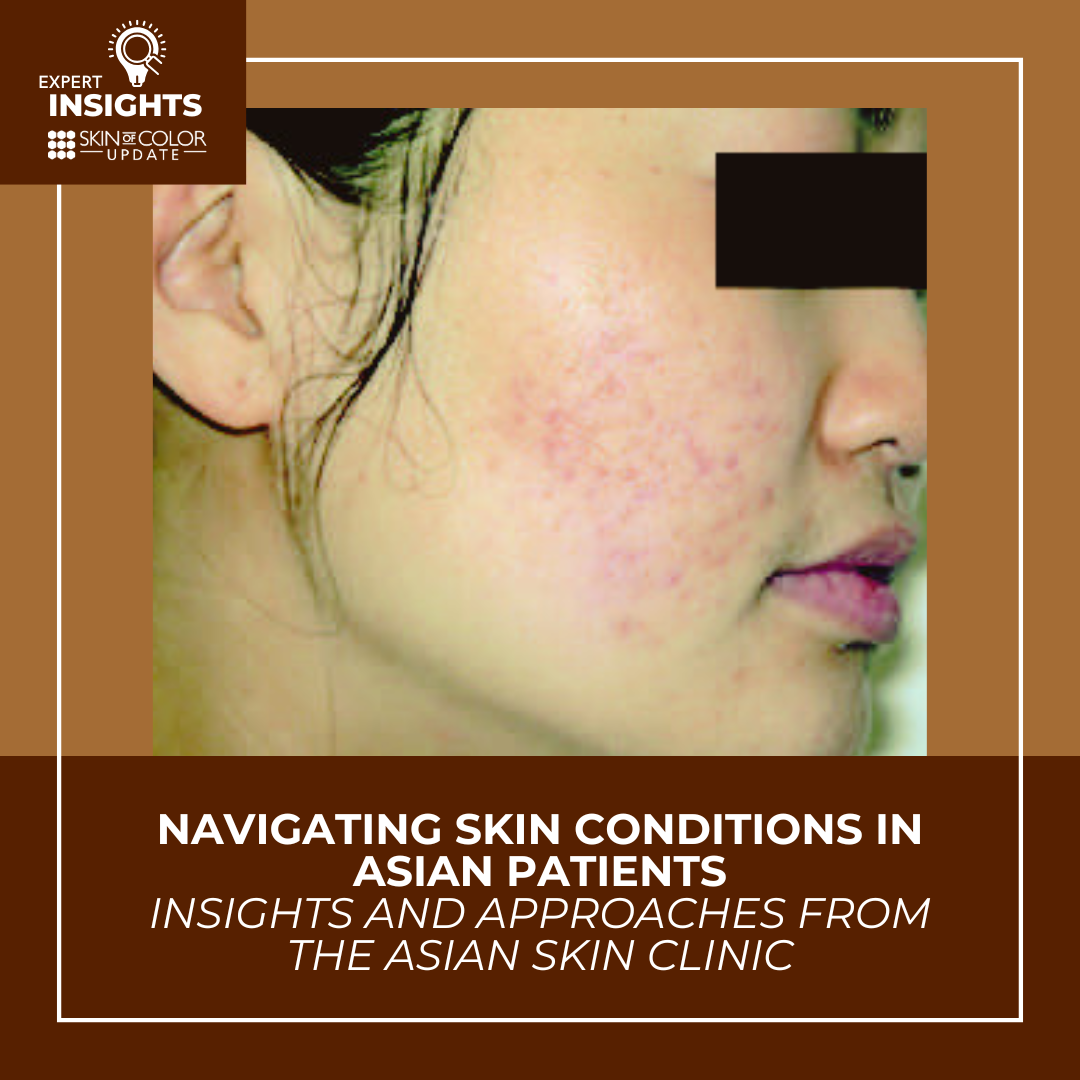
During a recent lecture at the Skin of Color Update conference, Hye Jin (Leah) Chung, MD, MMSc, FAAD, shared clinical pearls for managing dermatologic conditions in Asian patients. Dr. Chung emphasized that Asian skin possesses unique characteristics, such as a higher ceramide content than both White and Black skin, and a significantly higher propensity for reactivity. This sensitivity directly influences treatment selection, as clinicians must balance efficacy with the high risk of irritation and post-inflammatory hyperpigmentation (PIH).
Understanding and Managing Melasma
Melasma is highly prevalent in Asian populations, necessitating a multifaceted approach to care.
-
-
Photoprotection: Because the opsin-3 receptor in Asian skin is sensitive to blue light, Dr. Chung recommends tinted sunscreens that provide visible light blocking.
-
Topical Therapy: While triple combination creams containing hydroquinone are standard, they cause irritation in over 50% of Asian patients. Similarly, cysteamine is not recommended as a first-line non-hydroquinone alternative due to high irritation rates. Instead, Dr. Chung prefers gentler agents like azelaic acid, kojic acid, or topical tranexamic acid (TXA).
-
Oral Tranexamic Acid: Described as a “game changer,” Dr. Chung’s protocol involves 325 mg BID for three months, then tapering to 325 mg daily for another three months, followed by a six-month drug holiday. She advises a thorough history and baseline lab testing for thrombophilia (e.g., protein C, protein S, factor V Leiden mutation, lupus anticoagulant, anticardiolipin antibodies) before initiation.
- Laser Toning: Low-fluence Q-switched or picosecond Nd:YAG lasers can achieve subcellular selective photothermolysis (destroying melanosome without damaging cells), with the clinical endpoint of subtle erythema.
-
Addressing Complex Pigmentary Disorders
Beyond melasma, other acquired pigmentary conditions require specialized interventions.
-
-
Riehl’s Melanosis (a subtype of acquired dermal macular hyperpigmentation): Often considered a form of pigmented contact dermatitis, Dr. Chung’s two-step treatment approach begins with disease stabilization using topical corticosteroids or calcineurin inhibitors, sometimes combined with oral mini-pulse dexamethasone, colchicine, or mycophenolate mofetil, followed by a focus on minimizing hyperpigmentation with topical hydroquinone, low-dose isotretinoin (20 mg daily for 6-12 months) or acitretin, and chemical peels.
-
Acquired Bilateral Nevus of Ota-like Macules (ABNOM, Hori’s nevus): This condition can mimic melasma but but has distinguishing features. It typically starts on the malar cheek and spreads to the lateral forehead, temples, nasal root, and nasal alae, but never involves the central forehead (unlike melasma). ABNOM can appear grey or blue, while melasma is always brown. Because the pigment in ABNOM is located deep in the dermis, topical bleaching agents or chemical peels alone are often ineffective. Lasers, such as picosecond or Q-switched laser, may be required.
- Post-inflammatory Hyperpigmentation (PIH): Dr. Chung recommends the 1927-nm laser to create controlled coagulation of the epidermis and papillary dermis and improve pigmentation.
-
Advanced Techniques for Scarring
Management of acne scars in Asian skin must account for specific pathology and the risk of widening scars.
-
-
Papular Scars: Often a form of anetoderma, they are characterized by loss of elastic fibers on pathology. Dr. Chung recommends ablative CO₂ laser, which creates microthermal zones. In the absence of a laser, she suggests inserting a hypodermic needle to the scar and applying electrosurgery to the needle to create a small coagulation zone within the scars.
- CROSS Technique for Acne Scar Management: For ice pick scars, Dr. Chung utilizes the CROSS (chemical reconstruction of skin scars) technique with trichloroacetic acid (TCA) as monotherapy. She prefers an insulin syringe for application. TCA is drawn into the syringe, the plunger is removed, and the skin is stretched while TCA is applied directly into the scar, looking for white frosting as an endpoint. This method is more precise than using a wooden applicator and minimizes scar widening.
-
Safe Use of Lasers and Devices
Safety in Asian skin of color depends on minimizing heat generation.
-
-
Lower-Risk Modalities: Microneedling is generally considered to be safe in skin of color as it does not generate heat. Fractional radiofrequency microneedling is also safe, as its effects are focused on the dermis rather than the epidermis. Fractional picosecond lasers are also relatively safe because they create laser-induced optical breakdown -mechanical destruction rather than heat.
- High-Risk Modalities: Fractional ablative and nonablative lasers carry a higher risk of PIH due to heat. When used, Dr. Chung recommends high energy and low density settings to mitigate complications.
-
This summary reflects Dr. Chung’s approach to the diagnosis and management of common and unique dermatologic conditions in Asian patients, with a focus on minimizing irritation and pigmentary complications while optimizing outcomes with both topical and procedural therapies.
This information was presented at the 2025 Skin of Color Update conference by Hye Jin (Leah) Chung, MD, MMSc, FAAD. The above highlights from this lecture were written and compiled by Jay Nguyen, DO.