












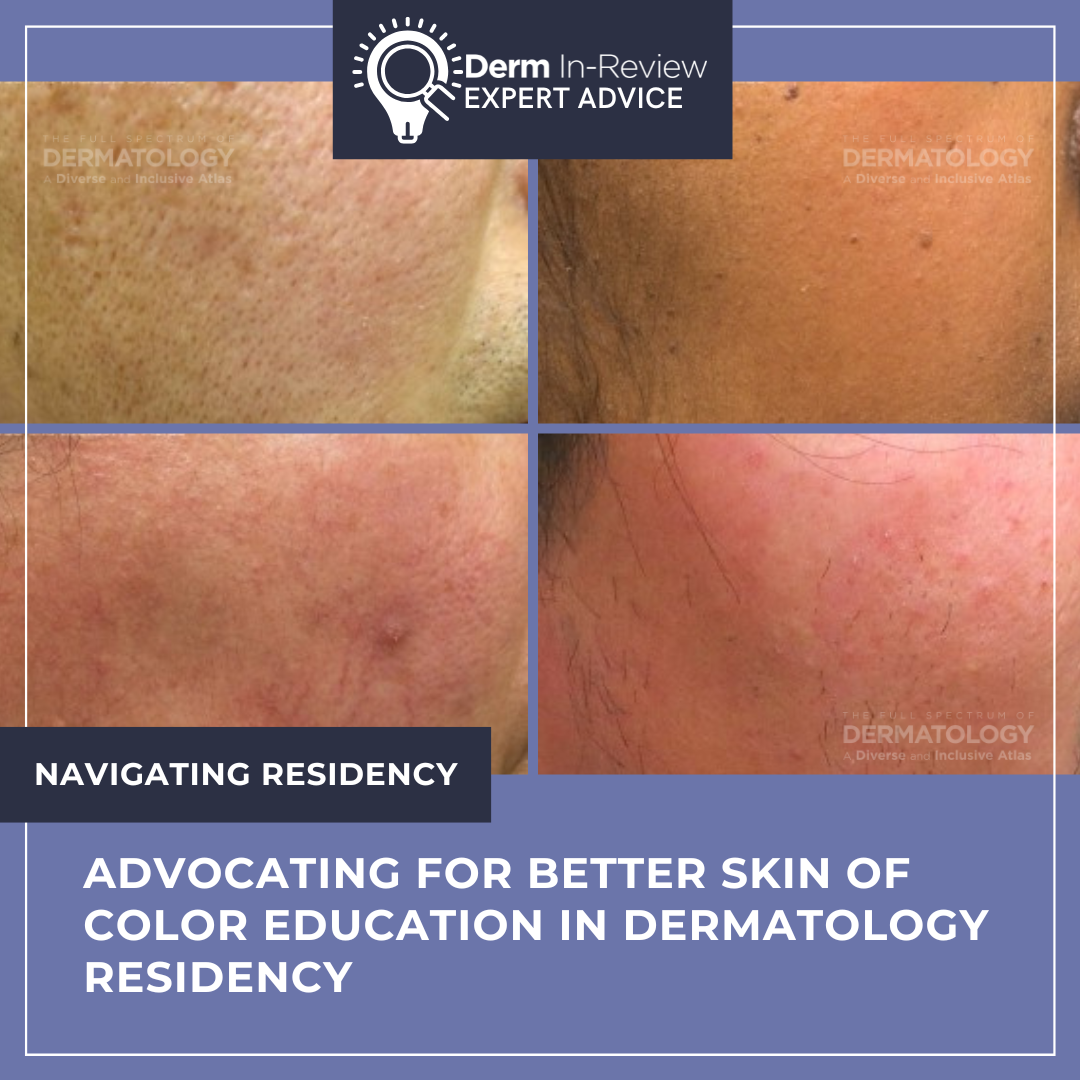
Throughout your dermatology training, you will pour over thousands of clinical photographs as you learn to identify various conditions. This will be coupled with viewing patients in person and learning to identify subtleties in morphology and presentation to make a diagnosis. No matter how robust and busy your training center is, it would be impossible to see everything. Therefore, the clinical images from which you learn to base your clinical knowledge on are incredibly important.
More recently, leaders in the field of dermatology have sought to include more adequate representation of cutaneous findings on skin of color in educational material. It is well documented that a lack of representation and diversity within medical education ultimately leads to worse patient outcomes. Despite efforts to improve this, studies continue to demonstrate a paucity of representation of conditions in patients with skin of color in many dermatology textbooks that are consistently used by residents. Additionally, there is a lag between this advocacy for change and tangible integration into dermatology residency curriculums.
How can dermatology residents advocate for better skin of color education?
First, it is important to identify what is missing. In the beginning of your training, it may feel difficult to know what gaps exist as you are still learning the basics, however this is an excellent time to intervene. Pay attention to the photos from which you are learning, whether it is from faculty lectures, textbooks, slide decks from other residents, or any other platform. Do you notice any trends or deficiencies? Once a deficiency is identified, it can be much easier to then make changes and update lectures in real time to include additional diverse photographs or supplement textbook material with real-life Kodas or examples of cutaneous conditions in various skin types.
 Advocate for consistency across the curriculum in skin of color training. Unfortunately, sometimes skin of color education is treated as a separate topic and is not embedded within the standard educational curriculum in dermatology residency. This serves as a detriment to inclusivity and only widens the gap of health disparities. The curriculum within a dermatology residency should span across all skin types and a range of disease entities, with ideally a mixture of skin types for every single disease represented.
Utilize resources already available to help build your residency curriculum. Rather than attempt to build a new curriculum from scratch, it can be helpful to incorporate structured resources available to all dermatology residents. The American Academy of Dermatology (AAD) Skin of Color curriculum is one such resource that provides clinicians and trainees with a framework to both diagnose and treat dermatologic conditions across an array of skin types.
Bring new cases to conferences to discuss and help promote awareness. Pay attention to patients that are being brought to grand rounds, regional lecture series, or other larger case conferences. Conferences are a huge part of resident learning, and many residents learn from the images, cases, and patient interactions. Residents can help advocate for better skin of color representation by bringing their own cases to these conferences, helping curate more inclusive and diverse images, and being on planning committees to help ensure there are adequate discussions about diagnosis of diseases within various skin types. This paradigm shift of inclusivity is more important than a single stand-alone lecture and will have a much bigger impact on future dermatologists and the way that they practice.
Be intentional with physical exam findings. Advocacy in this area is not delegated to just curricular changes but can be performed every day during clinic. Residents can help to transform dermatology language such that it is inclusive for all patient types. Better descriptions of color, scale, texture, pigmentary changes and other morphology contribute to better learning, as well as patient care.
Advocate for lasting changes and work with faculty to ensure the curriculum is constantly evolving. In many programs, faculty agree that skin of color education should be stronger, however the missing piece is often time, structure, or a concrete plan. Residents are often most effective when they bring both the concern and a workable suggestion. Residents who want to make a real difference should think about what would still be in place after they graduate. That could mean a shared image bank, a recurring conference session, more intentional use of the AAD curriculum, review of teaching slides for image diversity, or faculty mentorship in this area.
The future of dermatology needs to be as inclusive and expansive as the diversity of patients we treat and that starts first with adequate representation in training. Dermatology residents do not have to wait until they are faculty to influence how the specialty is taught. Powerful change and advocacy can begin with simply the recognition of an educational gap and dermatology residents are poised to exert significant influence in this area. Improving the educational curriculum in dermatology across all skin types should not be viewed as an additional piece to training. Rather, this is an integral part of dermatology residency and should be the standard by which all curriculums are created.
Did you enjoy this article? Find more on Navigating Residency here.