












From news articles to social media, “Ozempic face” is commonly used to describe facial changes that accompany rapid weight loss from GLP-1 receptor agonists. A gaunt, sunken, and aged appearance is commonly attributed to Ozempic and other GLP-1s. However, bariatric surgery and dietary changes can also lead to skin laxity and loss of facial volume. Irrespective of the weight loss method, patients who are experiencing rapid weight loss are seeking dermatologists’ care to improve the appearance of their face and body.
The authors of an original article published in the May Journal of Drugs in Dermatology evaluated the evidence behind rapid weight loss’s impact on soft tissue and created guidance for dermatologists in treating and counseling weight loss patients. I interviewed authors Sam Fathizadeh, BS, University of Illinois at Chicago College of Medicine, and dermatologists Melanie D. Palm, MD, MBA, and Deirdre Hooper, MD.
What’s the motivation behind your research?
GLP-1 receptor agonists have captured enormous public and clinical attention, and with that has come a surge of patient questions about what these medications are doing to their skin. The cultural shorthand “Ozempic face” has placed nearly the entire conversation on the medication, when in fact the dermatologic picture is far more nuanced. What motivated this review was a sense that the conversation was outrunning the evidence. Patients and even some clinicians were attributing skin laxity, facial volume loss, and muscle wasting specifically to the drug, when the literature comparing bariatric surgery, lifestyle interventions, and GLP-1 therapies consistently shows similar tissue outcomes across all three. We wanted to pull together what is actually known about the physiology of rapid weight loss on soft tissue, cut through some of the attribution bias, and give dermatologists a framework for counseling and managing these patients. With GLP-1 agonists now being investigated for indications well beyond metabolic disease, including alcohol use disorder, obstructive sleep apnea, depression, and Alzheimer’s disease, dermatologists will field these questions far more often. And with emerging data suggesting potential roles for these agents in inflammatory skin diseases, such as hidradenitis suppurativa and psoriasis, dermatologists need to be ready to counsel patients on the full spectrum of tissue effects, not just the metabolic ones.
There’s a lot of talk about GLP-1 related changes to the skin. Is the medication to blame or does rapid weight loss in general lead to tissue changes?
The short answer is that rapid weight loss itself, regardless of how it is achieved, is the primary driver of most tissue changes. Our review found that studies comparing bariatric surgery, dietary interventions, and GLP-1 therapy show broadly similar effects on skin laxity, muscle mass, and body composition. The rate and magnitude of weight loss appear to matter far more than the specific modality. That said, there is one area where GLP-1 agents may have a more direct, medication-specific effect: dermal white adipose tissue (dWAT), a metabolically distinct fat layer closely integrated with the dermis that contributes to skin thickness and facial volume. Early data suggest GLP-1 signaling may influence dWAT homeostasis independently of overall fat loss, which could partly explain the facial changes some patients experience. This is an active and important area of investigation, and further research is needed before we can draw firm conclusions.
You conducted a narrative review looking at studies on soft tissue changes that occur with rapid weight loss irrespective of the modality. What were some of your key findings? Which findings were most surprising?
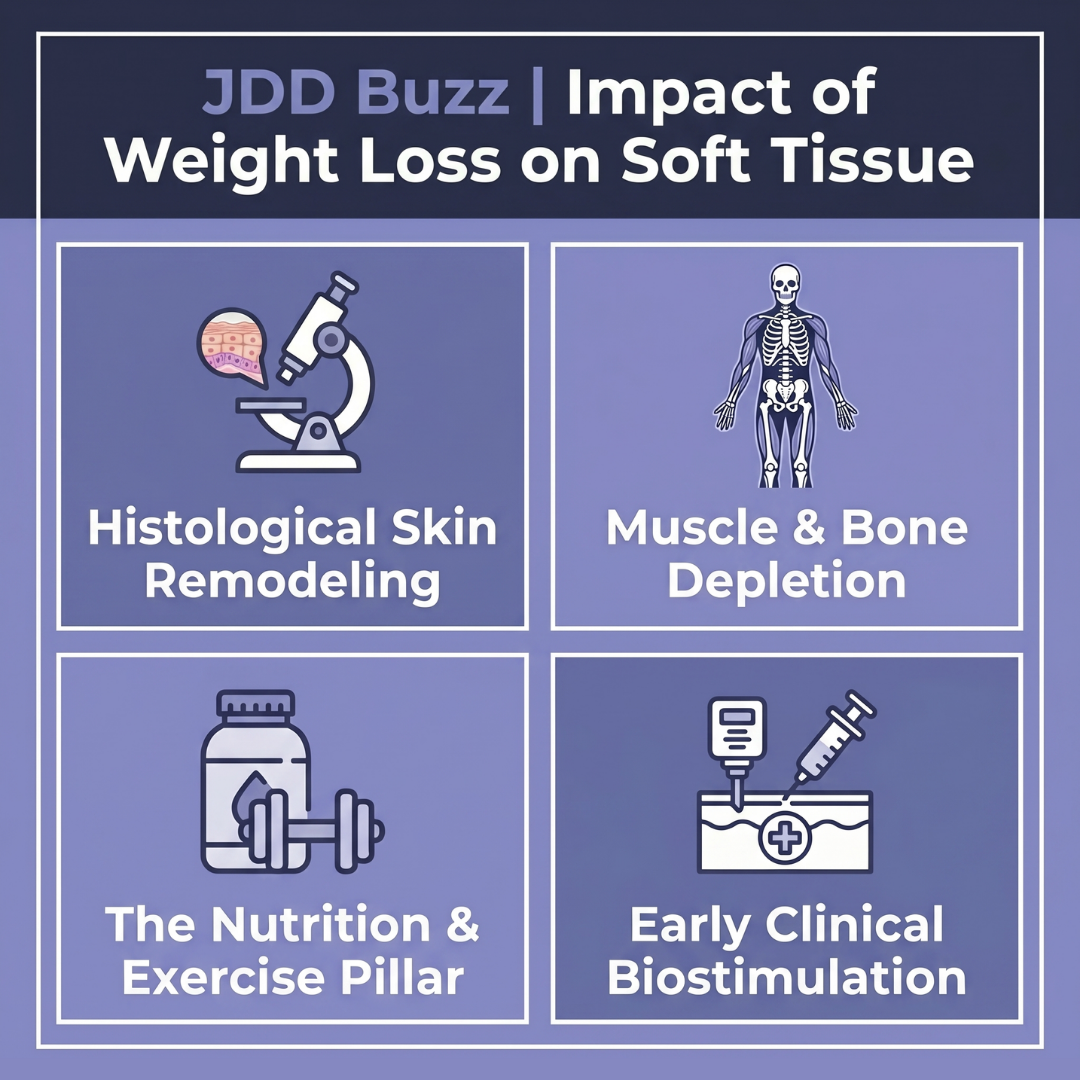
We synthesized the literature from 2000 through 2025 across bariatric, pharmacologic, and lifestyle-based weight-loss approaches, and three findings stood out. First, the convergence of histology. Regardless of modality, massive weight loss is consistently associated with disorganization of collagen fibers, reduced collagen and elastic fiber density, declining fibroblast activity, and epidermal and dermal atrophy. These cellular changes explain why skin does not retract the way patients hope, and why even surgical contouring can deliver limited results in this population. Second, the role of dermal white adipose tissue. dWAT depletion appears to contribute meaningfully to accelerated skin aging, and its centrality to the post-weight-loss picture was more prominent in the literature than we had appreciated going in. Third, the parallel changes in muscle and bone. Sarcopenia and reduced bone density occur alongside skin changes, and perhaps the most surprising part was how consistently these are underappreciated in dermatology conversations. Patients and clinicians focus on the skin, but the entire scaffold beneath it is remodeling at the same time.
What’s unique about rapid weight loss’s histological impact on the body?
What distinguishes rapid weight loss is the constellation of changes occurring simultaneously and at depth: disorganized collagen architecture, reduced extracellular matrix density, fibroblast quiescence, thinning of the epidermis and dermis, and depletion of dermal white adipose tissue. This is not simply skin that has stretched and now lacks elasticity. It is a remodeled, less metabolically robust matrix whose biosynthetic engine has slowed. That is why patients can look gaunt, fragile, or aged in ways that do not match their chronological years, and why a purely surgical approach to removing excess skin often falls short of the aesthetic result patients are hoping for. The altered dermis sets a different biological baseline for what any intervention can achieve, and understanding that histologic reality is essential for setting appropriate expectations and sequencing treatment thoughtfully.
How does rapid weight loss impact the skeletal system, and why is this important for dermatology clinicians to consider?
Rapid weight loss, particularly without concurrent resistance training, can reduce bone density through reduced mechanical loading, hormonal shifts, and inadequate intake of calcium, vitamin D, and protein. These deficits are common in post-bariatric patients and those on GLP-1 agonists who experience significant appetite suppression. Without appropriate management, this trajectory can lead to osteoporosis and increased fracture risk. For dermatologists, this matters beyond the obvious systemic health concerns. The facial bony skeleton is the architecture beneath the skin we treat, and when that underlying scaffold remodels, soft tissue support diminishes, and the aging trajectory accelerates in ways that injectables and topicals alone cannot fully address. It also reinforces the importance of counseling patients holistically and coordinating with or referring to the appropriate specialists when bone health, nutrition, or strength are at risk.
You recommend a well-rounded approach to addressing skin-related changes from rapid weight loss, including nutrition, exercise, and cosmetic procedures. How should dermatology clinicians counsel patients undergoing rapid weight loss?
The counseling conversation should start early, ideally before or concurrent with the onset of significant weight loss and should be framed around skin health rather than cosmetic correction.
Three pillars anchor that conversation:
Nutrition first. A protein-forward diet, with a general target of at least 1 gram per kilogram of body weight per day, helps preserve muscle mass and supports collagen synthesis. Foods rich in omega-3 fatty acids, zinc, and vitamins A, C, and E also provide substrate for skin repair and barrier integrity.
Exercise second. Resistance training is not optional. Patients who combine caloric restriction with strength training preserve significantly more lean mass and functional strength than those who rely on diet alone, and that lean mass directly supports the skin above it. Patients on GLP-1 agonists often experience nausea and appetite suppression severe enough to discourage physical activity, so it is worth proactively addressing that barrier.
Third, where clinically appropriate, using the lowest effective dose of weight-loss medication paired with intentional nutrition may mitigate downstream effects on skin and muscle.
Layered onto these pillars, early biostimulation is worth introducing as a proactive health strategy rather than an afterthought. This includes topical agents that support collagen and barrier function, biostimulatory injectables, and energy-based devices, all initiated with the goal of preserving tissue integrity throughout the weight loss journey rather than addressing laxity after the fact. Setting realistic expectations about what any single modality can achieve, and coordinating with the patient’s broader care team, are equally important parts of that conversation.
Based on your research, what cosmetic procedures should dermatology clinicians consider for these patients and at what point in the weight loss journey?
Our approach is to start early and start gently, and minimally invasive options should come first. Fractional lasers, radiofrequency, and ultrasound-based devices address collagen remodeling and skin tightening. Biostimulatory injectables, particularly poly-L-lactic acid (PLLA) and calcium hydroxylapatite, are well-suited for restoring volume and stimulating neocollagenesis. Recent comparative work suggests PLLA may also carry a distinctive adipocyte-mediated regenerative mechanism, which is particularly relevant in the post-weight-loss face where dWAT depletion is part of the clinical picture.
Combination protocols layering energy-based devices with biostimulators are showing real promise, and platelet-rich plasma is under active investigation as an adjunct. High-intensity focused electromagnetic stimulation, with or without synchronized radiofrequency, is worth considering for the underlying muscle loss, with MRI studies demonstrating meaningful gains in muscle volume in treated areas that translate to better structural support for overlying skin. For patients with severe laxity affecting hygiene, function, or emotional well-being, surgical referral for abdominoplasty, brachioplasty, thighplasty, or rhytidectomy is appropriate.
On timing, the goal is to intervene during the active weight-loss phase rather than waiting until the tissue has fully relaxed, while ensuring weight has stabilized enough to make the treatment durable.
What else should dermatology clinicians know about the impact of weight loss on soft tissue?
A few things stand out. First, expectation-setting is part of the procedure. The histology tells us these patients often have less collagen reserve to work with, and we owe them transparent conversations about what is and is not achievable with any given modality. Second, the evidence base is still maturing. We have very little prospective head-to-head data on optimal treatment sequencing, particularly in GLP-1-treated populations, and most existing studies center on post-bariatric cohorts. There are real gaps that ongoing research will need to fill. Third, the regenerative space is worth watching closely. Platelet-rich plasma, next-generation biostimulators, and combination protocols are likely to expand what we can offer, and the literature is moving quickly. Fourth, this is not a dermatology-alone problem. The best outcomes come from real coordination among dermatologists, endocrinologists, dietitians, physical therapists, plastic surgeons, and the patient’s primary care team. Rapid weight loss reshapes the entire person, and our care approach should be equally integrated.
Did you enjoy this JDD Buzz article? You can find more here.