












In the continuity clinic, the patients are there to see you! Most residency programs have some kind of continuity clinic. They vary across institutions and even across sites within the same institution. They can vary from one half-day per week to two full days per week, and be at the same site throughout the residency or change. An attending may staff each patient, or they may only see a patient if a resident asks with the level of autonomy generally increasing as the resident progresses in the program. There may also be just one resident present at a time, while others may have multiple (or all) residents present.
Reframing the Purpose of Continuity Clinic
The continuity clinic serves a crucial role in a resident’s training. It is not just learning which creams or pills will treat a patient’s acne, psoriasis, eczema, and hives. It’s learning how to practice dermatology independently. For example, you:
-
- Develop your unique treatment protocols
- Figure out which treatments are actually accessible for patients (and which are not)
- Learn when and how to engage family members in care
- Experiment with different ways to communicate test results to patients
- Learn how to work collaboratively with office staff
- Experience how social determinants of health influence how patients receive care
- Develop your confidence and autonomy
- Learn the basics of coding and insurance
- And so much more
While it may be easy for residents to shy away from extra work, residency is a special, protected, and short phase of training. Residents should challenge themselves to see as many patients as they can, without overwhelming themselves, cutting corners, or offering substandard care. Even for diagnoses that seem routine, each patient experiences our healthcare system differently and can provide a unique lesson.
In general, optimizing your continuity clinic comes down to three things: preparation, understanding your schedule, and building efficient systems. Here are some tips I have learned over the last three years:
Pre-Clinic Preparation
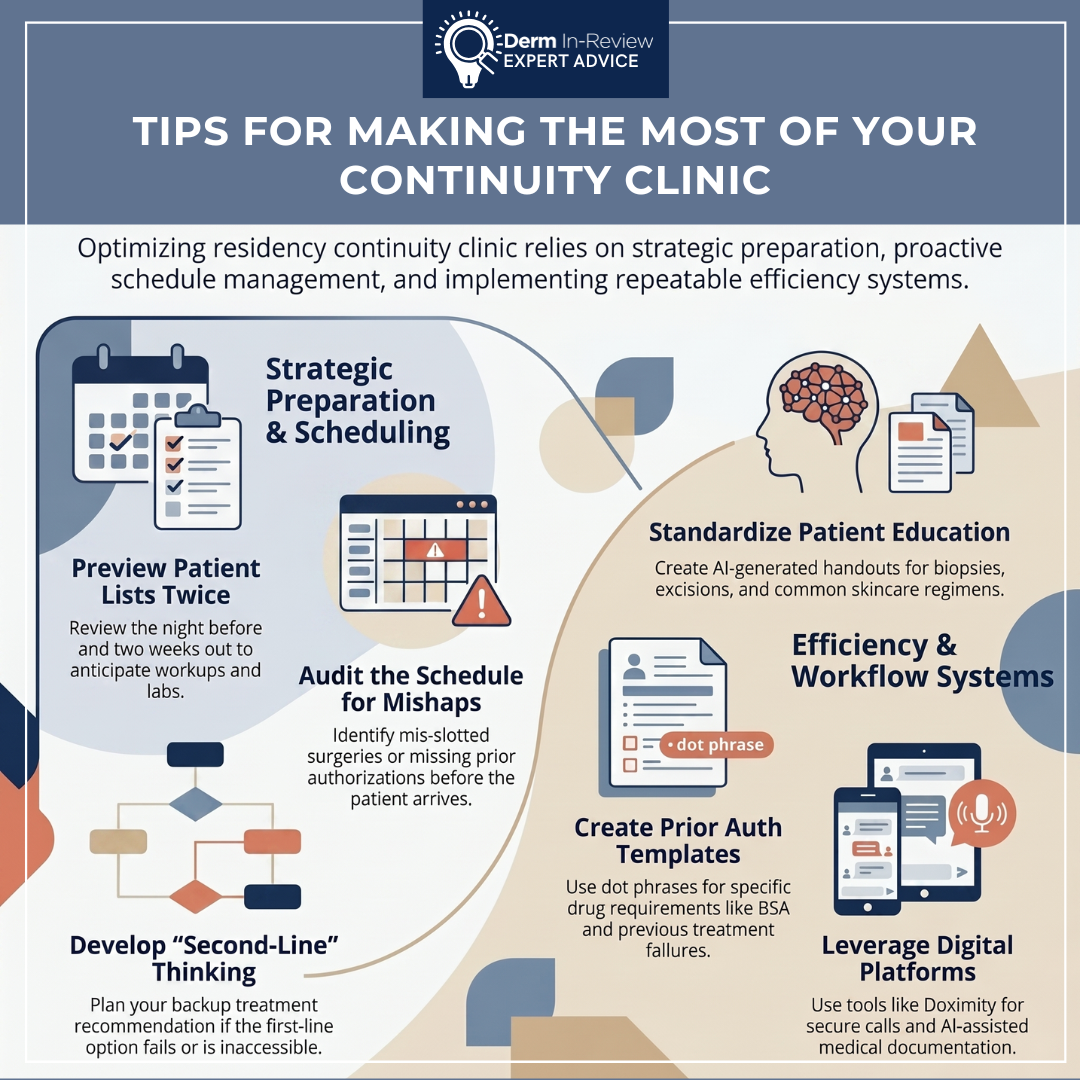
As a resident, your clinic may not be optimized to your preference. There may not be adequate support staff, the staff may change regularly, staff may not be aware of your preferences, and patients may also not know you well enough to forgive you when things don’t go as smoothly as they hope. Preparation equals control over your clinic day. Generally, before each clinic day, I preview my patient list at least twice.
Previewing the night before allows me to anticipate my patients’ needs, their workup, and treatments. Have they completed their previously recommended labs for their biologic? For a patient referred by the local urgent care for a recurrent abscess under their arms, what do you think the diagnosis may be, and how might you treat it? If the patient isn’t improved after following my first-line recommendation, what is going to be my second-line recommendation?
Schedule Optimization
In addition to previewing the patients the night before, I also find it helpful to preview one or two weeks in advance. You may not control your schedule, but you should understand it well enough to influence it.
People often center their entire days or weeks around appointments, especially for surgeries. Previewing helps identify scheduling mishaps. For example, a large excision allotted in a 15-minute slot. Maybe an excision was rescheduled from a prior visit because a prior authorization was needed, but that prior authorization was never actually requested. If a punch excision is unnecessarily blocked off for an hour, this may limit scheduling for other patients who may have more urgent concerns or who may offer more educational value. Schedule optimization helps avoid mishaps that lead to angry patients, and it allows me to see and learn from as many patients as possible without overwhelming myself or my staff.
Efficiency Systems
Below are other tips to work faster in the clinic (or that will free up your time to be more thorough in other ways):
-
- Create patient education handouts. Time is limited during appointments. There’s not enough time to realistically explain everything that probably should be explained. Even when you do explain, patients forget. Handouts free up time in the room, help patients remember things that were discussed in the room, and ultimately encourages adherence and outcomes. I used AI to create handouts for biopsies, freezing, excisions, isotretinoin enrollment, basic skin care regimens, and over-the-counter recommendations to treat acne.
- Get to know your staff. Have open lines of communication with your staff and lean on them often. Know everyone’s name, everyone’s role, and how to reach out to them to get various tasks done. A positive patient experience is a team effort.
- Create templates for prior authorizations. There are new medications coming out all the time. Access can be a challenge. Create templates in your notes app documenting the requirements to obtain each medication (e.g., body surface area, severity, previous treatments, impact on physical and psychological well-being, results of pretreatment tests, statements about vaccine status, etc.). Copy and paste these into each patient’s chart and modify as needed, or use dot phrases if your EMR has that. Pay attention to little nuances in your templates, like Opzelura being indicated for vitiligo less than 10% but atopic dermatitis less than 20%. Also, make a note of which specialty pharmacies dispense which medications.
- Use Doximity or a similar platform (not sponsored). I use this daily to securely voice call, video call, or text patients, communicate test results, and send and receive faxes. You can set the caller ID to the office or department number. I also use its generative AI feature to write prior authorizations, write work and school notes, and assist in medical decision-making.
Other Tips
Coding. If your EMR calculates this for you, make a point to acknowledge how the coding of your note changes based on your documentation (e.g., diagnosis complexity or plans, like counseling, injections, biopsies, etc.). Coding often gets overlooked in residency, but it is an essential skill as an attending.
Conclusion
Continuity clinic is a protected space to safely make decisions, refine your workflow, and develop your own style of practice. The more intentional you are with it now, the more prepared you’ll be when that safety net is gone.