












While once only available at prestige beauty retailers, Korean skincare products are now mainstays in the skincare sections of big box stores and pharmacies. And the Korean influence is only growing: A recent Elle article profiled Korean in-office skincare treatments that are now available at some cosmetic practices in the U.S. These new products and procedures give more options for consumers, but is their presence adding confusion to an already crowded skincare market?
For her take on the K-beauty boom and how dermatologists may counsel their patients, I interviewed Heather Woolery-Lloyd, MD, FAAD, director of the Skin of Color Division for the University of Miami Dr. Phillip Frost Department of Dermatology and Cutaneous Surgery.
What’s your experience with K-beauty products, both as a consumer and as a dermatologist?
As a dermatologist, I have seen more and more patients coming in using K-beauty products. Patients are typically excited to try these new products because they tend to have ingredients that are not as well known here in the US. I have also personally tried several K-beauty products. I especially like the sunscreen formulations.
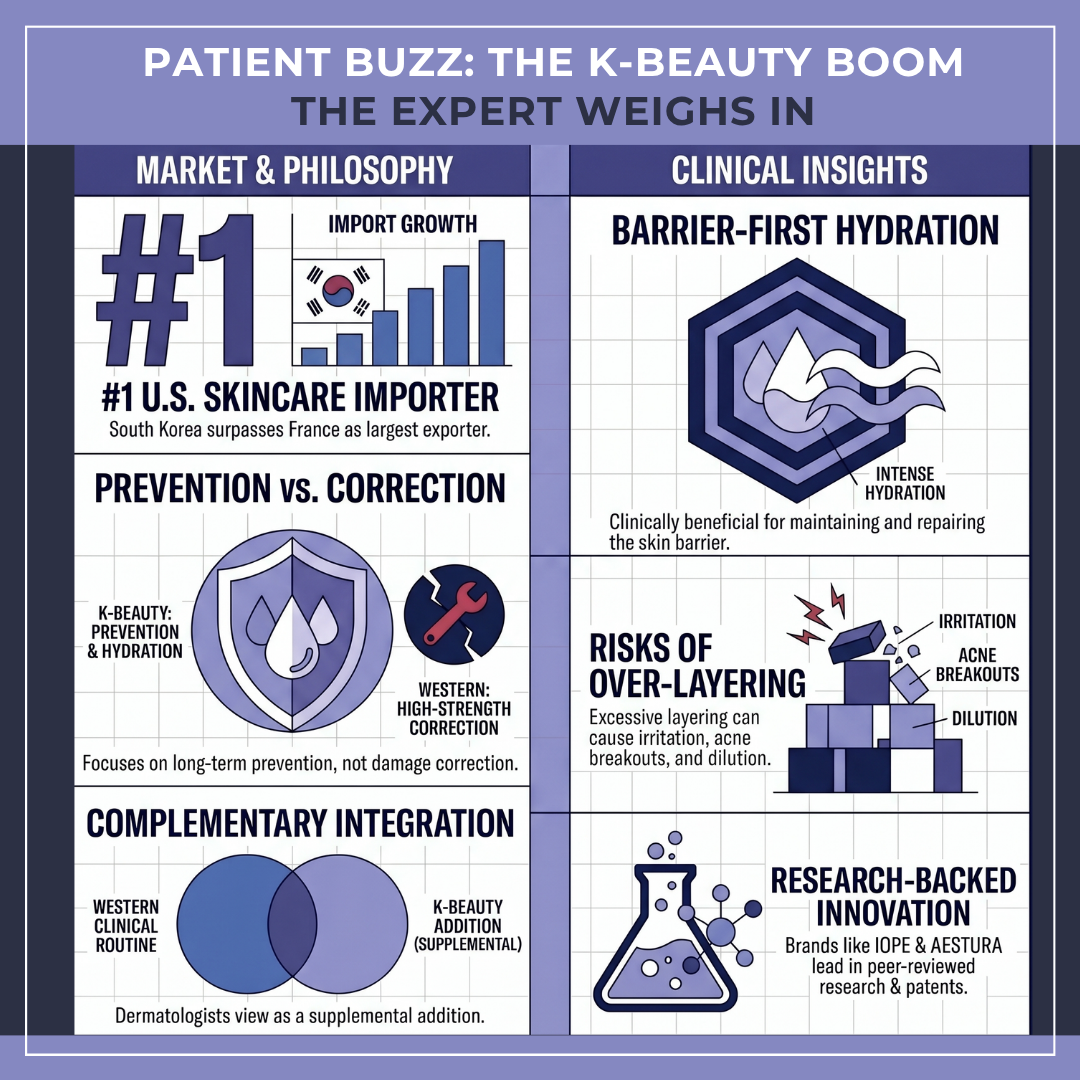
Western skincare has traditionally focused on correcting damage (like using high-strength retinols), while K-beauty emphasizes prevention. Do you see K-beauty products as competitive with or complementary to U.S. products?
I see K-beauty products as complementary. They tend to offer different ingredients and can be used alongside many of the products that we currently use in the U.S. The only concern that I have is that sometimes people have overly complicated routines, which can lead to irritation. Although it’s interesting to try new technologies, it’s important not to overdo it.
K-beauty originated the “glass skin” trend. What are the skincare risks of heavily layering products?
There are a few risks of heavily layering products. The first risk is that if too many exfoliating ingredients are used, it can be irritating to the skin. The second concern is that when layering multiple skincare products you might lose efficacy of active ingredients as they become more diluted with each layer. And, finally, in people with acne prone skin, layering of heavy products may increase the chance of breakouts.
K-beauty also focuses on intense hydration. Is this helpful or harmful to the skin barrier?
Intense hydration is extremely helpful to the skin barrier. I love the focus on maintaining a healthy barrier.
K-beauty is known for innovative ingredients, including snail mucin and fermented extracts, and now exosome-infused essences and lab-grown collagen are trendy. Is there robust, peer-reviewed data supporting their use? Are there K-beauty brands with scientific backing?
Currently, peer-reviewed research supporting the use of many K-beauty ingredients is limited. IOPE is one of the brands that does have significant research. They have been innovators in retinoids and have published dozens of papers and obtained many patents for their stabilized retinol technology. This brand is one of the K-beauty brands that stands out when it comes to research.
How may dermatology clinicians direct patients in selecting effective K-beauty products?
There are so many brands. It may be hard for dermatology clinicians to keep up with all of the K-beauty products on the market. IOPE is well known for its commitment to research and innovative technologies.
AESTURA is another leading brand that is closely connected to medical professionals in South Korea. This brand focuses heavily on skin barrier repair with patented technologies.
Are there any potential concerns to incorporating both U.S. and Korean products into a skincare routine, including potent actives such as tretinoin?
There are no concerns with using both U.S. and Korean products together. A well-designed skincare routine is what is most important.
How do you envision K-beauty changing the U.S. skincare market?
South Korea is now the largest importer of skincare to the U.S., surpassing France a few years ago. I do not think K-beauty is a trend. I think it is here to stay and we will continue to see more of these products on the market.
Did you enjoy this Patient Buzz expert commentary? You can find more here.