












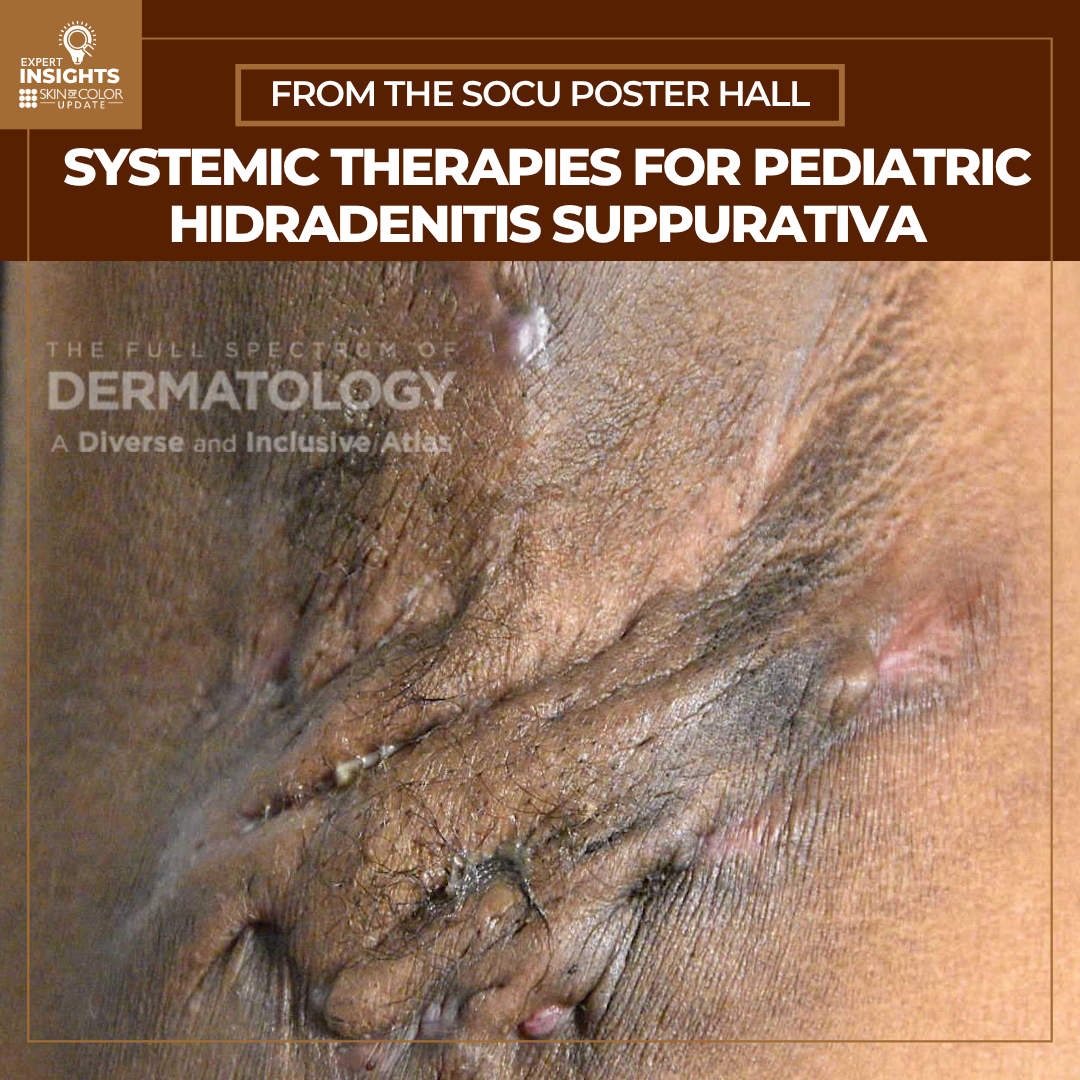
Clinicians treating adults with hidradenitis suppurativa (HS) can use a variety of strategies, from topical and oral medications, to deroofing and laser therapy, as research supports their use. However, choosing an appropriate treatment isn’t as easy when the patient is a developing child. Data on the long-term safety of systemic medications for HS in children isn’t well known. Yet treating pediatric HS demands effective treatment as the condition often involves aggressive inflammation and frequent recurrence.
A poster presented at Skin of Color Update titled “Systemic Therapies for Pediatric Hidradenitis Suppurativa: Stratified Assessment of Efficacy, Adverse Profiles, and Age-Specific Considerations” evaluated the body of research on the use of systemic therapies for HS, with the goal of raising awareness of research gaps and encouraging dermatology clinicians in the safe administration of systemic therapies in these patients. I interviewed the poster’s lead author, Rachel Aronov, BS, of the Donald and Barbara Zucker School of Medicine at Hofstra/Northwell.
How common is HS in children, and what are some of the differences between pediatric and adult HS?
Hidradenitis suppurativa is less common in children than in adults, with pediatric prevalence estimates around 0.03–0.06% (≈28 per 100,000 children and adolescents), and rising in later adolescence (highest in ages 15–17).1 That said, up to one-third of patients with HS report symptom onset before age 18, so early disease is not rare in clinic.2 Compared with adults, pediatric HS more often presents in the context of obesity and metabolic risk, and early-onset disease (≤14 years) more frequently involves genital or “hidden” sites, which may delay disclosure and diagnosis and amplify psychosocial burden.3 Children may also accrue scarring and tunnels early, so even “mild” disease by lesion count can be functionally severe.
How is HS typically treated in children?
In children, we still start with the same stepwise framework as adults—topicals, lifestyle optimization, and targeted systemic therapy—but almost all systemic options are off-label and extrapolated from adult data. First-line systemic agents in older adolescents are usually oral tetracyclines, while younger children more often receive time-limited courses of clindamycin–rifampin for inflammatory control. Hormonal modulation (e.g., spironolactone, combined OCPs) is reserved for post-menarchal females with cycle-linked disease. Biologics are generally introduced for moderate-to-severe or refractory HS. At present, adalimumab is the only biologic with an HS indication in patients ≥12 years and remains the most frequently used systemic agent in pediatric practice.
Systemic therapies remain off-label for children who have HS. What are some of the challenges in dosing systemic therapies in children when they’re used off-label?
Off-label systemic use in pediatric HS is challenging because “adult” dosing doesn’t cleanly map onto a growing child. Age-dependent pharmacokinetics (volume of distribution, clearance), rapidly changing body composition and BMI, and pubertal hormonal shifts all influence drug exposure, while we have very little pediatric PK/PD data for HS-directed agents. Growth and developmental toxicities must also be considered—e.g., tetracycline-associated enamel dysplasia, retinoid effects on growth plates and bone, and hormonal therapies in still-maturing reproductive systems. Practically, clinicians are forced to balance weight-based vs fixed adult regimens, decide how aggressively to escalate in higher-weight adolescents, and monitor for long-term skeletal, reproductive, and immune effects without robust safety data to guide them.
Your poster evaluated systemic therapies for pediatric HS, looking at efficacy, age of administration, treatment duration, and adverse effects. How did you conduct your study, and what did you find?
We conducted a targeted literature review (2000–2025) using PubMed, Google Scholar, and ClinicalTrials.gov, including studies of patients ≤18 years receiving systemic therapy for HS—randomized trials, cohorts, case series, and pharmacology reports. We extracted data on HiSCR response, flares, lesion burden, dosing strategies, adverse events, and growth- or reproduction-related toxicities, and grouped therapies into TNF-α inhibitors, oral antibiotics, hormonal agents, retinoids, and procedural adjuncts. Overall, we found that adalimumab is the best-studied systemic option in pediatric HS, with roughly 42–60% of adolescents and mixed pediatric cohorts achieving HiSCR and meaningful reductions in nodules and flares, while most other systemic agents are supported only by small series, heterogeneous outcome measures, and limited follow-up.
Which therapies fared better and which fared worse?
Among systemic options, adalimumab emerged as the most consistently effective biologic in youth, with HiSCR rates around 42–58% in adolescents ≥12 and similar response ranges in mixed pediatric cohorts, along with reductions in nodules and flares. Infliximab also showed good efficacy in refractory disease—complete resolution in ~23% and partial response in ~73%, with a small non-response rate—but is limited by infusion logistics and safety considerations. Clindamycin–rifampin combinations produced 47–70% response rates, particularly in earlier Hurley stages, but benefits were often time-limited and recurrent flares were common after discontinuation. Tetracyclines functioned as first-line agents in older adolescents but had limited long-term efficacy in follicular-predominant HS. Hormonal therapies and oral retinoids provided mixed or modest benefit and carry more pronounced age-specific risks (thromboembolic risk, menstrual irregularities, growth plate and skeletal concerns), which makes them less attractive as long-term options in many pediatric patients.
What data is needed for dermatology clinicians to make more informed treatment decisions when considering systemics in their pediatric HS patients?
Clinicians need robust pediatric-specific data rather than continued extrapolation from adults. This includes:
-
- Prospective trials of systemic therapies (biologics and antibiotics) powered for pediatric HS, with standardized outcomes such as HiSCR, pain, and quality of life.
- Age- and weight-stratified PK/PD data to inform dosing algorithms across prepubertal children, early adolescents, and older teens.
- Long-term safety studies focused on growth plates, bone health, and fertility/reproductive outcomes with hormonal therapies or oral retinoids, as well as immune function and infection risk with prolonged biologic or antibiotic use.
- Data on treatment durability and relapse after taper or discontinuation, particularly in preadolescents who seem prone to early relapse.
This data would allow us to move from “educated guessing” to more precise, guideline-level recommendations tailored to age and developmental stage.
Is there anything else dermatology clinicians should know about systemic therapies for pediatric HS?
A few key takeaways:
-
- Systemic therapy in pediatric HS is not just about clearing lesions—it’s a chance to alter disease trajectory, prevent tunnel and scar formation, and reduce a significant psychosocial burden that often begins in early adolescence.
- When selecting a systemic agent, factor in age, pubertal status, comorbidities (obesity, metabolic syndrome, mood disorders), and the family’s capacity for monitoring (labs, TB screening, infusion visits).
- Adalimumab is currently the most evidence-supported biologic for moderate-to-severe pediatric HS, but close monitoring for infection, vaccination status, and adherence is critical.
- Collaboration with pediatrics, endocrinology, gynecology, and mental health can be invaluable, especially for patients with early-onset, genital involvement, or significant mood symptoms.
Ultimately, we advocate for earlier, thoughtfully selected systemic therapy in appropriate pediatric patients—paired with vigilant safety monitoring and shared decision-making—to improve long-term outcomes.
Additional authors of the poster include:
Bijoy Shah, BS, College of Medicine, Albert Einstein
Alex Silberzweig, BA, Donald and Barbara Zucker School of Medicine at Hofstra/Northwell
Rachel Breidbart, BS, Donald and Barbara Zucker School of Medicine at Hofstra/Northwell
Claudia Rodriguez, BA, Donald and Barbara Zucker School of Medicine
Kelly Frasier, DO, MS, Northwell
Pooja R. Shah, MD, Northwell
References
-
- Garg A, Lavian J, Lin G, Strunk A, Alloo A. Prevalence estimates for hidradenitis suppurativa among children and adolescents in the United States: a gender- and age-adjusted population analysis. J Invest Dermatol. 2018;138(10):2152-2156.
- Cotton CH, Chen SX, Hussain SH, Lara-Corrales I, Zaenglein AL. Hidradenitis suppurativa in pediatric patients. Pediatrics. 2023;151(5):e2022061049. doi:10.1542/peds.2022-061049
- Dattolo A, Sampogna F, Mastroeni S, Fania L, Ciccone D, Abeni D. Health-related quality of life and clinical characteristics of hidradenitis suppurativa in a pediatric population. Dermatol Reports. 2025;17(2):10086. doi:10.4081/dr.2024.10086