












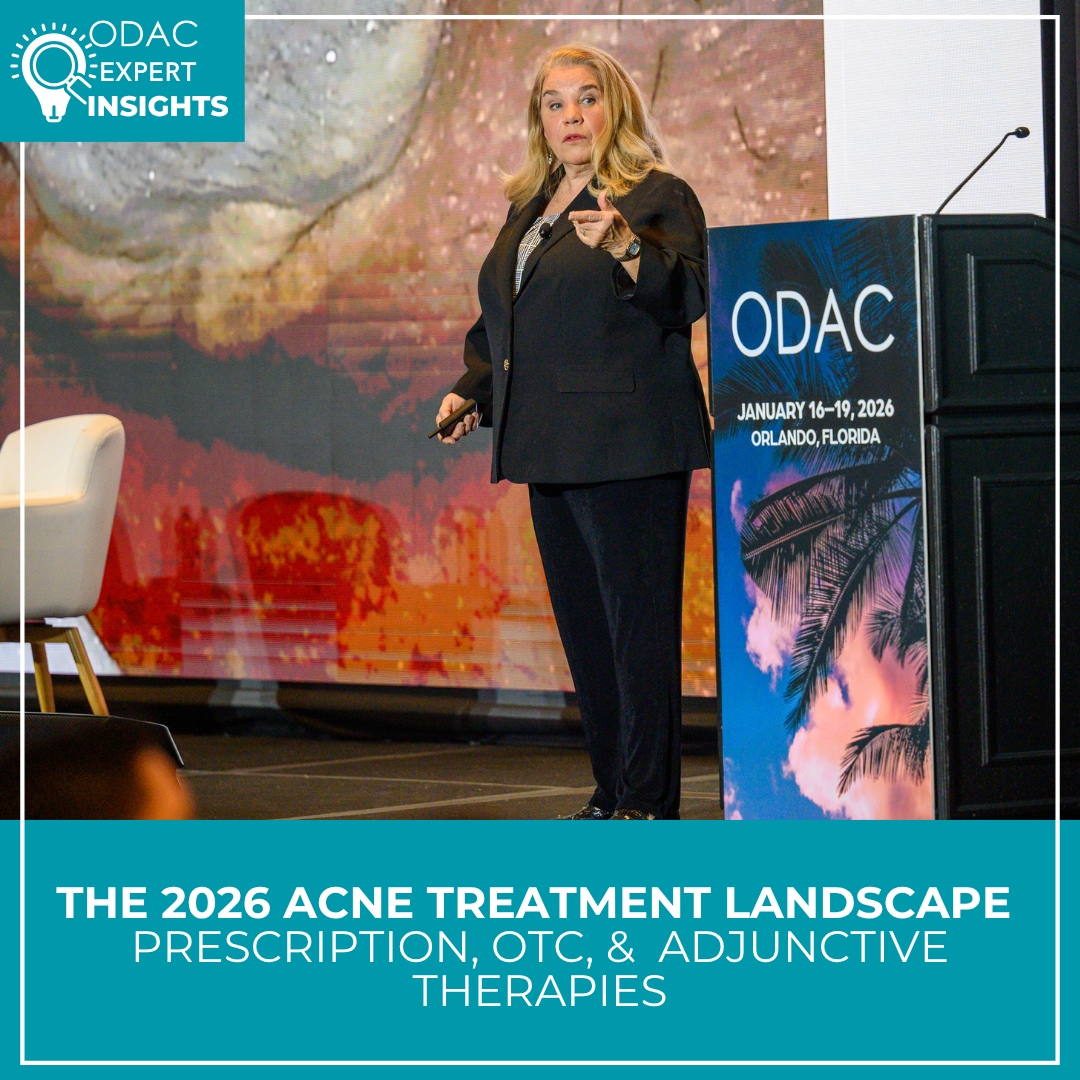
Managing acne effectively requires a nuanced approach that combines cutting-edge innovations with tried-and-true clinical strategies. In a recent presentation at the ODAC Dermatology Conference, Dr. Hilary Baldwin, MD, FAAD—Medical Director of The Acne Treatment and Research Center and Clinical Associate Professor at Rutgers Robert Wood Johnson Medical Center—shared her clinical expertise on maximizing the full spectrum of acne therapies. From advanced delivery formulations to over-the-counter barrier support, Dr. Baldwin outlined practical strategies to optimize outcomes for patients with acne.
The current topical and oral prescription medications address different components of acne pathophysiology, including hyperkeratinization, inflammation, C. acnes, and sebum overproduction. Although some of these options, such as retinoids and benzoyl peroxide, are older medications, the technology of delivering these proven actives has improved. For example, microsphere, microencapsulation, and polymeric emulsion improve tolerability, absorption, and stability.1 Similarly, lidose and micronized formulations for oral isotretinoin reduces the need for a high-fat meal for absorption, which has historically limited efficacy with variable fasting and non-fasting patient use. Topical clascoterone has the newest mechanism of action as a topical androgen receptor antagonist, reducing sebum and associated pro-inflammatory cytokines. However, Dr. Baldwin encouraged the audience to not fear leaning on tried-and-true options, such as antibiotics. If considering trimethoprim-sulfamethoxazole, she advised trimethoprim alone to avoid the risk of Stevens-Johnson syndrome. She pointed out that of the various formulations of doxycycline, monohydrate may be less associated with gastrointestinal distress and ulcers.
Over-the-counter options allow treatment of acne as a disorder of barrier defects, addressing transepidermal water loss, ceramide concentration, pH, and microbiome diversity.2 Dr. Baldwin noted many cleansers can be more harmful than helpful, highlighting that ideal cleansers tend to be lipid-free syndets that hit the sweet spot of acidic pH.3,4 At the junction of drug and over-the-counter active ingredients, acneceuticals is an area of rapidly increasing interest for patients. Actives such as niacinamide, salicylic acid, and azelaic acid, can serve as first-line anti-inflammatory options whereas ingredients with emerging evidence, such as cannabidiol, aloe vera, and green tea, can be adjunctive add-ons.5 Research into the skin microbiome shows promise for modulating with topical probiotics,6 likely by replacing pathogenic Type 1 C. acnes with physiologic Type 2 C. acnes.
In conclusion, innovation continues to advance the landscape of acne management. Leveraging the nuances of over-the-counter and prescription options can make the difference for patients in efficacy as well as tolerability. Developing work in acneceuticals and the skin microbiome are areas of increasing interest and potential new options for a highly variable condition that markedly affects quality-of-life.
References
-
- Baldwin H, Webster G, Stein Gold L, Callender V, Cook-Bolden FE, Guenin E. 50 Years of Topical Retinoids for Acne: Evolution of Treatment. Am J Clin Dermatol. 2021 May;22(3):315-327. PMID: 33871811.
- Dull K, Lénárt K, Dajnoki Z, et al. Barrier function-related genes and proteins have an altered expression in acne-involved skin. J Eur Acad Dermatol Venereol. 2023 Jul;37(7):1415-1425. PMID: 36971768.
- Proksch E. pH in nature, humans and skin. J Dermatol. 2018 Sep;45(9):1044-1052. PMID: 29863755.
- Draelos ZD. Concepts in skin care maintenance. Cutis. 2005;76(6 Suppl):19–25.
- Baldwin H, Frey C, Hebert A, Ted Lain E, Schlesinger T. An algorithm integrating acneceuticals into the management of acne vulgaris. J Drugs Dermatol. 2025 Apr 1;24(4):376-380. PMID: 40196955.
- Alqam ML, Jones BC, Hitchcock TM. Safety Evaluation of topical products containing live cultures and ferment of cutibacterium acnes subspecies defendens strain XYCM42 in individuals predisposed to acne vulgaris. J Clin Aesthet Dermatol. 2025 May 1;18(5):44-53. PMID: 40538528.
This summary was prepared by Dr. Nagasi Adusumilli, ODAC 2026 Onsite Correspondent, who attended the session. The content reflects the Onsite Correspondent’s notes and interpretations, may contain errors, and is provided for educational purposes only. It does not constitute official faculty endorsement and should not replace original sources or clinical judgment.
Did you enjoy this article? You can find more on acne here.