












Friday Pop Quiz 8/14/2026
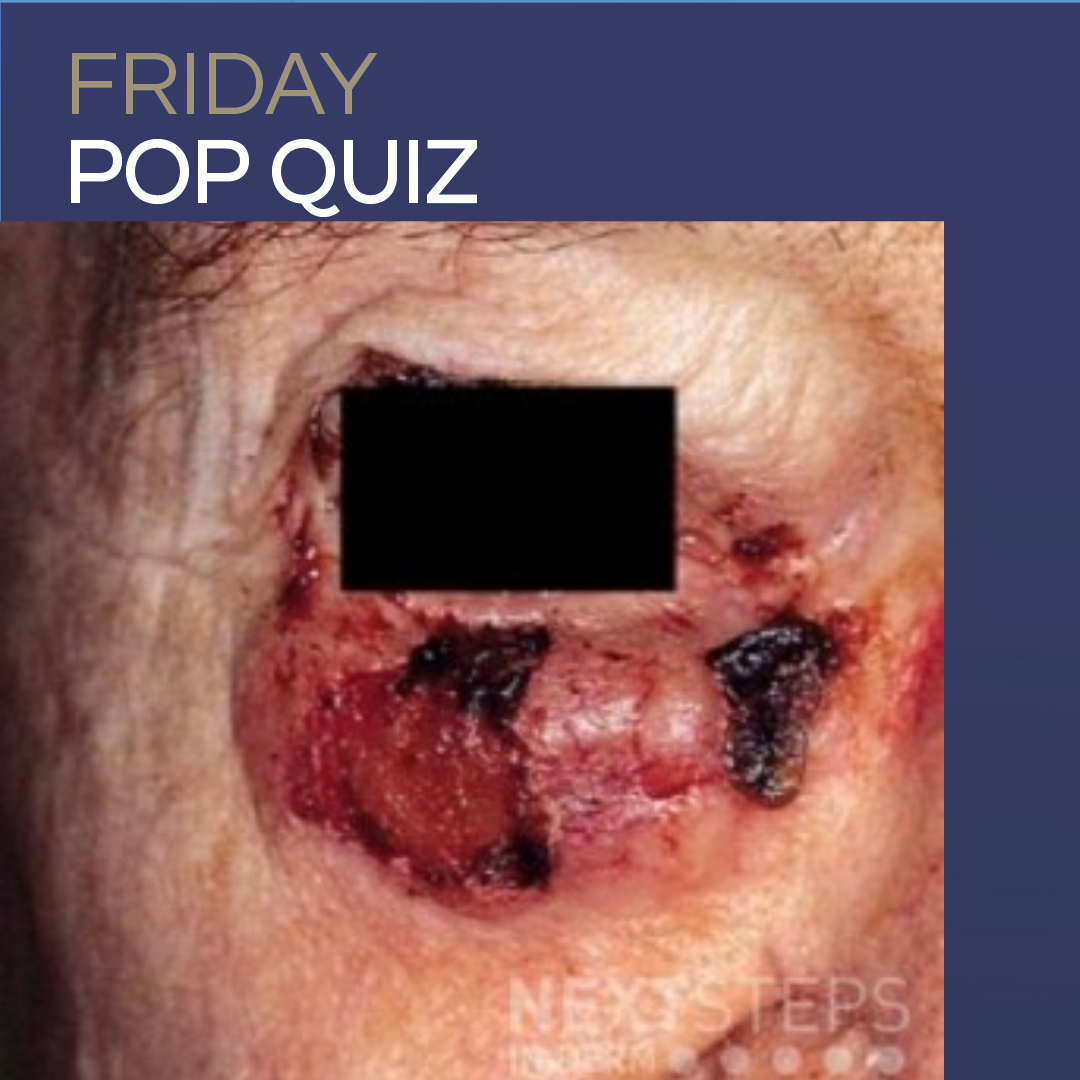 A 70-year-old female presents for treatment of a large tumor shown on her face. It has been increasing in size for over 10 years. Which of the following medication is FDA approved for locally advanced basal cell carcinoma that is not amenable to surgical therapy?
A. Ipilimumab
B. Sonidegib
C. Erolitinib
D. Interferon alpha
E. 5-fluorouracil
To find out the correct answer and re …
A 70-year-old female presents for treatment of a large tumor shown on her face. It has been increasing in size for over 10 years. Which of the following medication is FDA approved for locally advanced basal cell carcinoma that is not amenable to surgical therapy?
A. Ipilimumab
B. Sonidegib
C. Erolitinib
D. Interferon alpha
E. 5-fluorouracil
To find out the correct answer and re …
A 70-year-old female presents for treatment of a large tumor shown on her face. It has been increasing in size for over 10 years. Which of the following medication is FDA approved for locally advanced basal cell carcinoma that is not amenable to surgical therapy?
A. Ipilimumab
B. Sonidegib
C. Erolitinib
D. Interferon alpha
E. 5-fluorouracil
To find out the correct answer and re …  A 22-year-old man presents for the evaluation of multiple cystic lesions on his abdomen and forearms, as shown. His father, who passed away three years prior, had similar findings. Which of the following is most associated with the patient’s condition?
A. Congenital adrenal hyperplasia
B. Gardner syndrome
C. Loeys-Dietz syndrome
D. Mutilating palmoplantar keratoderma (Olmsted syn …
A 22-year-old man presents for the evaluation of multiple cystic lesions on his abdomen and forearms, as shown. His father, who passed away three years prior, had similar findings. Which of the following is most associated with the patient’s condition?
A. Congenital adrenal hyperplasia
B. Gardner syndrome
C. Loeys-Dietz syndrome
D. Mutilating palmoplantar keratoderma (Olmsted syn …  A 29-year-old woman with Fitzpatrick skin type III presents with a history of recurrent erythematous plaques on her forearms after brief sun exposure, especially during the spring and early summer. She reports no systemic symptoms and no photosensitizing medications. Biopsy confirms findings consistent with polymorphous light eruption (PMLE). She wants a sunscreen that will minimize her flares …
  An infant is referred by their pediatrician for further evaluation of seborrheic dermatitis refractory to standard therapy. What is the most appropriate intervention?
A. Prescribe clobetasol solution
B. Obtain bacterial culture
C. Obtain fungal culture
D. Obtain complete blood count
E. Obtain skin biopsy
To find out the correct answer and read the explanation, click here. …
An infant is referred by their pediatrician for further evaluation of seborrheic dermatitis refractory to standard therapy. What is the most appropriate intervention?
A. Prescribe clobetasol solution
B. Obtain bacterial culture
C. Obtain fungal culture
D. Obtain complete blood count
E. Obtain skin biopsy
To find out the correct answer and read the explanation, click here. …  Which of the following is the most likely diagnosis in this 56-year-old woman with pruritic hair loss for 3 months?
A. Lichen planopilaris
B. Androgenetic alopecia
C. Central centrifugal cicatricial alopecia
D. Discoid lupus erythematosus
E. Folliculitis decalvans
F. Alopecia areata
To find out the correct answer and read the explanation, click here. …
Which of the following is the most likely diagnosis in this 56-year-old woman with pruritic hair loss for 3 months?
A. Lichen planopilaris
B. Androgenetic alopecia
C. Central centrifugal cicatricial alopecia
D. Discoid lupus erythematosus
E. Folliculitis decalvans
F. Alopecia areata
To find out the correct answer and read the explanation, click here. …