












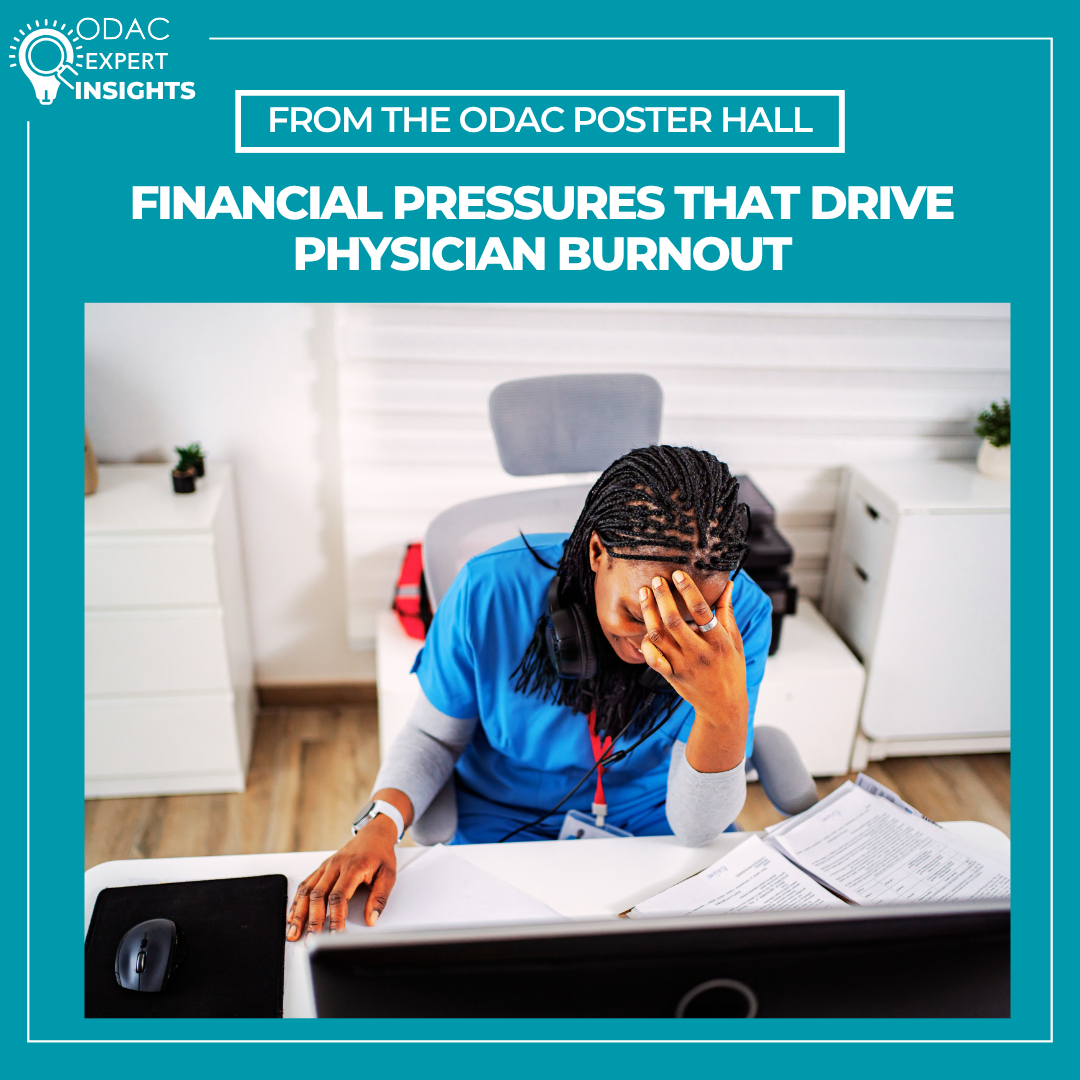
Physician burnout is pervasive in medicine. A Stanford Medicine-led study of U.S. physicians conducted in 2023 and 2024 found nearly half experienced at least one symptom of burnout. While the broader conversation may raise burnout as a concerning issue, the lived experience of physicians tells a different story. Despite the fact burnout is so prevalent, the demands on physicians remain unchanged: Provide care to as many patients as possible to bring in as much revenue as possible. Financial pressures are often the drivers of physician burnout.
A poster presented at ODAC titled Financial Pressures That Drive Physician Burnout and Their Impact on System Performance examined how current healthcare compensation models as well as administrative structures drive physician burnout and, as a result, undermine the very healthcare systems they are designed to protect. I interviewed poster author Yash Jani, BS, of the Medical College of Georgia.
What motivated you to study the role financial pressures play in physician burnout?
My interest in this topic is both academic and deeply personal. I grew up watching my father practice hematology-oncology in a demanding, emotionally intense environment. Despite the complexity and volume of his work, what has always stood out to me was how intentionally he preserves the human side of medicine. He continues to know his patients well, follow them through difficult seasons of life, and maintain meaningful longitudinal relationships even during very busy clinic days.
Equally important, he was disciplined about maintaining his own clarity and balance. He understood that sustained performance in medicine requires intentional renewal, whether through exercise, quiet time, or simply being fully present at home. That example shaped my early understanding that medicine is not just about clinical skill, but about sustaining the cognitive and emotional capacity to care well over decades.
As I started medical school, I began thinking more about what allows that kind of balance to last over time. It’s easy to talk about resilience, but I became more curious about the environment physicians are working in every day. How much of burnout is about personal coping, and how much of it is about the way clinics are structured, how productivity is measured, or how much administrative work fills the margins of the day?
That curiosity is what led to this project. I wanted to better understand how financial models and documentation systems shape what clinical practice feels most like, to ask how we can design systems that protect the parts of practice that matter most: patient connection, thoughtful decision-making, and professional fulfillment.
As I am interested in the field of dermatology, that question feels especially relevant. Dermatology is a field built on longitudinal relationships, precision, and innovation. If we want those strengths to endure, we must think seriously about how the broader healthcare structure either supports or strains them.
You conducted a narrative review and conceptual analysis of peer-reviewed literature and policy reports. What did you learn about the relationship between payment models and burnout?
One of the most consistent themes in the literature is that incentives quietly shape behavior. Payment models influence how clinics are structured, how time is allocated, and how success is measured. That doesn’t mean productivity-based models are inherently problematic; efficiency and sustainability matter in any healthcare system. But when compensation is heavily weighted toward volume, it can gradually shift the rhythm of clinical work.
Across specialties, including outpatient fields, the data suggest that physicians working in highly volume driven environments report higher levels of emotional exhaustion. The issue isn’t that productivity is wrong, it’s that when financial incentives feel disconnected from the parts of medicine physicians find meaningful, such as thoughtful counseling, complex decision-making, and longitudinal relationships, tension builds.
Dermatology is an interesting case in this discussion. It’s a specialty that blends procedural expertise with cognitive care and long-term disease management. When incentives align well, dermatology thrives, and many practices have done this exceptionally well. But like all fields operating within modern healthcare systems, it still exists within broader reimbursement structures. The literature suggests that alignment between incentives and professional values is what ultimately protects against burnout. When physicians feel they have autonomy and that metrics reflect quality rather than just throughput, outcomes, both personal and systemic, are better.
Relatedly, EHR demands and other administrative burdens place additional strains on physicians. What did your study find?
Administrative burden was one of the most reproducible contributors to burnout in the research. Time-motion studies show that physicians frequently spend a significant portion of their day on documentation, inbox management, coding justification, and regulatory tasks, sometimes rivaling the time spent in direct patient care.
In dermatology, this can look like prior authorizations for biologics, documentation requirements for E/M coding, image storage workflows, and patient portal communication. None of these tasks are unnecessary; many are essential for patient access and continuity. The challenge is cumulative load. When documentation becomes layered primarily around compliance and billing verification, it can fragment attention.
What stood out to me is that this isn’t about frustration with technology itself. It’s about cognitive friction. Physicians are trained to think deeply and synthesize information. When the workflow is repeatedly interrupted by clerical tasks, it pulls attention away from clinical reasoning. Over time, that cognitive strain contributes to exhaustion.
Importantly, this is not unique to dermatology. It is pervasive across outpatient medicine. But because dermatology often operates in high-volume clinic settings, workflow efficiency and documentation design become especially important in protecting physician bandwidth.
What are the tangible effects of these financial and administrative pressures on physicians? How are these effects compromising care?
The measurable outcomes are clear in the literature: higher burnout correlates with increased turnover, reduced clinical effort, lower professional satisfaction, and higher self-reported medical error.
But beyond statistics, there’s a more subtle impact. Sustained time pressure and administrative load reduce cognitive space. In dermatology, that can influence how much time is available to educate patients about chronic inflammatory disease, discuss systemic therapy risks and benefits in depth, or address psychosocial aspects of visible skin conditions.
Dermatology remains a deeply patient-centered field. The concern isn’t that care quality suddenly declines. It’s that chronic structural strain can slowly erode the margin for nuance, the extra five minutes of reassurance, the additional counseling that strengthens adherence, and the moment of diagnostic reflection that improves accuracy.
These pressures are systemic and widespread. Recognizing that allows the specialty to think proactively about protecting what it already does exceptionally well.
What’s the potential impact to the healthcare system if these pressures continue?
If these structural dynamics persist without thoughtful adjustment, we risk normalizing chronic professional fatigue. Burnout contributes to earlier retirement, reduced clinical hours, and difficulty sustaining long careers. Workforce projections already suggest significant physician shortages in the coming decade, and burnout accelerates that trajectory.
There’s also a systems-level paradox. Models designed to maximize efficiency can create hidden inefficiencies if they contribute to turnover, recruitment costs, lost mentorship, and fragmented continuity. Healthcare sustainability isn’t just about financial margins; it’s about maintaining a workforce that can perform at a high level over decades.
This is not a dermatology-specific issue. It’s a healthcare-wide challenge. But dermatology, as a specialty known for innovation and adaptability, is well positioned to model balanced systems that preserve both efficiency and professional fulfillment.
You write that, “physician burnout functions as a marker of system design failure rather than a deficit of individual resilience.” How is that an important message for physicians to hear?
Medicine attracts disciplined, high-achieving individuals. When they feel overwhelmed or disengaged, the instinct is often to internalize it, to assume they need to work harder, be more efficient, or manage stress better, which I personally can attest to as someone pursuing a career in this field.
The research suggests that structural factors, workload intensity, loss of autonomy, and administrative burden, are powerful drivers of burnout. Recognizing that broadens the conversation. It reduces unnecessary self-blame and reframes burnout as something that can be addressed through workflow design, compensation alignment, and thoughtful leadership.
That perspective doesn’t remove personal responsibility. It simply acknowledges that resilience alone cannot compensate for chronic structural strain. For dermatologists and advanced practice providers, this framing allows for proactive conversations about practice design without implying that the specialty itself is flawed. It shifts the mindset from endurance to optimization.
What changes need to be made as the result of your findings?
The solutions are incremental and structural rather than dramatic. Compensation models that balance productivity with quality and autonomy appear protective. Streamlined documentation requirements developed with clinician input reduce friction. Team-based care and clerical support preserve cognitive bandwidth. Continued innovation in EHR usability and AI-assisted documentation may meaningfully reduce after-hours workload.
For dermatology specifically, more specialty-focused research would be valuable. The field operates within a unique outpatient model that integrates procedures, chronic disease management, and cosmetic care. Understanding how reimbursement and administrative structures uniquely affect that blend will allow for targeted improvements rather than broad assumptions.
Ultimately, the goal isn’t to eliminate pressure from medicine; pressure is inherent to caring for patients. The goal is alignment. When systems support the relational and intellectual core of clinical work, physicians are more likely to sustain the kind of practice many of us envision when we enter the field.
Additional authors of the poster include:
Ameena Ali, BS, Mercer School of Medicine
Connie Koutsos, Touro College of Osteopathic Medicine
Aileen Poron, BS, Baylor University
Victoria Salathe, BS, University of Missouri-Columbia
Shing Ou, BS, Kansas City University College of Osteopathic Medicine
Anuj Shah, BS, Philadelphia College of Osteopathic Medicine
Kelly Frasier, DO, MS, Northwell
Did you enjoy this scientific poster interview? You can find more here.