












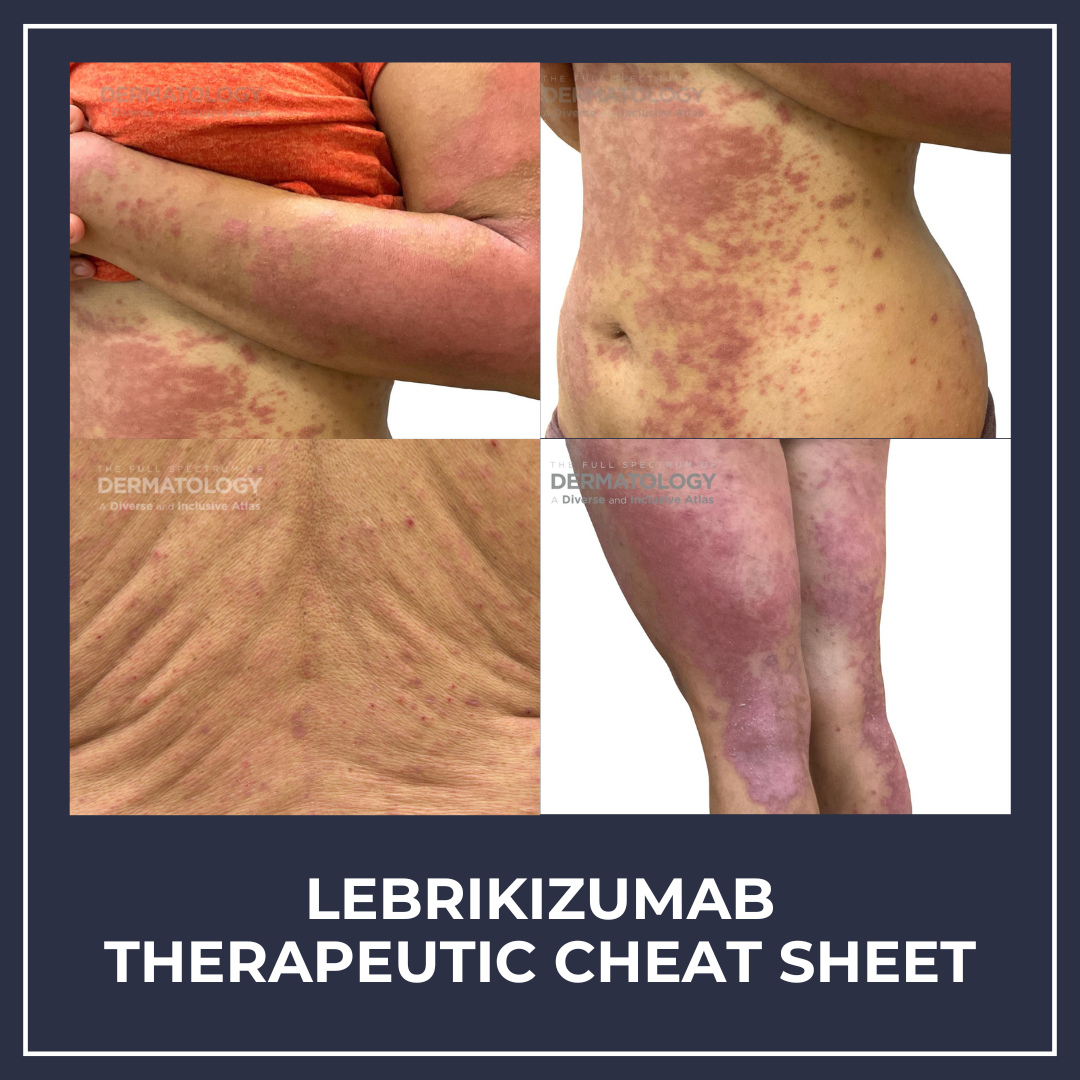
Lebrikizumab is a humanized immunoglobulin G4 (IgG4) monoclonal antibody that selectively targets IL-13, a key cytokine implicated in the pathogenesis of type 2 inflammatory diseases.1 Lebrikizumab binds IL-13 with high affinity and a slow dissociation rate, which prevents heterodimerization of the IL-13 receptor alpha-1 subunit (IL-13Rα1) with the IL-4 receptor alpha (IL-4Rα) signaling complex.1 Through this mechanism, lebrikizumab blocks downstream IL-13 signaling implicated in the pathogenesis of atopic dermatitis (AD) and other type-2 mediated inflammatory diseases.1 We continue our Therapeutic Cheat Sheet Series with a closer look at lebrikizumab and its dermatologic applications.
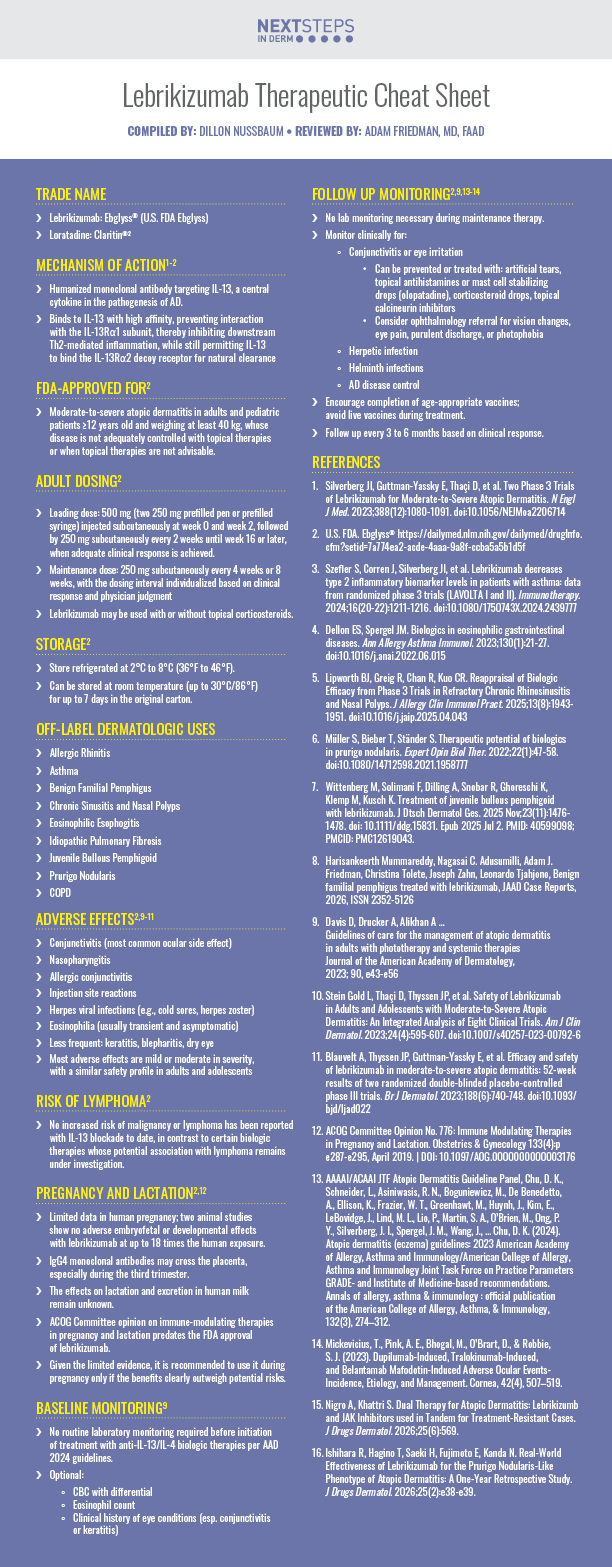
Lebrikizumab Therapeutic Cheat Sheet
Compiled by Dillon Nussbaum, MD | Reviewed by: Adam Friedman, MD, FAAD
TRADE NAME
-
- Lebrikizumab: Ebglyss® (U.S. FDA Ebglyss)
MECHANISM OF ACTION 1,2
-
- Humanized monoclonal antibody targeting IL-13, a central cytokine in the pathogenesis of AD.
- Binds to IL-13 with high affinity, preventing interaction with the IL-13Rα1 subunit, thereby inhibiting downstream Th2-mediated inflammation, while still permitting IL-13 to bind the IL-13Rα2 decoy receptor for natural clearance.
FDA APPROVED FOR 2
-
- Moderate-to-severe atopic dermatitis in adults and pediatric patients ≥12 years old and weighing at least 40 kg, whose disease is not adequately controlled with topical therapies or when topical therapies are not advisable.
ADULT DOSING 2
-
- Loading dose: 500 mg (two 250 mg prefilled pen or prefilled syringe) injected subcutaneously at week 0 and week 2, followed by 250 mg subcutaneously every 2 weeks until week 16 or later, when adequate clinical response is achieved.
- Maintenance dose: 250 mg subcutaneously every 4 weeks or 8 weeks, with the dosing interval individualized based on clinical response and physician judgment
- Lebrikizumab may be used with or without topical corticosteroids.
STORAGE 2
-
- Store refrigerated at 2°C to 8°C (36°F to 46°F).
- Can be stored at room temperature (up to 30°C/86°F) for up to 7 days in the original carton.
OFF-LABEL USES 3-8
-
- Allergic Rhinitis
- Asthma
- Benign Familial Pemphigus
- Chronic Sinusitis and Nasal Polyps
- Eosinophilic Esophogitis
- Idiopathic Pulmonary Fibrosis
- Juvenile Bullous Pemphigoid
- Prurigo Nodularis
- COPD
ADVERSE EFFECTS 2,9-11
-
- Conjunctivitis (most common ocular side effect)
- Nasopharyngitis
- Allergic conjunctivitis
- Injection site reactions
- Herpes viral infections (e.g., cold sores, herpes zoster)
- Eosinophilia (usually transient and asymptomatic)
- Less frequent: keratitis, blepharitis, dry eye
- Most adverse effects are mild or moderate in severity, with a similar safety profile in adults and adolescents
RISK OF LYMPHOMA2
-
- No increased risk of malignancy or lymphoma has been reported with IL-13 blockade to date, in contrast to certain biologic therapies whose potential association with lymphoma remains under investigation.
PREGNANCY AND LACTATION 2,12
-
- Limited data in human pregnancy; two animal studies show no adverse embryofetal or developmental effects with lebrikizumab at up to 18 times the human exposure.
- IgG4 monoclonal antibodies may cross the placenta, especially during the third trimester.
- The effects on lactation and excretion in human milk remain unknown.
- ACOG Committee opinion on immune-modulating therapies in pregnancy and lactation predates the FDA approval of lebrikizumab.
- Given the limited evidence, it is recommended to use it during pregnancy only if the benefits clearly outweigh potential risks.
BASELINE MONITORING 9
-
- No routine laboratory monitoring required before initiation of treatment with anti-IL-13/IL-4 biologic therapies per AAD 2024 guidelines.
- Optional:
- CBC with differential
- Eosinophil count
- Clinical history of eye conditions (esp. conjunctivitis or keratitis)
FOLLOW UP MONITORING 2,9,13-14
-
- No lab monitoring necessary during maintenance therapy.
- Monitor clinically for:
- Conjunctivitis or eye irritation
- Can be prevented or treated with: artificial tears, topical antihistamines or mast cell stabilizing drops (olopatadine), corticosteroid drops, topical calcineurin inhibitors
- Consider ophthalmology referral for vision changes, eye pain, purulent discharge, or photophobia
- Herpetic infection
- Helminth infections
- AD disease control
- Conjunctivitis or eye irritation
- Encourage completion of age-appropriate vaccines; avoid live vaccines during treatment.
- Follow up every 3 to 6 months based on clinical response.
FURTHER READING
If you would like to learn more about lebrikizumab in dermatology, check out the following articles in the Journal of Drugs in Dermatology:
Nigro, S. Khattri MD
Summary:
Combining lebrikizumab with an oral JAK inhibitor may offer an effective treatment option for select patients with refractory moderate-to-severe atopic dermatitis. In this retrospective cohort of nine patients treated at a single academic center, 67% demonstrated clinical improvement following initiation of dual therapy, while adverse events were generally mild and consistent with the established safety profiles of each agent, with no severe safety signals observed. Most treatment discontinuations were related to insurance coverage rather than lack of efficacy. Although limited by its small sample size and retrospective design, the study provides early evidence that combining lebrikizumab with a JAK inhibitor may represent a promising therapeutic strategy for select patients with refractory atopic dermatitis who have not achieved adequate disease control with monotherapy. Larger prospective studies are needed to further define the efficacy, safety, and optimal role of this combination approach.
J Drugs Dermatol . 2026 Jun 6;25(2):569.
R. Ishihara, MD, T. Hagino MD PhD, H. Saeki MD PhD, E. Fujimoto MD PhD, N. Kanda MD PhD
A 48-week retrospective study evaluated the effectiveness and safety of lebrikizumab in patients with the prurigo nodularis (PN)-like phenotype of atopic dermatitis. In this analysis of 26 patients, lebrikizumab was associated with rapid and sustained improvements in disease severity, pruritus, sleep quality, and quality of life, with clinical benefits observed as early as 12 weeks and maintained through one year. By week 48, half of patients achieved an Investigator Global Assessment (IGA) score of 0/1, while substantial improvements in itch, sleep disturbance, and dermatology-specific quality of life were also reported. Treatment was generally well tolerated, with only mild-to-moderate conjunctivitis observed and no serious adverse events or treatment discontinuations due to adverse effects. Although larger prospective studies are needed, these findings provide encouraging real-world evidence supporting lebrikizumab as an effective treatment option for patients with the PN-like phenotype of atopic dermatitis.
J Drugs Dermatol . 2026 Feb 1;25(2):e38-e39.
References
-
- Silverberg JI, Guttman-Yassky E, Thaçi D, et al. Two Phase 3 Trials of Lebrikizumab for Moderate-to-Severe Atopic Dermatitis. N Engl J Med. 2023;388(12):1080-1091. doi:10.1056/NEJMoa2206714
- U.S. FDA. Ebglyss® https://dailymed.nlm.nih.gov/dailymed/drugInfo.cfm?setid=7a774ea2-acde-4aaa-9a8f-ccba5a5b1d5f
- Szefler S, Corren J, Silverberg JI, et al. Lebrikizumab decreases type 2 inflammatory biomarker levels in patients with asthma: data from randomized phase 3 trials (LAVOLTA I and II). Immunotherapy. 2024;16(20-22):1211-1216. doi:10.1080/1750743X.2024.2439777
- Dellon ES, Spergel JM. Biologics in eosinophilic gastrointestinal diseases. Ann Allergy Asthma Immunol. 2023;130(1):21-27. doi:10.1016/j.anai.2022.06.015
- Lipworth BJ, Greig R, Chan R, Kuo CR. Reappraisal of Biologic Efficacy from Phase 3 Trials in Refractory Chronic Rhinosinusitis and Nasal Polyps. J Allergy Clin Immunol Pract. 2025;13(8):1943-1951. doi:10.1016/j.jaip.2025.04.043
- Müller S, Bieber T, Ständer S. Therapeutic potential of biologics in prurigo nodularis. Expert Opin Biol Ther. 2022;22(1):47-58. doi:10.1080/14712598.2021.1958777
- Wittenberg M, Solimani F, Dilling A, Snobar R, Ghoreschi K, Klemp M, Kusch K. Treatment of juvenile bullous pemphigoid with lebrikizumab. J Dtsch Dermatol Ges. 2025 Nov;23(11):1476-1478. doi: 10.1111/ddg.15831. Epub 2025 Jul 2. PMID: 40599098; PMCID: PMC12619043.
- Harisankeerth Mummareddy, Nagasai C. Adusumilli, Adam J. Friedman, Christina Tolete, Joseph Zahn, Leonardo Tjahjono, Benign familial pemphigus treated with lebrikizumab, JAAD Case Reports, 2026, ISSN 2352-5126
- Davis D, Drucker A, Alikhan A …
Guidelines of care for the management of atopic dermatitis in adults with phototherapy and systemic therapies
Journal of the American Academy of Dermatology, 2023; 90, e43-e56 - Stein Gold L, Thaçi D, Thyssen JP, et al. Safety of Lebrikizumab in Adults and Adolescents with Moderate-to-Severe Atopic Dermatitis: An Integrated Analysis of Eight Clinical Trials. Am J Clin Dermatol. 2023;24(4):595-607. doi:10.1007/s40257-023-00792-6
- Blauvelt A, Thyssen JP, Guttman-Yassky E, et al. Efficacy and safety of lebrikizumab in moderate-to-severe atopic dermatitis: 52-week results of two randomized double-blinded placebo-controlled phase III trials. Br J Dermatol. 2023;188(6):740-748. doi:10.1093/bjd/ljad022
- ACOG Committee Opinion No. 776: Immune Modulating Therapies in Pregnancy and Lactation. Obstetrics & Gynecology 133(4):p e287-e295, April 2019. | DOI: 10.1097/AOG.0000000000003176
- AAAAI/ACAAI JTF Atopic Dermatitis Guideline Panel, Chu, D. K., Schneider, L., Asiniwasis, R. N., Boguniewicz, M., De Benedetto, A., Ellison, K., Frazier, W. T., Greenhawt, M., Huynh, J., Kim, E., LeBovidge, J., Lind, M. L., Lio, P., Martin, S. A., O’Brien, M., Ong, P. Y., Silverberg, J. I., Spergel, J. M., Wang, J., … Chu, D. K. (2024). Atopic dermatitis (eczema) guidelines: 2023 American Academy of Allergy, Asthma and Immunology/American College of Allergy, Asthma and Immunology Joint Task Force on Practice Parameters GRADE- and Institute of Medicine-based recommendations. Annals of allergy, asthma & immunology : official publication of the American College of Allergy, Asthma, & Immunology, 132(3), 274–312.
- Mickevicius, T., Pink, A. E., Bhogal, M., O’Brart, D., & Robbie, S. J. (2023). Dupilumab-Induced, Tralokinumab-Induced, and Belantamab Mafodotin-Induced Adverse Ocular Events-Incidence, Etiology, and Management. Cornea, 42(4), 507–519.
- Nigro A, Khattri S. Dual Therapy for Atopic Dermatitis: Lebrikizumb and JAK Inhibitors used in Tandem for Treatment-Resistant Cases. J Drugs Dermatol. 2026;25(6):569.
- Ishihara R, Hagino T, Saeki H, Fujimoto E, Kanda N. Real-World Effectiveness of Lebrikizumab for the Prurigo Nodularis-Like Phenotype of Atopic Dermatitis: A One-Year Retrospective Study. J Drugs Dermatol. 2026;25(2):e38-e39.
Did you enjoy this Therapeutic Cheat Sheet? You can find more here.