












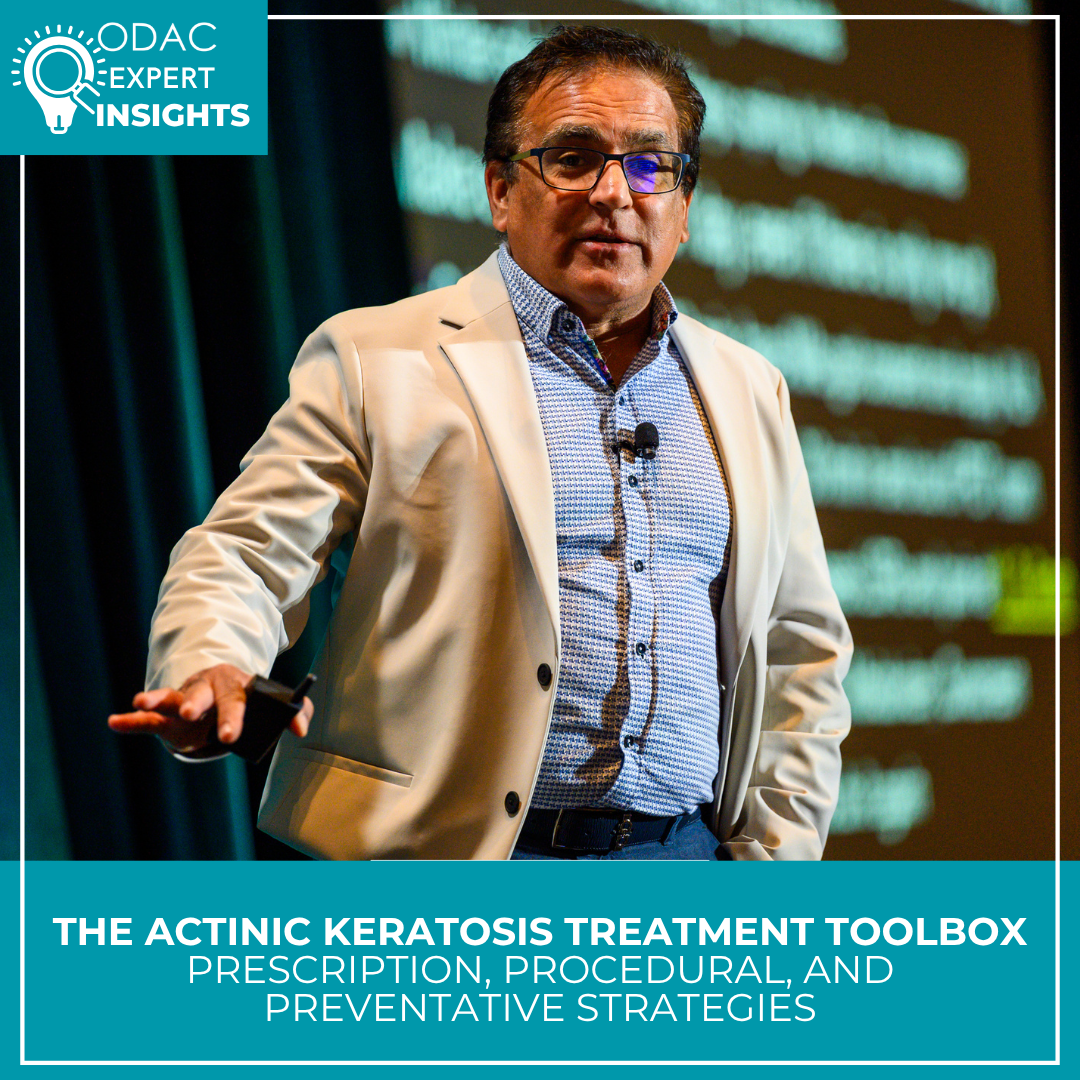
Following up on insights shared at the ODAC Dermatology Conference, Dr. Neal Bhatia, MD, FAAD, Director of Clinical Dermatology at Therapeutics Clinical Research, offered a comprehensive overview of actinic keratosis (AK) management. Dr. Bhatia emphasized actionable approaches to balancing prescription topicals and procedural techniques in everyday practice.
The incidence for non-melanoma skin cancer (NMSC) is rising, and although melanoma is commonly thought of as the particularly dangerous malignancy, mortality from NMSC may even exceed the statistics from melanoma and is likely underestimated.1 Dr. Bhatia compared the pre-malignant nature of AKs to air travel: pre-cancer is part of the cancer process, just as pre-boarding is part of the boarding process! Consequently, he emphasized a multifaceted blueprint to hit AKs hard. Instead of monotherapy with a single treatment modality, he recommended sequentially using cryotherapy and photodynamic therapy (PDT)2 repeatedly over the course of a year. Timing is everything when trying to get patients on board for coming in multiple times to the office. Counseling about timing should include avoiding vacations, social events, and photo ops. The time change due to Daylight Saving can serve as reminders built into the calendar for scheduling PDT. Dr. Bhatia encouraged careful attention to detail with verbiage during counseling. Pitching the redness, discomfort, and desquamation of PDT as expected localized skin reactions rather than side effects can make the difference in the shared decision-making process with patients. He advised against short-changing the post-procedure process for both cryotherapy and PDT, highlighting topical anesthetics to reduce lingering pain, topicals with hyaluronic acid, prebiotic complex, and zinc, and sunscreens with photolyases for optimizing wound healing.
When considering prescription topicals for field therapy, Dr. Bhatia reviewed the mechanistic rationale for combining 5-fluorouracil (5-FU) with calcipotriene. Induction of thymic stromal lymphopoietin increases recruitment of anti-tumor T cells,3 likely contributing to lower rates of squamous cell carcinoma (SCC) within 3 years of treatment when compared to treatment with topical 5-FU alone.4 Because the inflammatory pathways induced by topical tirbanibulin lead to keratinocyte apoptosis, expected localized skin reactions tend to be more tolerable, with minimal swelling, vesiculation, and pustulation. Dr. Bhatia noted that reevaluation after tirbanibulin should be after 2 months rather than the 1-month follow-up after topical 5-FU formulations.
In conclusion, actinic keratoses should be treated aggressively, particularly in the context of a “field” of actinic damage with multiple suspicious lesions. Dr. Bhatia argued for a combination approach of procedures, topicals, and PDT, rinsing and repeating cycles over the course of a year.
References
-
- Salah S et al. A comprehensive analysis of global skin cancer incidence and mortality with a focus on dermatologist density and population risk factors. Presented at the EADV Congress 2023; 11 October 2023.
- Piacquadio D, Houlihan A, Ferdon MB, Berg JE, Marcus SL. A Randomized Trial of Broad Area ALA-PDT for Field Cancerization Mitigation in High-Risk Patients. J Drugs Dermatol. 2020;19(5):452-458.
- Cunningham TJ, Tabacchi M, Eliane JP, et al. Randomized trial of calcipotriol combined with 5-fluorouracil for skin cancer precursor immunotherapy. J Clin Invest. 2017 Jan 3;127(1):106-116.
- Rosenberg AR, Tabacchi M, Ngo KH, et al. Skin cancer precursor immunotherapy for squamous cell carcinoma prevention. JCI Insight. 2019 Mar 21;4(6):e125476.
This information was presented by Neal Bhatia, MD at the 2026 ODAC Dermatology Conference. The above highlights from his lecture were written and compiled by Nagasai Adusumilli, MD, MBA.