












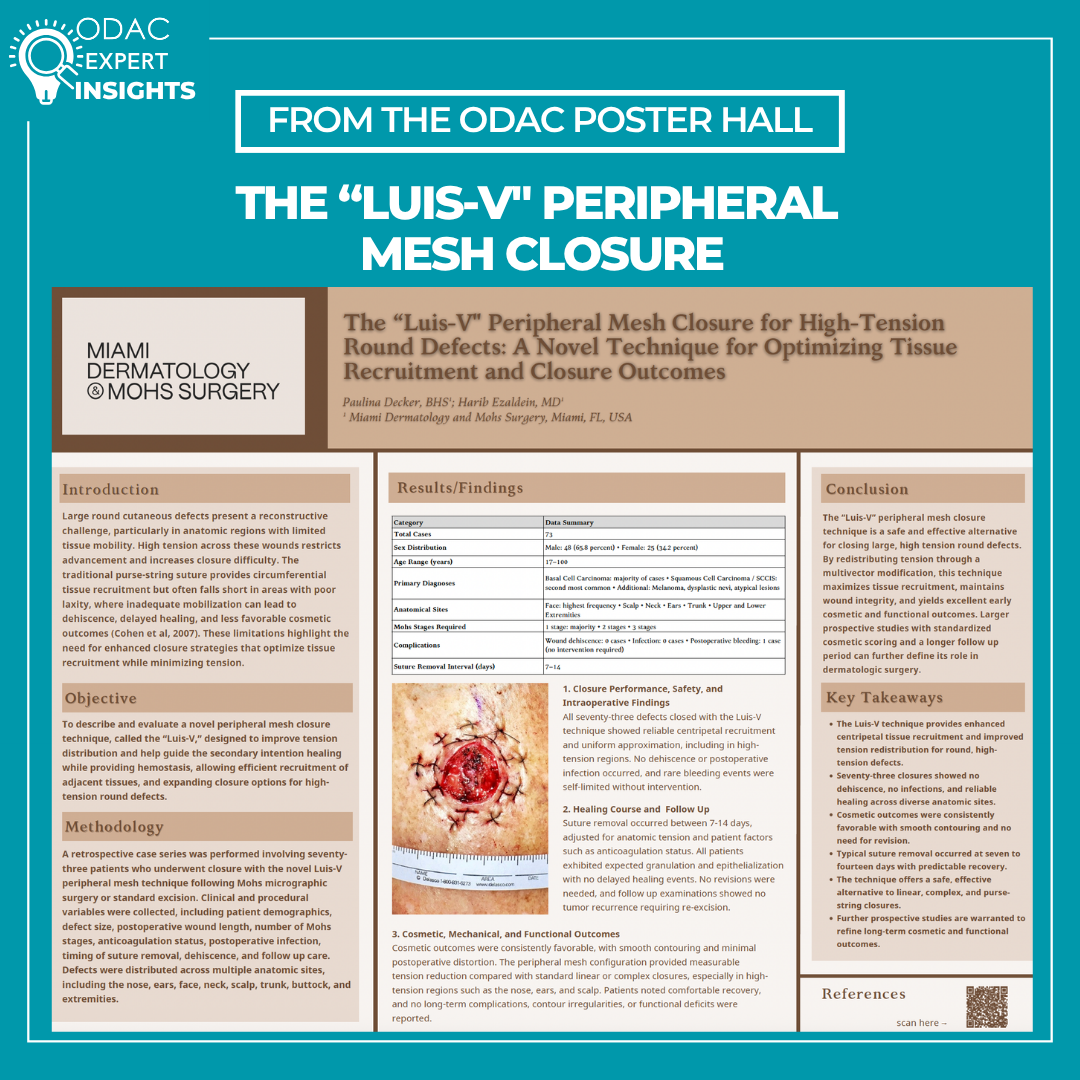
Healing by secondary intention is a common technique in dermatologic surgery, especially in patients with large, round wounds. Yet the technique has its drawbacks, including increased bleeding risk early on in the healing process as well as a risk of poor cosmetic outcomes. A novel technique – the “Luis V” peripheral mesh closure – serves an alternative, improving healing and resulting in a functional surgical site with minimal cosmetic impact.
A poster presented at ODAC titled The “Luis-V” Peripheral Mesh Closure for High-Tension Round Defects: A Novel Technique for Optimizing Tissue Recruitment and Closure Outcomes outlines this novel technique and the results of a retrospective case study. I interviewed the poster’s authors, Paulina Decker, BHS, clinical and research fellow, and Harib H. Ezaldein, MD, FAAD, FACMS. Both are with Miami Dermatology and Mohs Surgery.
What is the “Luis-V” peripheral mesh closure technique, and how was it developed?
The “Luis-V” peripheral mesh closure is a tension-modulating, hemostatic suture technique designed to close large, round cutaneous defects by redistributing tension circumferentially instead of along a single linear axis. This closure was inspired by the delicate surgical net technique by the vintage Brazilian plastic surgeon Dr. Andre Auersvald. Evenly spaced dermal bites are placed around the periphery of the defect in a mesh-like pattern that allows hemostatic tension at the peripheral aspects of the wound. This also creates a centripetal force on the undermined edges to help reduce the size of the wound. The rationale for design was that the cross-hatched design helps restrict skin edge vessels from bleeding during the first few nights postoperatively. Blood vessels that travel perpendicularly and parallel to the circular wound edge are both restricted and thus, we reasoned that this may also elevate hypoxia-induced factor-1 protein expression early on in the wound healing phase, to help with angiogenesis and overall better wound healing. Through repeated intraoperative use and refinement, this approach emerged as a reliable way to stabilize large defects while preserving surrounding anatomy and improving early wound control. Also, who wouldn’t like a designer stitching pattern around an ugly wound, especially here in Miami?
What led you to want to investigate this novel technique?
The motivation to formally study this technique came from consistent clinical observations in cases where large, round defects would typically be left to heal by secondary intention. While granulation can be appropriate, these wounds often bleed excessively in the early postoperative period, particularly in larger defects with exposed subcutaneous tissue or in patients with vascular fragility or anticoagulation. After repeatedly seeing that the peripheral mesh closure allowed partial or near-complete closure of these wounds with improved hemostasis and wound stability, it became clear that this was more than an anecdotal solution. It also became increasingly popular among experienced surgical patients due to its lower rate of overnight bleeding compared to granulating wounds alone. A structured investigation was needed to assess its safety, reproducibility, and potential role in reducing reliance on secondary intention healing.
What’s the need for a new way to close large, round cutaneous defects?
Large, round defects pose a unique challenge because they lack a natural axis for linear closure and tend to concentrate tension unevenly when traditional techniques are applied. As a result, surgeons often default to secondary intention healing, which can lead to prolonged bleeding, frequent dressing changes, delayed epithelialization, and unpredictable cosmetic outcomes. Flaps, while effective, may increase operative complexity and scar burden. There is a clear need for a closure strategy that reduces wound surface area early, improves hemostasis, and stabilizes the defect without excessive tension or anatomic distortion. The “Luis-V” technique addresses this gap by offering a middle ground between full flap reconstruction and leaving wounds entirely to granulate.
You conducted a retrospective case series. What did you discover?
In our retrospective case series, the “Luis-V” peripheral mesh closure consistently allowed large, round defects to be closed primarily or partially in situations where secondary intention healing would have otherwise been chosen. The technique was associated with low rates of postoperative bleeding, wound dehiscence, and infection, and it reduced prolonged oozing that is commonly seen in large granulating wounds. Adjacent anatomic structures were preserved without significant distortion, and healing progressed reliably without the need for secondary interventions. Importantly, the technique proved adaptable across multiple anatomic sites and defect sizes, reinforcing its practical utility in everyday dermatologic surgery.
What should dermatologic surgeons take away from the results of your study?
Dermatologic surgeons performing cutaneous surgery should consider the “Luis-V” peripheral mesh closure as a valuable option when managing large, round defects that would traditionally be left to heal by secondary intention. Beyond improving cosmetic and functional outcomes, the technique offers a meaningful hemostatic advantage by reducing exposed wound surface area and stabilizing tissue early in the healing process. The key takeaway is that circumferential tension redistribution can expand closure options, decrease postoperative bleeding risk, and improve patient experience without adding significant technical complexity. This approach complements existing reconstructive strategies and can be readily incorporated into routine surgical practice.
Did you enjoy this scientific poster interview? You can find more here.