












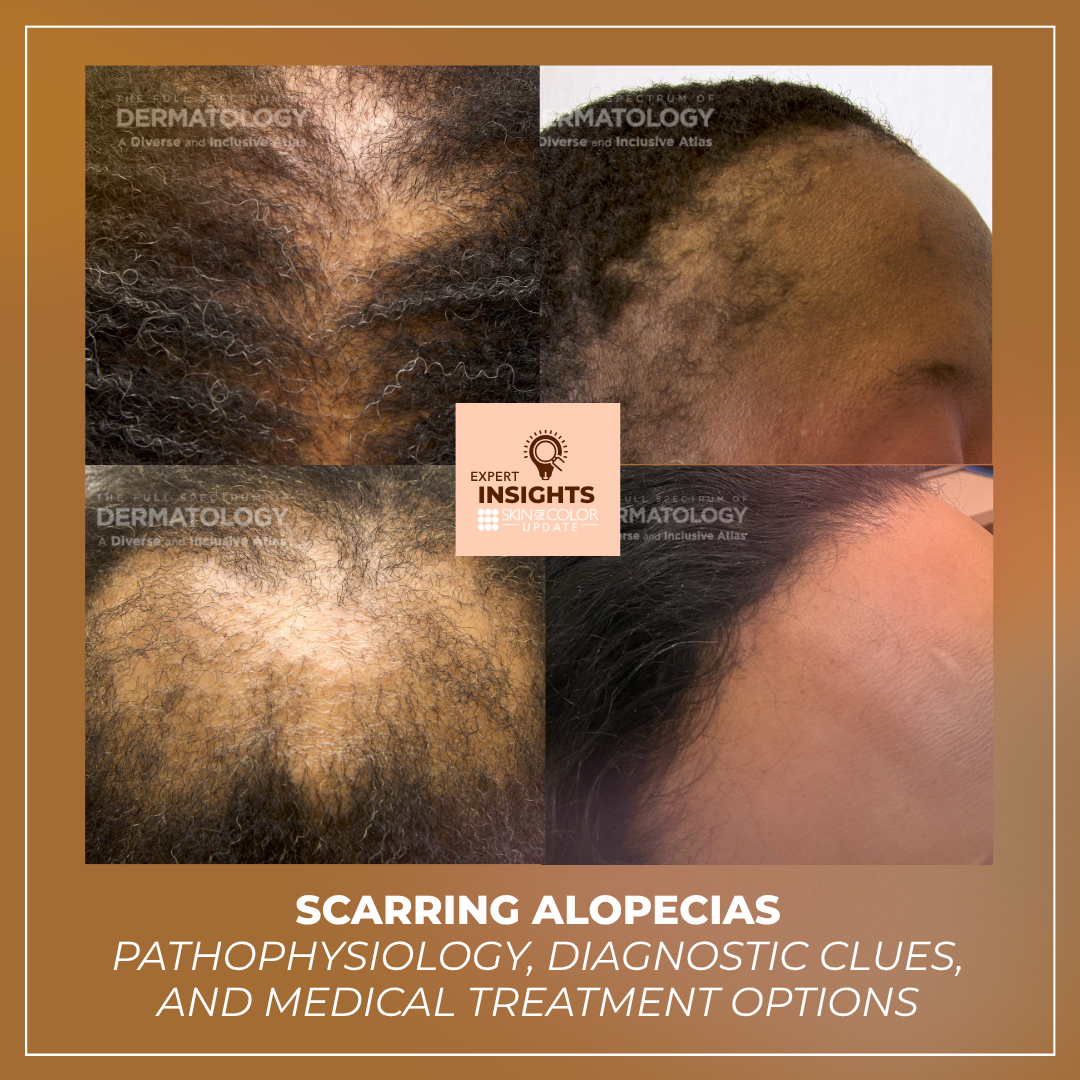
Scarring alopecias in skin of color are increasingly recognized and remain a major cause of irreversible hair loss. During the 2025 Skin of Color Update in New York City, Susan C. Taylor, MD, presented an updated clinical approach to identifying and managing lichen planopilaris (LPP), frontal fibrosing alopecia (FFA), and central centrifugal cicatricial alopecia (CCCA) with a focus on early detection, correct diagnosis, and meaningful disease stabilization.
Follicular destruction leads to permanent hair loss, therefore early recognition of inflammatory activity is the primary determinant of treatment success.
Pathophysiology: Inflammation and Fibrosis
Despite different phenotypes, cicatricial alopecias converge through:
-
- Lymphocyte-driven inflammation targeting the upper follicle
- Loss of bulge stem cells leading to failure of regeneration
- Fibrosis replacing destroyed follicles, resulting in permanent scarring
- Activation of the JAK-STAT pathway across multiple entities
- Metabolic dysregulation, supporting anti-fibrotic therapeutic targets
These insights justify treatment approaches focused on early immunomodulation and fibrosis prevention.
Diagnostic Clues in Skin of Color
Dr. Taylor provided several key points to evaluate hair loss:
-
- Examine eyebrows as these are frequently affected in FFA
- Assess sideburns and beard in men
- Evaluate arms and legs for follicular keratotic papules (LPP spectrum)
- Ask about itch, pain, burning, and trichodynia, which are symptoms of active inflammation
- Use serial photos to detect subtle progression
The “Lonely Hair Sign”
Clinically this presents as a few preserved terminal hairs within a smooth, shiny band of recession. This was first described in FFA, but Dr. Taylor reviews that although many cases may present with this, it is not pathognomonic for FFA and may appear in other scarring alopecias. The presence of the lonely hair sign should prompt evaluation for active scarring alopecic processes.
Lichen Planopilaris (LPP)
-
- Patchy scarring alopecia with perifollicular scale/erythema.
- May include loss of body hair and follicular keratotic papules, representing LPP spectrum involvement
- Frontal Fibrosing Alopecia (FFA) and Lassueur-Graham-Little-Piccardi syndrome are variants of LPP
Frontal Fibrosing Alopecia (FFA)
-
- The classic characteristic distribution is a band-like frontotemporal recession along the anterior hairline, which then progressively spreads posteriorly.
- Other patterns include diffuse zig-zag (presents with an irregular, saw-tooth hairline recessing with alternating loss and preservation of follicles), pseudo-fringe sign (presents with apparent preservation of a thin band of hair along the frontal hairline but eventually leads to follicular loss), ophiasis-like (presents with a band-like hair loss along the frontal, temporal and occipital scalp margins), cockade-like (patchy, circular or oval areas representing cockades shape and evolves to include the frontal and temporal hairline), and AGA-like (marked and symmetric recession of frontotemporal hairlines which spares the paramedian frontal hairline)
- It is important to recognize early signs of FFA which may include thinning eyebrows and facial skin changes. Additionally, depression of the frontal vein and absence of forehead wrinkles can be early diagnostic clues.
Trichoscopy for Early Disease Recognition
Trichoscopy may reveal very early disease, even when recession is not obvious.
LPP demonstrates perifollicular hyperkeratosis and perifollicular erythema.
FFA leads to loss of follicular ostia, perifollicular scale, perifollicular hyperpigmentation.
Central centrifugal cicatricial alopecia (CCCA) demonstrates a peripilar white/gray halo, interfollicular, irregularly distributed small white round macules in a “starry sky” pattern, and white patches of follicular scarring that interrupt honey-comb network, as well as absence of follicular ostia with peripilar white halos around follicles.
Three-Phase Therapeutic Framework
Dr. Taylor discussed an approach to treatment that relies on 3 care phases:
| Phase | Description |
| Phase 1: Active Inflammation Control + Immunomodulation | Reduce lymphocytic or neutrophilic inflammation driving follicular destruction |
| Phase 2: Fibrosis Modulation + Symptom Relief (Anti-fibrotic + Supportive) | Limit fibrosis and scarring progression; relieve itch, pain, burning; maintain scalp health |
| Phase 3: Restoration When Stable (Regenerative or Surgical) | Promote residual follicle function and reach disease stability |
Emerging and Adjunctive Therapies
Dr. Taylor discussed multiple emerging therapies including medications that function through the JAK pathway, as well as antifibrotic/repurposed metabolic agents, immunomodulators and procedure and light energy for adjunctive use beyond the JAK pathways.
New options within the JAK pathway include topical delgocitinib, which in a randomized, vehicle-controlled trial in FFA patients, showed 24-week hair shedding stabilization, hair regrowth and reduced Th1/IFN-gamma biomarkers.
Additionally, topical Ruxolitinib 1.5% has had growing case-level evidence for FFA but requires more controlled data. Currently, oral baricitinib (JAK 1/2) is in a phase 4 trial with 4 mg daily for FFA with results pending. Currently being studied is a dual JAK1/TYK2 inhibitor for cicatricial alopecia, which points to TYK2 as a potential near-term target.
Outside of the JAK pathway, low dose oral metformin and topical metformin have been shown in case series to show symptomatic improvement and modulation of pro-fibrotic/inflammatory gene signatures for CCCA. Similarly, oral pioglitazone has demonstrated the same for LPP. Topical cyclosporine for LPP has also been shown in a case series to provide improvement in LPPAI scores, with 3 patients achieving complete recovery by the end of their treatment period.
Lastly, PRP and LED cap trials are currently underway for adjunctive treatment of various types of scarring alopecia.
Take Home Points
Scarring alopecias require a proactive approach, particularly in skin of color. Dr. Taylor emphasized early inflammation control, fibrosis mitigation, and timely intervention to preserve remaining follicles. With advancing research in JAK/STAT and anti-fibrotic pathways, therapeutic options continue to expand and offer hope for improved outcomes.
References
-
- Araoye, E. F., Thomas, J. A. L., & Aguh, C. U. (2020). Hair regrowth in 2 patients with recalcitrant central centrifugal cicatricial alopecia after use of topical metformin. JAAD case reports, 6(2), 106–108. https://doi.org/10.1016/j.jdcr.2019.12.008
- Assouly, P., & Reygagne, P. (2009). Lichen planopilaris: update on diagnosis and treatment. Seminars in cutaneous medicine and surgery, 28(1), 3–10. https://doi.org/10.1016/j.sder.2008.12.006
- Bao, A., Qadri, A., Gadre, A., Will, E., Collins, D., Ahima, R., Bordone, L. A., & Aguh, C. (2024). Low-Dose Metformin and Profibrotic Signature in Central Centrifugal Cicatricial Alopecia. JAMA dermatology, 160(11), 1211–1219. https://doi.org/10.1001/jamadermatol.2024.3062
- Chiang C, Piliang M. Frontal fibrosing alopecia: updated clinical and trichoscopic features. Int J Dermatol. 2023;62(1):58-67.
- ClinicalTrials.gov. Baricitinib in frontal fibrosing alopecia. Identifier: NCT04128176
- Desai, D., Nohria, A., Lo Sicco, K., & Shapiro, J. (2024). The use of topical ruxolitinib 1.5% cream in frontal fibrosing alopecia: A case report. JAAD case reports, 50, 141–143. https://doi.org/10.1016/j.jdcr.2024.04.034
- Dlova NC, Makhanya N. Clinical characteristics and pathogenesis of CCCA: updates in skin of color. J Am Acad Dermatol. 2023;88(2):455-466.
- Harries M, Messenger A. Advances in primary cicatricial alopecias. Br J Dermatol. 2021;185(3):445-458.
- Icahn School of Medicine at Mount Sinai. Dual JAK1/TYK2 Inhibitor for Cicatricial Alopecia. ClinicalTrials.gov Identifier: NCT05076006. Last Update Posted: 2024-07-15.
- Jafarzadeh, A., Salami, N., Bazargan, A. S., Ghassemi, M., Salehi, S., & Goodarzi, A. (2025). Successful treatment of lichen planopilaris with topical cyclosporine: A case series. JAAD case reports, 65, 174–178. https://doi.org/10.1016/j.jdcr.2025.02.011
- Krzesłowska, W. J., & Woźniacka, A. (2024). The Frontal Fibrosing Alopecia Treatment Dilemma. Journal of clinical medicine, 13(7), 2137. https://doi.org/10.3390/jcm13072137
- Lis-Święty, A., & Brzezińska-Wcisło, L. (2020). Frontal fibrosing alopecia: a disease that remains enigmatic. Postepy dermatologii i alergologii, 37(4), 482–489. https://doi.org/10.5114/ada.2020.98241
- Mesinkovska, N. A., Tellez, A., Dawes, D., Piliang, M., & Bergfeld, W. (2015). The use of oral pioglitazone in the treatment of lichen planopilaris. Journal of the American Academy of Dermatology, 72(2), 355–356. https://doi.org/10.1016/j.jaad.2014.10.036
- Rossi A, et al. TYK2 inhibitors in immune-mediated dermatology. Drugs. 2024;84(2):123-138.
- Rudnicka L, et al. Dermoscopic patterns in primary cicatricial alopecias. Clin Dermatol. 2021;39(3):417-426.
- Strazzulla LC, King BA. JAK pathway inhibitors in alopecia management. J Am Acad Dermatol. 2024;90(5):1025-1038.
This information was presented at the 2025 Skin of Color Update conference by Susan Taylor, MD. The above highlights from her lecture were written and compiled by Dr. Courtney Hanna.
Did you enjoy this article? Find more on Skin of Color Dermatology here.