












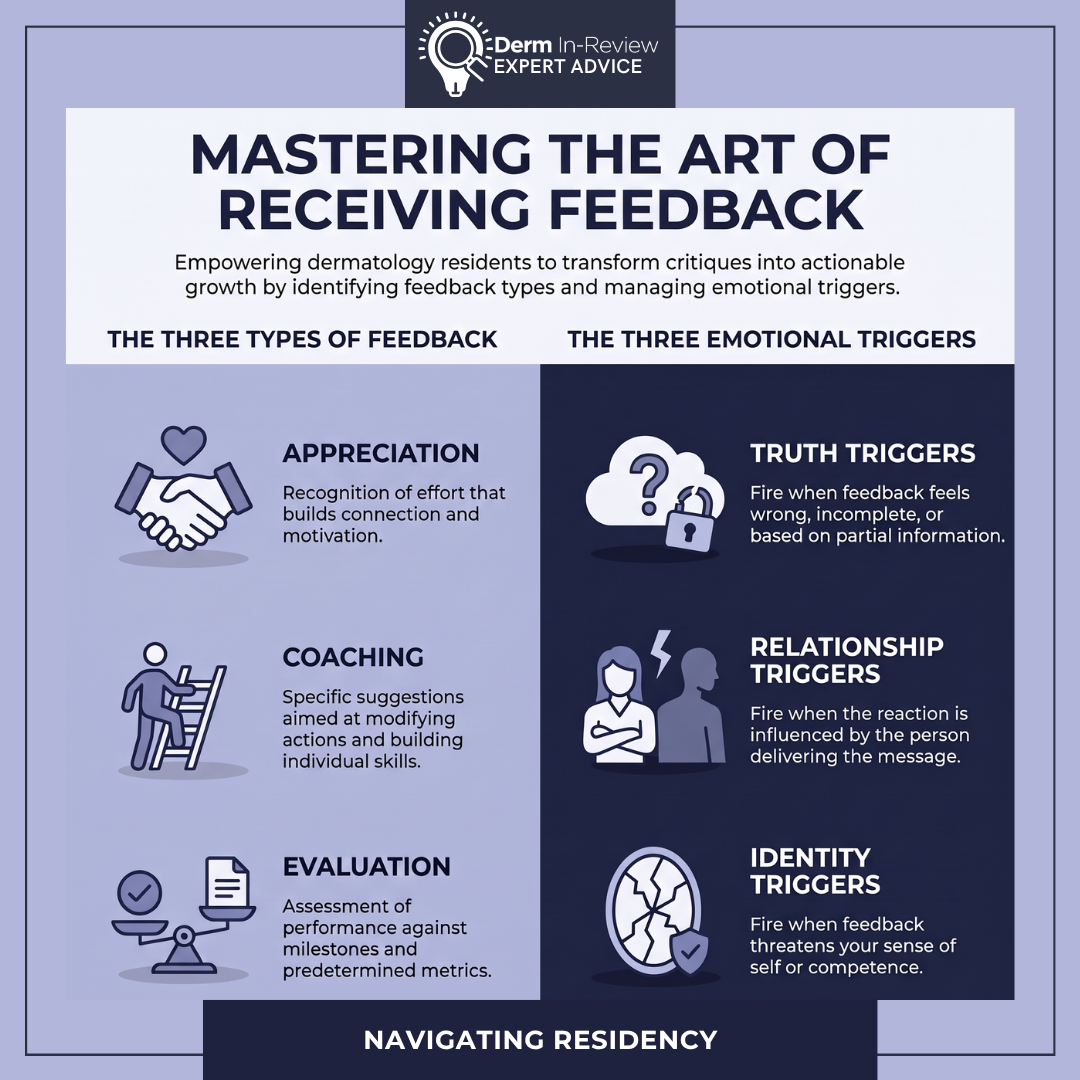
Most residency programs and hospital institutions teach how to provide feedback. Attendings and residents are asked to fill out structured rubrics, track ACGME milestones, and elicit patient surveys. Few programs, however, offer training about how to receive that feedback.
The skill of receiving feedback is carefully outlined in Douglas Stone and Sheila Heen’s book Thanks for the Feedback. They argue that most organizations invest heavily in making people better givers of feedback, but fail to recognize that the receiver actually holds more power over whether that feedback lands and does anything useful.
Receiving feedback is a learnable skill that requires attention and practice. When you can name the type of feedback you are receiving and certain triggers that may cloud your processing of that feedback, you may discover valuable information that can help you better receive and incorporate the feedback. Let’s take a closer look at Stone and Heen’s three types of feedback and the three triggers that people often face when receiving feedback.
Three Types of Feedback
Frustration with feedback often results from miscommunication in the type of feedback being given and the one that you are expecting to receive. Attendings rarely announce which type of feedback they are giving (and they may not even know the type!), and residents rarely ask attendings to clarify. By understanding the different types of feedback, attendings and residents can learn and teach more effectively.
Appreciation is feedback where the residents’ actions are seen and recognized. “Thanks for staying late to squeeze in that urgent consult.” It builds connection and motivation, but does not teach technique.
Coaching is feedback where residents’ actions are open to modification. “Next time, slowly inject the lidocaine into areas that have already been anesthetized to reduce discomfort.” It aims to build individual growth.
Evaluation is feedback on where the resident stands in relation to others. “Your surgical skills are at a PGY-2 level.” It marks developmental milestones against predetermined metrics.
Having a shared framework of these different types allows for smoother interactions. A resident might want appreciation after a hard call night, but instead receive a list of coaching points about documentation. Or a resident might want honest coaching on their punch biopsy technique, but instead get vague appreciation of “good job.” Speak up and advocate for what you are looking for! “I would like to get some coaching on my cryotherapy technique,” or “I want to know if I am on pace for my PGY-3 milestones.” This helps attendings pay more attention to the aspects of care that you want to focus on and better tailor their comments for your personal growth.
It is important to note that there are contexts when different types of feedback are more appropriate. You may receive appreciation during a busy clinic, but inquire about coaching at the end of the day. Furthermore, you should expect evaluation when you are in an annual review meeting with the chair.
Three Types of Triggers
Even if the type of feedback is delivered well, it can fail to land if you are triggered by the comment or the deliverer. Here are a few examples of triggers:
Truth triggers fire when the feedback itself seems wrong or incomplete. “My HPI was great, but the mother was distracted by her children and did not give me complete answers.” Feedback may be based on partial information, but there is usually still some knowledge to be gained.
Relationship triggers fire when the reaction is really about who is giving the feedback, not what they are saying. A comment about your tumor board presentation style lands very differently coming from an attending you trust versus one you suspect has never treated you fairly. We often discount accurate content based on our judgment of the giver’s credibility or motives, even when the substance of the comment is sound.
Identity triggers fire when feedback threatens your sense of self. A single comment about a single horizontal mattress suture can feel like evidence that you are incompetent to become a surgical dermatologist. This is the trigger most likely to derail an otherwise minor piece of coaching into a spiral of self-doubt.
The practical move is to name the trigger before trying to respond. Ask yourself: Is this truly about the accuracy of what was said, about my relationship with this person, or about what it means for who I am? Naming the trigger does not make the sting disappear, but it allows you to see the underlying truth a little more clearly.
A Comment on the “Wrong Spotting” problem
It is extremely easy to find a flaw in any piece of feedback: a missing detail, an unfair generalization, bad timing, or wrong context. How many times does a patient deny taking a medication or have a positive family history of something only to say the exact opposite to the attending? Residents often use this as an unconscious offramp to dismiss feedback entirely. Even if the feedback is not 100% accurate, there is likely still a kernel of truth. It is helpful to assume there’s something useful in the feedback while acknowledging what’s unfair or incomplete.
Autobiographical Listening
Identity triggers are often associated with what psychologists call autobiographical listening, which is the tendency to hear feedback filtered through your own internal story. A comment about slow suturing speed can be absorbed into a larger cloud of self-doubt: “I am behind my coresidents,” or “I lack natural hand skills.” The feedback itself is often narrow and specific, but it gets absorbed into a broader identity complex. Learning to separate the coaching from your internal monologue makes you more confident in your ability to improve.
Growth Mindset
You need to be open to growth in order to learn! Carol Dweck’s book Mindset: The New Psychology of Success teaches that a growth mindset is a practical filter that promotes evolution. While a fixed mindset treats coaching as a verdict on a stable trait (you either have good surgical hands or you do not), a growth mindset treats coaching as developing a skill under construction, which is actually the entire premise of residency. No dermatology resident arrives with a fully formed eye for morphology or perfect surgical technique. Perfection is actually never attained, and you will be learning and growing throughout your entire career.
Receiving feedback well does not mean accepting all of it uncritically, agreeing with every attending, or suppressing the sting of a hard comment. It means identifying what type of feedback you are getting, noticing if a trigger is fired and why, separating the specific comment from your autobiography, and treating the feedback as data for a skill in progress. Receiving feedback is a skill that takes time and practice, and deserves a place on a residency’s curriculum.
Did you enjoy this article? Find more on Navigating Residency here.