











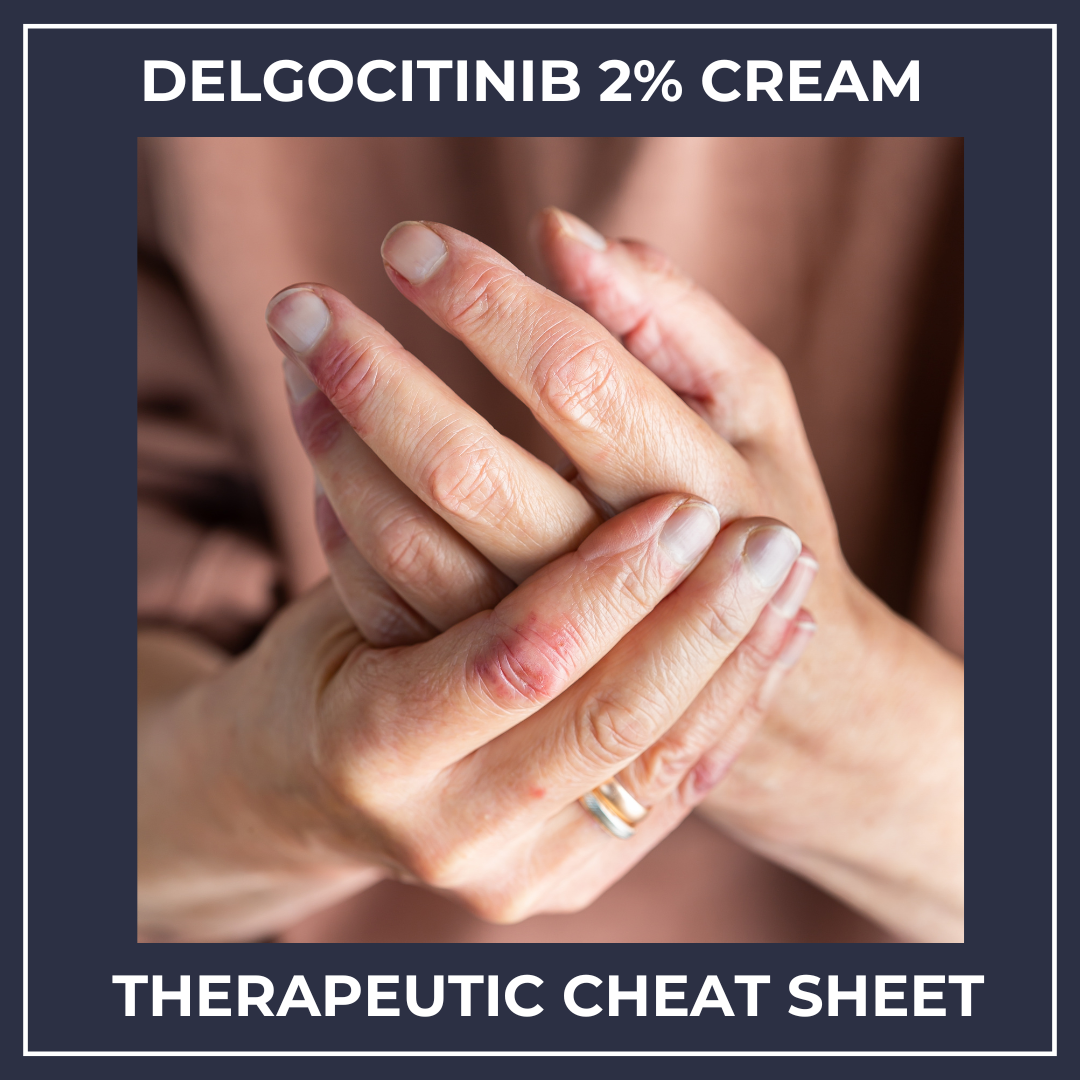
Delgocitinib is a topical pan-Janus kinase (JAK) inhibitor that represents a novel non-steroidal treatment mechanism for chronic hand dermatitis. As a pan-JAK inhibitor, delgocitinib blocks all four members of the JAK family (JAK1, JAK2, JAK3, and tyrosine kinase 2 (TYK2)), thus simultaneously modulating the many cytokine pathways that drive chronic inflammatory skin disorders. Delgocitinib was initially developed by Japan Tobacco and first approved in Japan in 2020 as a topical agent (Corectim®) for atopic dermatitis; though it is not currently FDA-approved for the treatment of atopic dermatitis in the United States.1 As Anzupgo®, delgocitinib is the first (and only) medication specifically FDA-approved for the management of chronic hand dermatitis.2,3 Because it is a topical medication applied to a limited surface area and that has negligible systemic absorption, delgocitinib offers a novel option for gaining the benefits of JAK inhibition while avoiding the systemic concerns associated with oral JAK inhibitors.3,4,5 We continue our series, Therapeutic Cheat Sheets, with a closer look at topical delgocitinib.
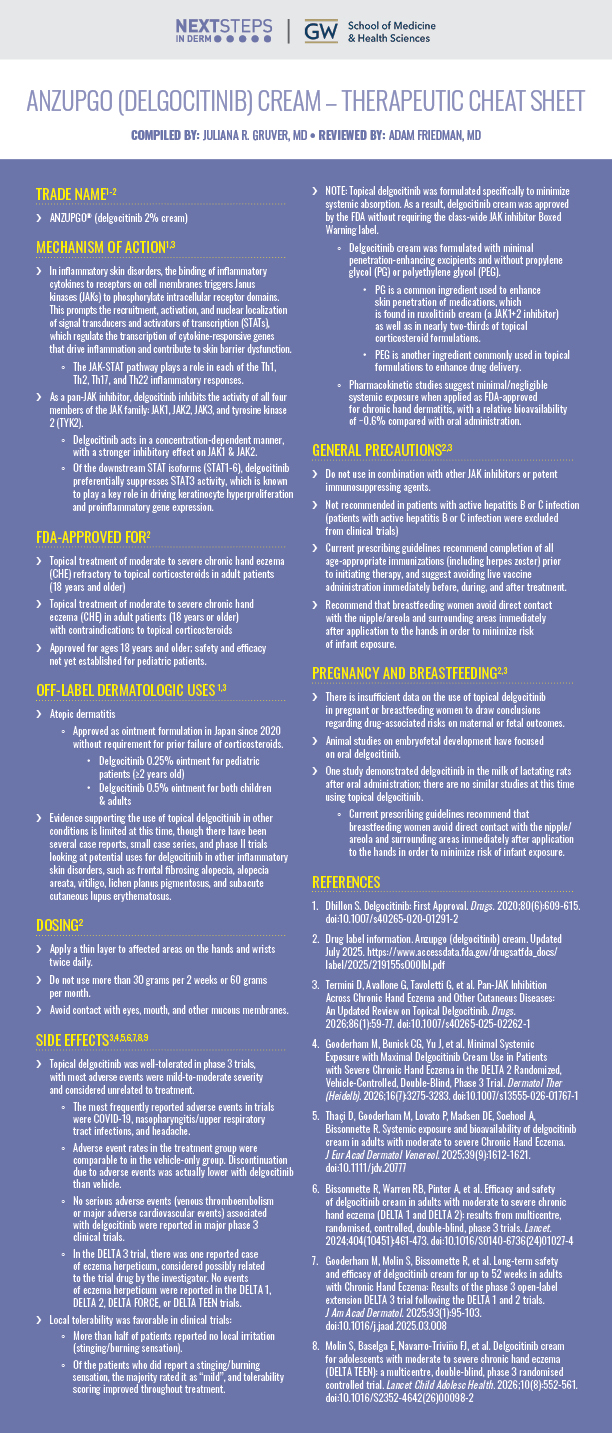
Delgocitinib 2% Cream Therapeutic Cheat Sheet
Compiled by: Juliana R. Gruver, MD | Reviewed by: Adam Friedman, MD
TRADE NAME
-
- ANZUPGO® (delgocitinib 2% cream)
MECHANISM OF ACTION1,3
-
- In inflammatory skin disorders, the binding of inflammatory cytokines to receptors on cell membranes triggers Janus kinases (JAKs) to phosphorylate intracellular receptor domains. This prompts the recruitment, activation, and nuclear localization of signal transducers and activators of transcription (STATs), which regulate the transcription of cytokine-responsive genes that drive inflammation and contribute to skin barrier dysfunction.
- The JAK-STAT pathway plays a role in each of the Th1, Th2, Th17, and Th22 inflammatory responses.
- As a pan-JAK inhibitor, delgocitinib inhibits the activity of all four members of the JAK family: JAK1, JAK2, JAK3, and tyrosine kinase 2 (TYK2).
- Delgocitinib acts in a concentration-dependent manner, with a stronger inhibitory effect on JAK1 & JAK2.
- Of the downstream STAT isoforms (STAT1-6), delgocitinib preferentially suppresses STAT3 activity, which is known to play a key role in driving keratinocyte hyperproliferation and proinflammatory gene expression.
FDA-APPROVED FOR2
-
- Topical treatment of moderate to severe chronic hand eczema (CHE) refractory to topical corticosteroids in adult patients (18 years and older)
- Topical treatment of moderate to severe chronic hand eczema (CHE) in adult patients (18 years or older) with contraindications to topical corticosteroids
- Approved for ages 18 years and older; safety and efficacy not yet established for pediatric patients.
OFF-LABEL DERMATOLOGIC USES1,3
-
- Atopic dermatitis
- Approved as ointment formulation in Japan since 2020 without requirement for prior failure of corticosteroids.
- Delgocitinib 0.25% ointment for pediatric patients (≥2 years old)
- Delgocitinib 0.5% ointment for both children & adults
- Evidence supporting the use of topical delgocitinib in other conditions is limited at this time, though there have been several case reports, small case series, and phase II trials looking at potential uses for delgocitinib in other inflammatory skin disorders, such as frontal fibrosing alopecia, alopecia areata, vitiligo, lichen planus pigmentosus, and subacute cutaneous lupus erythematosus.
- Approved as ointment formulation in Japan since 2020 without requirement for prior failure of corticosteroids.
- Atopic dermatitis
DOSING2
-
- Apply a thin layer to affected areas on the hands and wrists twice daily.
- Do not use more than 30 grams per 2 weeks or 60 grams per month.
- Avoid contact with eyes, mouth, and other mucous membranes.
SIDE EFFECTS3,4,5,6,7,8,9
-
- Topical delgocitinib was well-tolerated in phase 3 trials, with most adverse events were mild-to-moderate severity and considered unrelated to treatment.
- The most frequently reported adverse events in trials were COVID-19, nasopharyngitis/upper respiratory tract infections, and headache.
- Adverse event rates in the treatment group were comparable to in the vehicle-only group. Discontinuation due to adverse events was actually lower with delgocitinib than vehicle.
- No serious adverse events (venous thromboembolism or major adverse cardiovascular events) associated with delgocitinib were reported in major phase 3 clinical trials.
- In the DELTA 3 trial, there was one reported case of eczema herpeticum, considered possibly related to the trial drug by the investigator. No events of eczema herpeticum were reported in the DELTA 1, DELTA 2, DELTA FORCE, or DELTA TEEN trials.
- Local tolerability was favorable in clinical trials:
- More than half of patients reported no local irritation (stinging/burning sensation).
- Of the patients who did report a stinging/burning sensation, the majority rated it as “mild”, and tolerability scoring improved throughout treatment.
- NOTE: Topical delgocitinib was formulated specifically to minimize systemic absorption. As a result, delgocitinib cream was approved by the FDA without requiring the class-wide JAK inhibitor Boxed Warning label.
- Delgocitinib cream was formulated with minimal penetration-enhancing excipients and without propylene glycol (PG) or polyethylene glycol (PEG).
- PG is a common ingredient used to enhance skin penetration of medications, which is found in ruxolitinib cream (a JAK1+2 inhibitor) as well as in nearly two-thirds of topical corticosteroid formulations.
- PEG is another ingredient commonly used in topical formulations to enhance drug delivery.
- Pharmacokinetic studies suggest minimal/negligible systemic exposure when applied as FDA-approved for chronic hand dermatitis, with a relative bioavailability of ~0.6% compared with oral administration.
- Delgocitinib cream was formulated with minimal penetration-enhancing excipients and without propylene glycol (PG) or polyethylene glycol (PEG).
- Topical delgocitinib was well-tolerated in phase 3 trials, with most adverse events were mild-to-moderate severity and considered unrelated to treatment.
GENERAL PRECAUTIONS2,3
-
- Do not use in combination with other JAK inhibitors or potent immunosuppressing agents.
- Not recommended in patients with active hepatitis B or C infection (patients with active hepatitis B or C infection were excluded from clinical trials)
- Current prescribing guidelines recommend completion of all age-appropriate immunizations (including herpes zoster) prior to initiating therapy, and suggest avoiding live vaccine administration immediately before, during, and after treatment.
- Recommend that breastfeeding women avoid direct contact with the nipple/areola and surrounding areas immediately after application to the hands in order to minimize risk of infant exposure.
PREGNANCY AND BREASTFEEDING2,3
-
- There is insufficient data on the use of topical delgocitinib in pregnant or breastfeeding women to draw conclusions regarding drug-associated risks on maternal or fetal outcomes.
- Animal studies on embryofetal development have focused on oral delgocitinib.
- One study demonstrated delgocitinib in the milk of lactating rats after oral administration; there are no similar studies at this time using topical delgocitinib.
- Current prescribing guidelines recommend that breastfeeding women avoid direct contact with the nipple/areola and surrounding areas immediately after application to the hands in order to minimize risk of infant exposure.
Further Reading
If you would like to learn more about topical delgocitinib, check out the following articles in the Journal of Drugs in Dermatology:
The Utility of Delgocitinib in Chronic Hand Eczema
Issa NT, Yu J, Bunick CG, Kircik L.
Chronic hand eczema (CHE) affects up to 10% of the general population and is associated with significant physical discomfort, impaired hand function, and reduced quality of life, yet effective long-term treatment options remain limited. Delgocitinib cream, a nonsteroidal topical pan-JAK inhibitor, has demonstrated high efficacy and safety in adult Phase 3 pivotal trials, significantly improving clinical signs, symptoms, and quality of life for patients across diverse CHE subtypes. Comparative studies suggest delgocitinib offers superior or similar benefits to systemic therapies like the oral retinoid alitretinoin and the biologic dupilumab, with negligible systemic exposure. These findings support delgocitinib cream as an innovative and promising topical therapy addressing a critical unmet need in CHE patient management.
J Drugs Dermatol. 2025;24(10):25412.
Expert Consensus on Advanced Topical Nonsteroidal Therapies for Chronic Hand Eczema
Armstrong AW, Nong Y, Bunick CG, et al.
Background: Chronic hand eczema (CHE) is a common, heterogeneous inflammatory skin disease associated with substantial symptom burden, impaired hand function, reduced quality of life, and work-related disability. Despite its clinical impact, evidence-based guidance for long-term, steroid-sparing topical management has been limited.
Objective: To develop expert consensus statements on the role of advanced topical nonsteroidal therapies in CHE management.
Methods: A panel of seven dermatologists with expertise in CHE conducted a structured literature review, prioritizing CHE-specific trials when available. Evidence was evaluated using the Strength of Recommendation Taxonomy (SORT). Draft statements were refined through a Delphi consensus process, with consensus predefined as ≥75% agreement.
Results: The panel reached consensus on six statements addressing advanced topical nonsteroidal therapies in CHE. These agents were recognized as important steroid-sparing options appropriate for long-term use. Delgocitinib cream is currently the only topical therapy with CHE-specific regulatory approval and is considered an appropriate first-line advanced topical treatment.
Clinical trial data show that advanced topical nonsteroidal therapies provide rapid and sustained improvements in erythema, scaling, fissuring, pruritus, and pain. Delgocitinib demonstrated sustained improvements in patient-reported outcomes and superior health-related quality-of-life benefits compared with oral alitretinoin in severe CHE. Treatment has also been associated with improved work productivity and daily functioning. These therapies have favorable safety profiles, with adverse events largely limited to local reactions, minimal systemic exposure, and no requirement for routine laboratory monitoring. Other topical nonsteroidal agents may have a role in selected patients, although CHE-specific data remain limited.
Conclusion: This consensus provides practical guidance supporting individualized, steroid-sparing CHE management while identifying areas for future research.
J Drugs Dermatol. 2026;25(3):228-233.
Armstrong AW, Nong Y, Bunick CG, et al.
Background: Advanced topical nonsteroidal therapies are expanding options for atopic dermatitis (AD) by providing targeted anti-inflammatory control without many limitations of long-term topical corticosteroids. As these agents become more available, practical guidance is needed on their use as first-line therapy, proactive maintenance, combination regimens, safety, and long-term management.
Objective: To develop expert consensus statements defining the clinical role of advanced topical nonsteroidal therapies in AD.
Methods: A seven-dermatologist expert panel used a structured Delphi process informed by a literature review. Statements were drafted, iteratively refined, and voted on across multiple rounds. Evidence quality and strength of recommendations were assessed using the Strength of Recommendation Taxonomy (SORT). Consensus was predefined as ≥75% agreement.
Results: The panel reached unanimous consensus on seven statements regarding advanced topical nonsteroidal therapies, including topical ruxolitinib, tapinarof, roflumilast, crisaborole, tacrolimus, pimecrolimus, and delgocitinib. These therapies were considered effective in reducing AD signs and symptoms, including pruritus, and appropriate as first-line agents for many patients. Their use was associated with longer disease control, fewer relapses, and reduced cumulative topical corticosteroid exposure. The panel agreed that these therapies improve patient-reported outcomes, including quality of life and sleep, and can be safely incorporated into combination regimens with other topical or systemic treatments. They demonstrated favorable safety and tolerability profiles without the need for baseline or ongoing laboratory monitoring. Compared with topical corticosteroids, nonsteroidal therapies were preferred for long-term management to avoid steroid-associated adverse effects, with simplified dosing and suitability for sensitive and high-impact sites supporting adherence.
Conclusion: Advanced topical nonsteroidal therapies represent an important evolution in AD management and are appropriate first-line options across disease severities, supporting sustained disease control and improved quality of life.
J Drugs Dermatol. 2026;25(3):221-227.
REFERENCES
-
- Dhillon S. Delgocitinib: First Approval. Drugs. 2020;80(6):609-615. doi:10.1007/s40265-020-01291-2
- Drug label information. Anzupgo (delgocitinib) cream. Updated July 2025. https://www.accessdata.fda.gov/drugsatfda_docs/label/2025/219155s000lbl.pdf
- Termini D, Avallone G, Tavoletti G, et al. Pan-JAK Inhibition Across Chronic Hand Eczema and Other Cutaneous Diseases: An Updated Review on Topical Delgocitinib. Drugs. 2026;86(1):59-77. doi:10.1007/s40265-025-02262-1
- Gooderham M, Bunick CG, Yu J, et al. Minimal Systemic Exposure with Maximal Delgocitinib Cream Use in Patients with Severe Chronic Hand Eczema in the DELTA 2 Randomized, Vehicle-Controlled, Double-Blind, Phase 3 Trial. Dermatol Ther (Heidelb). 2026;16(7):3275-3283. doi:10.1007/s13555-026-01767-1
- Thaçi D, Gooderham M, Lovato P, Madsen DE, Soehoel A, Bissonnette R. Systemic exposure and bioavailability of delgocitinib cream in adults with moderate to severe Chronic Hand Eczema. J Eur Acad Dermatol Venereol. 2025;39(9):1612-1621. doi:10.1111/jdv.20777
- Bissonnette R, Warren RB, Pinter A, et al. Efficacy and safety of delgocitinib cream in adults with moderate to severe chronic hand eczema (DELTA 1 and DELTA 2): results from multicentre, randomised, controlled, double-blind, phase 3 trials. Lancet. 2024;404(10451):461-473. doi:10.1016/S0140-6736(24)01027-4
- Gooderham M, Molin S, Bissonnette R, et al. Long-term safety and efficacy of delgocitinib cream for up to 52 weeks in adults with Chronic Hand Eczema: Results of the phase 3 open-label extension DELTA 3 trial following the DELTA 1 and 2 trials. J Am Acad Dermatol. 2025;93(1):95-103. doi:10.1016/j.jaad.2025.03.008
- Giménez-Arnau AM, Pinter A, Sondermann W, et al. Efficacy and safety of topical delgocitinib cream versus oral alitretinoin capsules in adults with severe chronic hand eczema (DELTA FORCE): a 24-week, randomised, head-to-head, phase 3 trial. Lancet. 2025;405(10490):1676-1688. doi:10.1016/S0140-6736(25)00001-7
- Molin S, Baselga E, Navarro-Triviño FJ, et al. Delgocitinib cream for adolescents with moderate to severe chronic hand eczema (DELTA TEEN): a multicentre, double-blind, phase 3 randomised controlled trial. Lancet Child Adolesc Health. 2026;10(8):552-561. doi:10.1016/S2352-4642(26)00098-2
Did you enjoy this Therapeutic Cheat Sheet? You can find more here.