











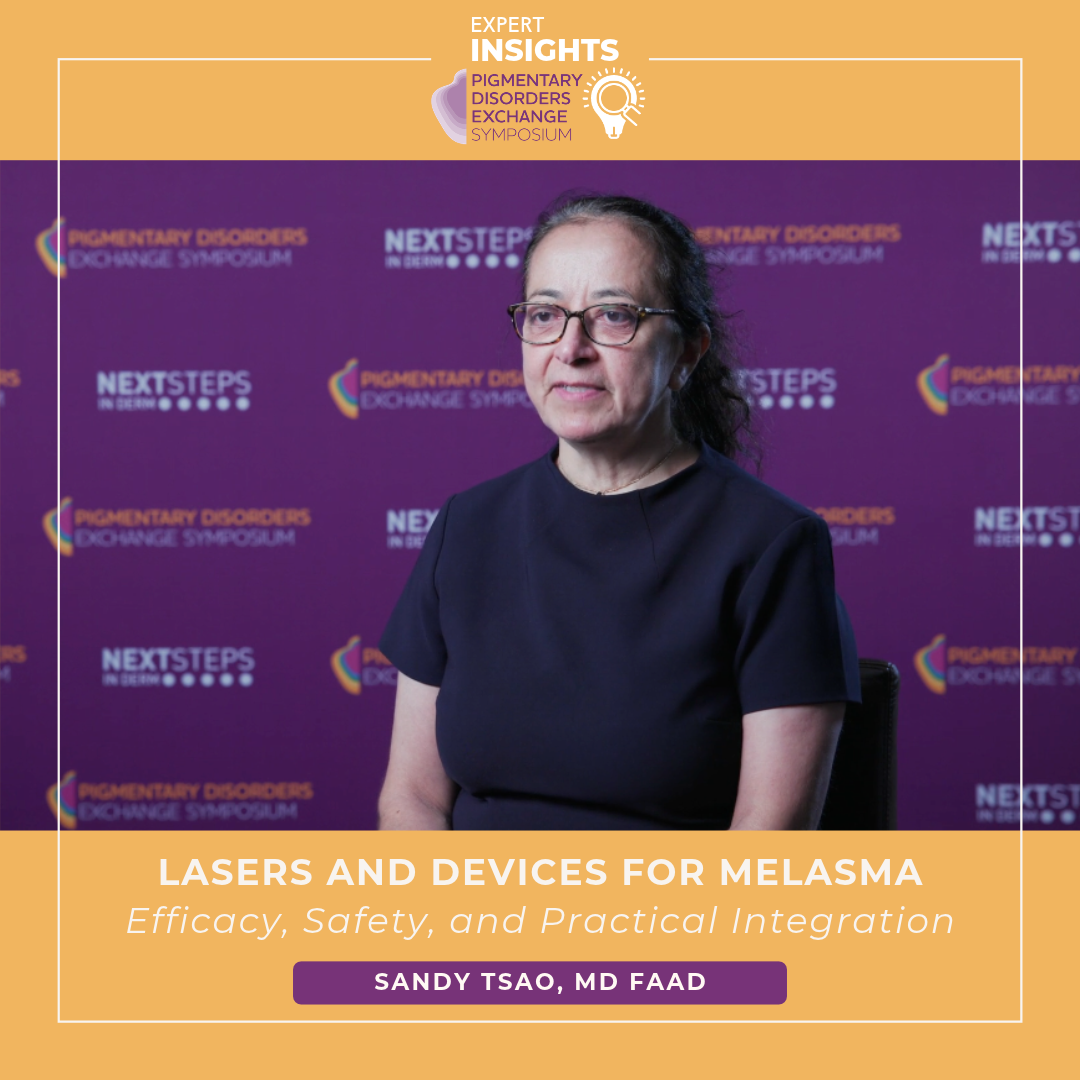
Melasma can present a complex challenge for both patients and dermatology clinicians, requiring a multimodal approach. Next Steps in Derm, in partnership with Pigmentary Disorders Exchange Symposium, interviewed Sandy Tsao, MD, FAAD, assistant professor of dermatology at Harvard Medical School. Watch as Dr. Tsao shares her procedural approach to treating melasma, including using lasers and other devices.
In the interview, Dr. Tsao outlines which melasma patients make the best candidates for laser and device procedures. She details where lasers fit in the therapeutic framework, and the role of chemical peels. In addition, Dr. Tsao gives an update on advancements and best practices when using picosecond lasers and non-ablative fractionated lasers for melasma. Plus, Dr. Tsao advises pre-treatment regimens that can enhance laser efficacy and minimize risks like post-inflammatory hyperpigmentation.
Navigating the journey to effectively treat melasma involves selecting the right patients, recognizing the potential risks associated with different treatments, and leveraging advancements in dermatological technologies. Dr. Tsao provides a comprehensive approach to managing this challenging condition with a balance of efficacy and safety.
Further Reading
If you want to read more about treating melasma, check out the following articles published in the Journal of Drugs in Dermatology:
ABSTRACT
Background: Facial hyperpigmentation, characterized by the excessive production of melanin in the skin, is a prevalent dermatological concern affecting individuals of various ethnic backgrounds.
Aims: To evaluate the safety and efficacy of a multi-wavelength 589/1319 nm dual-pulse duration laser device for the treatment of hyperpigmentation
Patients/Methods: A total of 17 healthy women (mean [SD] age of 43.4 [11.6] with skin phototype II-IV) were enrolled in this prospective, single-center study. Eligible participants received up to 3 treatments spaced 3 to 5 weeks apart with 2 follow-up visits at 4 and 12 weeks after the final treatment. Assessments included investigator ratings of skin quality, global aesthetic improvement, and hyperpigmentation. Safety and tolerability were monitored throughout the study.
Results: Significant improvements in hyperpigmentation and skin quality were observed at the 2 follow-up visits from baseline in most patients per investigator assessments. Patient satisfaction was high, and treatments were safe with transient self-resolving side effects such as erythema.
Conclusions: Laser treatments using a dual-wavelength 589/1319nm device significantly improve facial hyperpigmentation in patients of various skin types.
ABSTRACT
Visible light (400-700nm) comprises 45% of the sunlight spectrum and can induce both immediate and persistent skin darkening, as well as worsen dyschromia, especially in the skin of color population. In a recent mini-zone study, we demonstrated that iron oxide (FeO)-containing formulations could protect skin from visible light-induced pigmentation in Fitzpatrick skin type (FST) IV individuals, while ultraviolet (UV) protection sunscreen SPF 50+ (sun protection factor) could not. To assess the benefit of adding FeO-containing foundation into real-life daily sun care routine in improving the appearance of photodamage and melasma, we evaluated the efficacy of two sun protection regimens (SPF50 alone and SPF50+FeO) in healthy women of FST III to VI for 12 weeks. Clinical evaluation and colorimetric measurement showed that both regimens significantly improved skin quality and overall appearance over 12 weeks compared to baseline. At week 4, the photodamage subgroup using SPF50+FeO showed early improvement over baseline in skin roughness (visual and tactile). The melasma subgroup using SPF50+FeO showed early improvement in overall healthy appearance.
At week 12, although both groups showed improvement in colorimetric measurements (L*), the response was different: 36% of melasma participants in the SPF50+FeO group showed superior improvement in their skin radiance (L*) vs 0% in the SPF50 group. A self-assessment questionnaire revealed that SPF50+FeO enhanced the quality of life in participants with melasma. This study demonstrated the importance of including visible light protection into a daily sun care routine, especially for melasma: masking and improving existing conditions indoors and outdoors at the same time.
Did you enjoy this video interview? Find more here.