












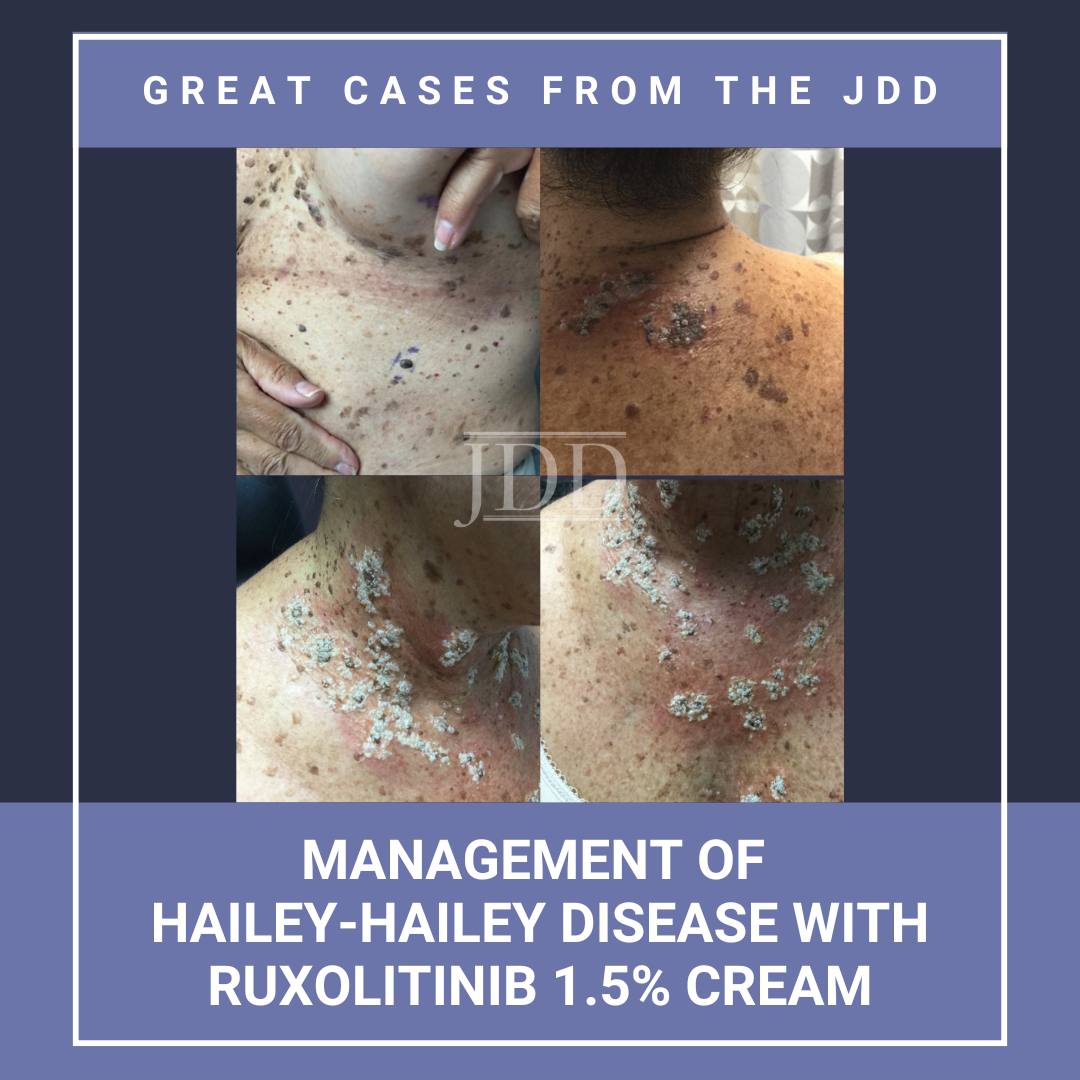
Management of Hailey-Hailey Disease With Ruxolitinib 1.5% Cream
 Introduction
Benign Familial Pemphigus (Hailey-Hailey Disease [HHD]) is caused by a mutation within ATP2C1, the gene encoding the calcium pump of golgi apparatuses, impacting keratinocytes' ability to adhere to each other, resulting in acantholysis.1 Clinical presentation of HHD encompasses blisters that become erythematous plaques and fissures within flexural areas on a relapsing basis …
Introduction
Benign Familial Pemphigus (Hailey-Hailey Disease [HHD]) is caused by a mutation within ATP2C1, the gene encoding the calcium pump of golgi apparatuses, impacting keratinocytes' ability to adhere to each other, resulting in acantholysis.1 Clinical presentation of HHD encompasses blisters that become erythematous plaques and fissures within flexural areas on a relapsing basis …
Introduction
Benign Familial Pemphigus (Hailey-Hailey Disease [HHD]) is caused by a mutation within ATP2C1, the gene encoding the calcium pump of golgi apparatuses, impacting keratinocytes' ability to adhere to each other, resulting in acantholysis.1 Clinical presentation of HHD encompasses blisters that become erythematous plaques and fissures within flexural areas on a relapsing basis … Continue reading "Management of Hailey-Hailey Disease With Ruxolitinib 1.5% Cream"
 INTRODUCTION
Benign Familial Pemphigus, or Hailey-Hailey Disease (HHD), affects intertriginous areas of the skin causing epidermal blistering and vesicles that coalesce into weeping and crusting plaques.¹
The loss-of-function mutation of the ATP2C1 gene causes a disruption in calcium homeostasis of keratinocytes. The resulting dysfunction in desmosomes and cell-cell adhesion causes acanthol …
INTRODUCTION
Benign Familial Pemphigus, or Hailey-Hailey Disease (HHD), affects intertriginous areas of the skin causing epidermal blistering and vesicles that coalesce into weeping and crusting plaques.¹
The loss-of-function mutation of the ATP2C1 gene causes a disruption in calcium homeostasis of keratinocytes. The resulting dysfunction in desmosomes and cell-cell adhesion causes acanthol … 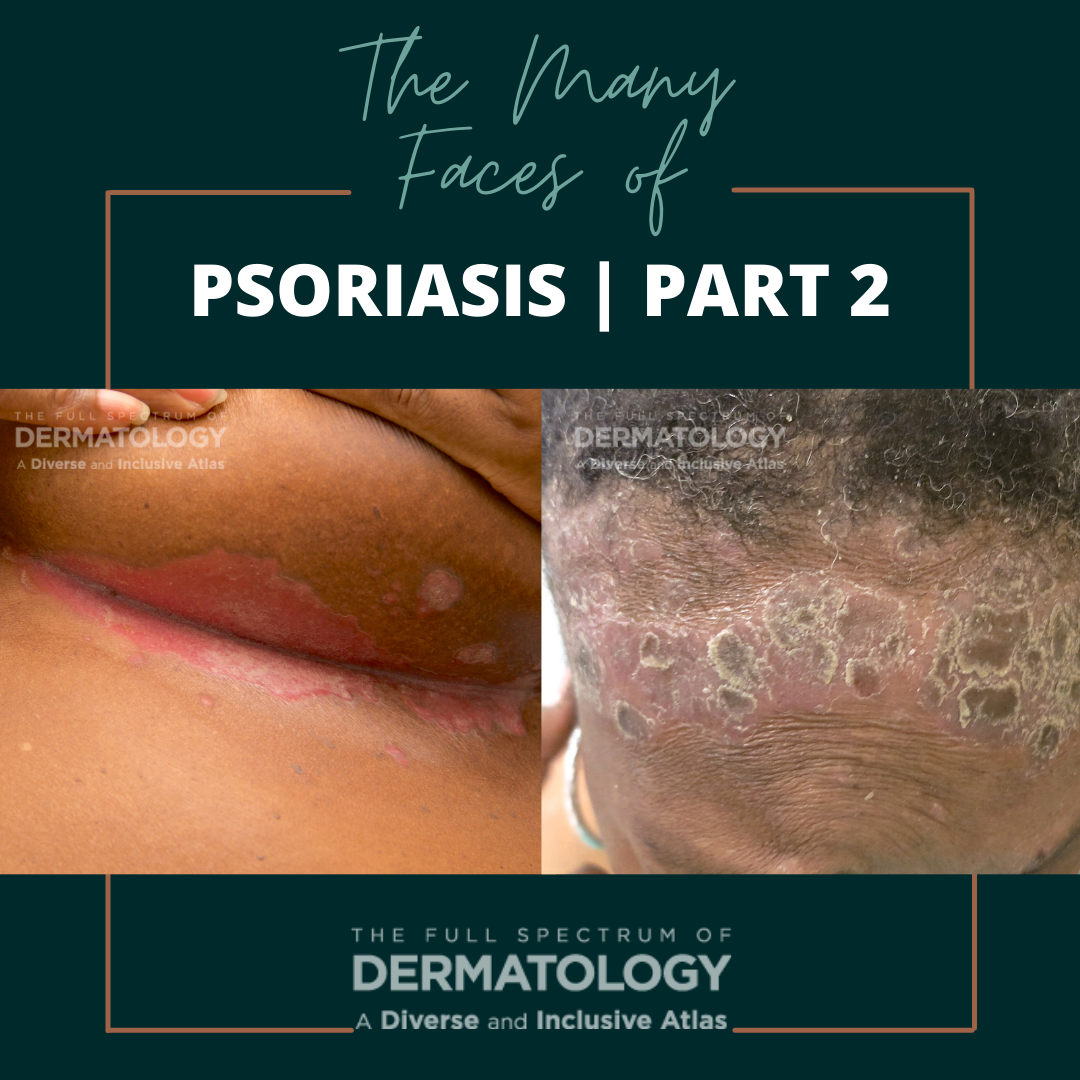 Did you know that psoriasis doesn’t just present on the arms, legs, and trunk? It can also appear in non-conventional locations (aka “special site” psoriasis) including the scalp, face, and body folds (such as the axillary, inframammary, and inguinal fields, and intergluteal clefts). In the skin folds, psoriasis is also referred to as “inverse psoriasis.” In darker skin types, the areas …