












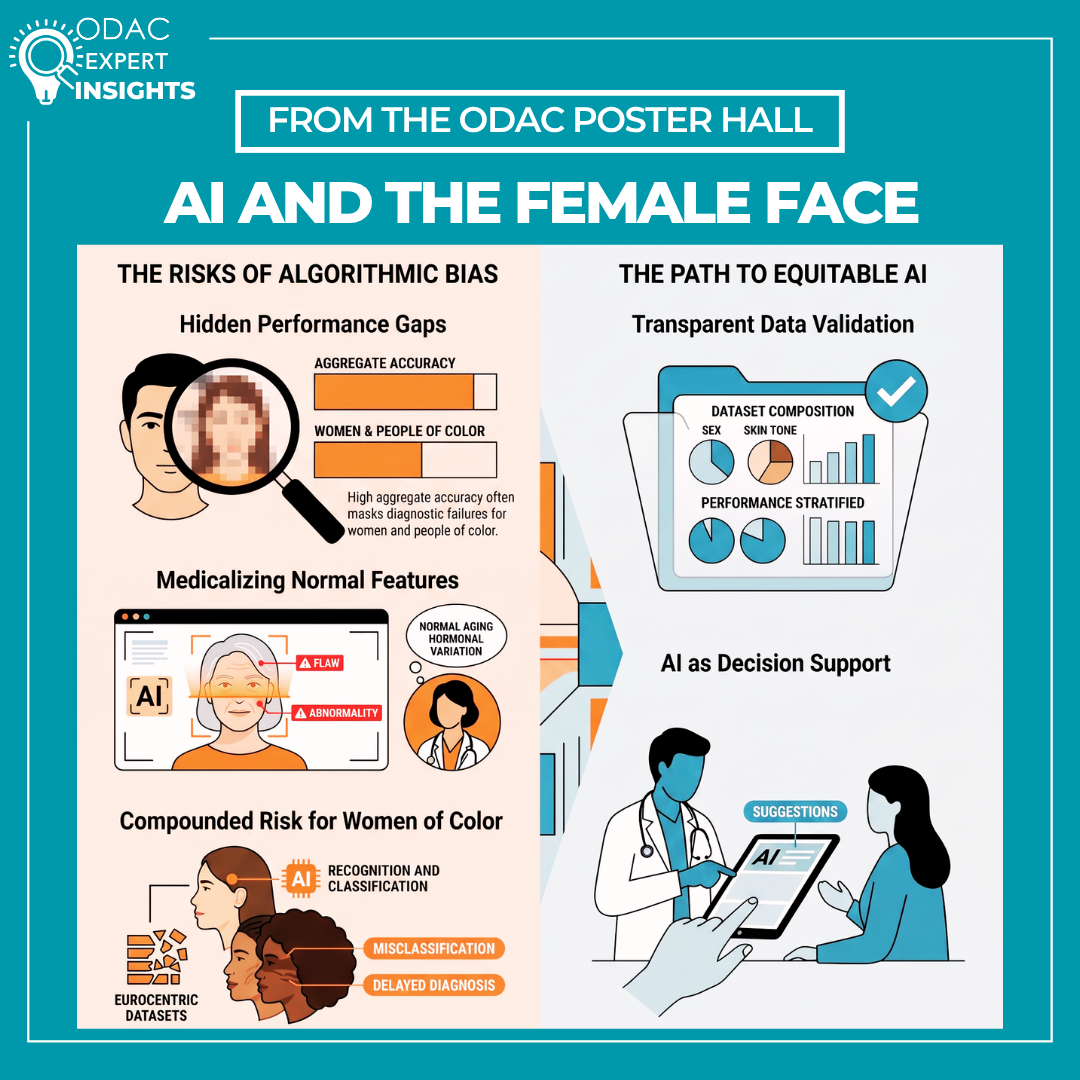
Concerns over the use of AI in dermatology often center on skin tone bias. Machine learning’s data sets commonly reflect the Eurocentric focus that’s traditionally found in dermatologic images. Now researchers are raising awareness of another bias in these data sets: sex and gender differences in the skin. These hormonal and morphologic differences are completely normal. However, when not accounted for in AI data sets, dermatologic care for women is compromised — diagnostic accuracy is reduced and unnecessary cosmetic procedures are recommended. These impacts are magnified for women of color.
A poster presented at ODAC and titled “AI and the Female Face and Algorithmic Bias in Dermatology Datasets” shares research on gender bias in AI algorithms. I interviewed poster author Grace Herrick, BA, of the Alabama College of Osteopathic Medicine.
What led you to investigate AI interpretation of the female face?
This work grew out of seeing AI tools increasingly used in dermatology for facial analysis, triage, and aesthetic planning without clear transparency around who those algorithms were trained on. While skin tone bias has begun to receive attention, sex and gender representation remain inconsistently reported, despite well-established differences in disease prevalence, morphology, and hormonal influences on female skin. When datasets underrepresent women, particularly women of color, performance disparities can remain hidden behind strong aggregate accuracy metrics. At the same time, aesthetic AI systems risk medicalizing normal features of female aging and pigmentation when trained on narrow, Eurocentric reference standards. We wanted to examine how these gaps affect both diagnostic reliability and ethical deployment, and to provide clinicians with a framework for evaluating AI tools before integrating them into patient care.
How is gender bias at play in AI algorithms? How did this bias come about?
Gender bias in dermatologic AI stems from the way training data are collected, labeled, and evaluated. Female patients are frequently underrepresented or insufficiently characterized, even though sex-related differences in skin biology, disease patterns, and facial aging are well established. When algorithms are trained on such imbalanced data, performance differences affecting women can be masked by overall accuracy metrics. This bias developed as datasets were built around convenience and historical precedent rather than intentional demographic balance, and persisted due to limited requirements for sex-specific reporting and validation.
You conducted a review of studies. What were you looking for and what did you find?
We reviewed the dermatologic AI literature to understand how datasets are described and how algorithm performance is evaluated, with attention to whether sex and skin tone were meaningfully considered. We examined how gender was handled conceptually in study design, dataset description, and interpretation of results. We found that gender was commonly absent, merged into broader categories, or acknowledged without downstream performance analysis, which limits the ability to assess how these tools function for female patients.
What did your review reveal about AI’s interpretation of skin tone, and how could this impact women of color?
Our review showed that many dermatologic AI systems are trained on datasets dominated by lighter skin tones, with limited transparency around how darker skin types are represented or evaluated. This skews algorithm learning and can reduce accuracy for pigmentary and inflammatory conditions, which are more likely to present differently in darker skin. For women of color, this creates a compounded risk, where both skin tone and sex-related differences are insufficiently captured, increasing the likelihood of misclassification, delayed diagnosis, and inappropriate aesthetic flagging.
Your review found that “aesthetic AI platforms disproportionately flagged features associated with natural aging, hormonal variation, or skin tone heterogeneity as ‘flaws.'” What is the potential impact on women?
When aesthetic AI systems label normal features of female skin as abnormalities, they risk medicalizing physiologic aging, hormonal change, and natural pigment variation. For women, this can distort clinical counseling, increase pressure toward unnecessary interventions, and reinforce narrow, culturally biased beauty standards. Over time, reliance on these tools may shift patient expectations and clinical decision-making in ways that undermine autonomy and trust rather than support informed, individualized care.
What does equitable AI in dermatology involve?
Equitable AI in dermatology requires that algorithms are trained, evaluated, and deployed in ways that reflect the real diversity of patients seen in practice. This includes transparent reporting of dataset composition, validation across sex and skin tone where supported by the data, and avoidance of reliance on aggregate performance metrics alone. It also involves clinician oversight to ensure AI outputs are interpreted in context, particularly in aesthetic applications, so that technology supports accurate diagnosis and ethical patient counseling rather than reinforcing existing disparities.
What else should dermatology clinicians know about gender bias in AI?
Dermatology clinicians should recognize that strong headline accuracy does not guarantee reliable performance for all patients. When sex and skin tone are not reported or stratified, important performance gaps affecting female patients can remain invisible. Clinicians should approach AI tools as decision support rather than objective truth, ask vendors about training data and validation populations, and remain attentive to how algorithmic outputs may influence diagnostic judgment, aesthetic counseling, and patient expectations.
Additional authors of the poster include:
Claudia Rodriguez, BA, Zucker School of Medicine at Hofstra/Northwell
Emily Uh, BS, SUNY Upstate Medical University
Harleen K. Multani, BS, Meharry Medical College School of Medicine
Kelly Frasier, DO, MS, Northwell Health
Pooja R. Shah, MD, FAAD, Northwell Health
Did you enjoy this scientific poster interview? You can find more here.