












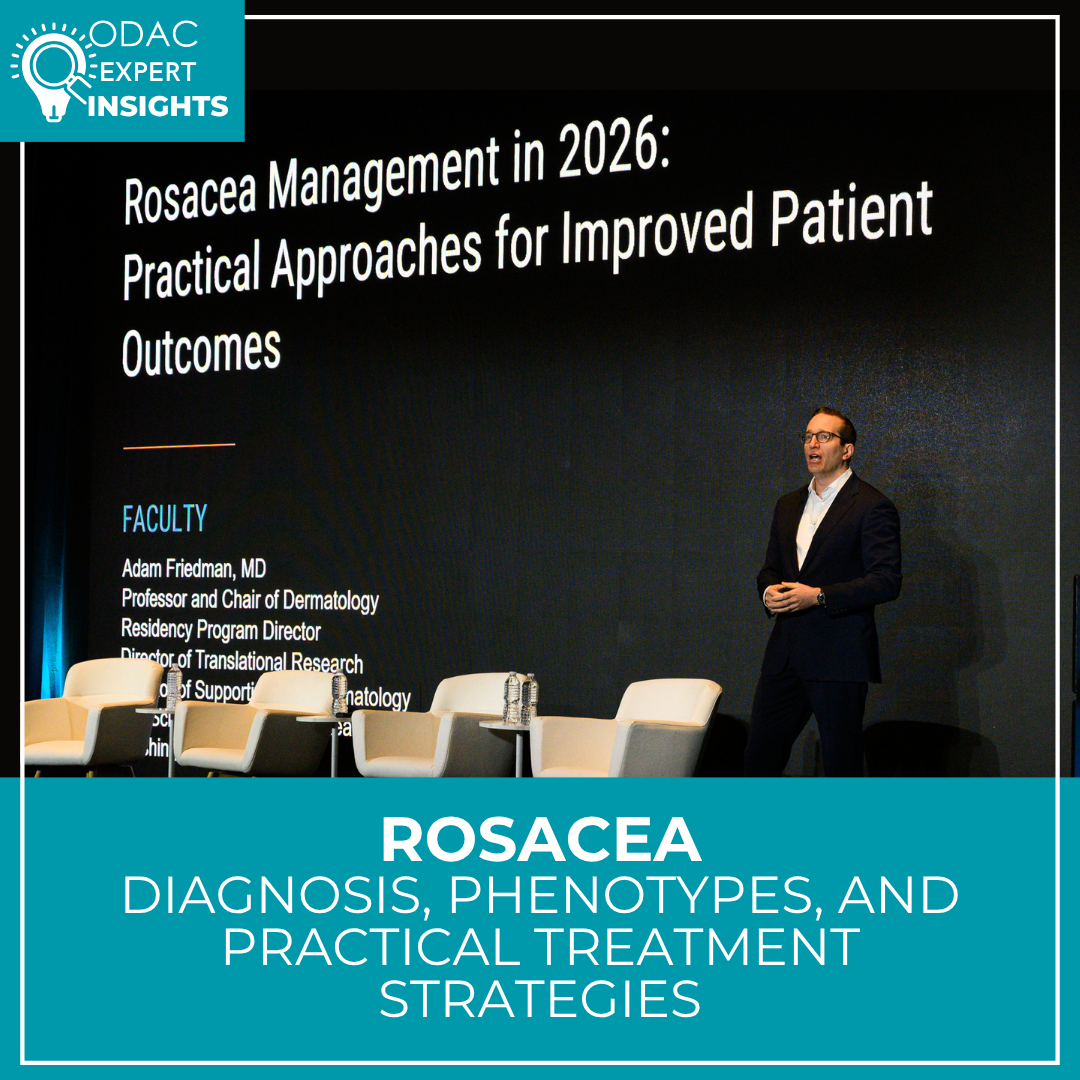
Managing rosacea requires moving beyond quick, symptomatic fixes toward a comprehensive framework that addresses the entire scope of the disease. In a recent presentation, Adam Friedman, MD, FAAD—Professor and Chair of Dermatology at The George Washington University School of Medicine & Health Sciences—outlined an updated clinical approach to diagnosing and managing rosacea. From recognizing subtle presentations and overlap conditions to navigating complex comorbidities and novel therapies, Dr. Friedman offered valuable pearls for optimizing patient care. Here is a summary of the key insights and actionable strategies from his talk.
A Simple Framework for Thinking About Rosacea
When evaluating a patient that you suspect has rosacea, a practical checklist that you should keep in mind includes:
-
- Confirming the diagnosis
- Assessing triggers (both dietary and lifestyle)
- Evaluating for comorbid diseases
- Creating an individualized treatment plan
This approach assists with avoiding a very common pitfall in rosacea management: symptomatic treatment without addressing the broader disease context.
First Step: Is It Only Rosacea?
Did you know that there’s an overlap between rosacea and seborrheic dermatitis? When Dr. Friedman mentioned this, I was kind of taken aback since I often see this overlap in clinic but never made the connection. Unfortunately, when present together, treatment can be quite challenging since treatment for seborrheic dermatitis can actually worsen rosacea.
Clinical pearl: Don’t miss the overlap between seborrheic dermatitis and rosacea.
Rosacea Occurs in All Skin Types
As we all know, rosacea does not discriminate by skin tone. However, the clinical presentation may differ especially in darker skin types. In darker skin, persistent erythema may be less obvious and commonly present with papular or granulomatous variants. And given the presence of monomorphic papules, rosacea may resemble conditions like papular sarcoidosis or granuloma annulare in darker skin types.
Because erythema is less visible, rosacea may be underdiagnosed or diagnosed late in these patients.
When in Doubt, Consider Demodex
A helpful diagnostic tool Dr. Friedman keeps handy when the clinical picture is unclear, is the 15 blade. Performing a simple facial scrapping can confirm or refute the diagnosis of rosacea. Although part of normal follicular microbiota, excessive presence of demodex mites may support a diagnosis within the rosacea sphere.
Clinical pear: When in doubt, pull out your 15 blade and perform a facial scrapping.
Diet and Comorbidities in Rosacea: What Actually Matters
Another interesting thing I learned was that biopsies of rosacea have shown a higher mast cell burden. This suggests that histamine containing or histamine releasing foods may contribute to disease activity. So contrary to traditional teaching, caffeine itself may not worsen rosacea. Rather, the trigger appears to be physical heat from hot beverages. I’m sure many coffee lovers with rosacea will be relieved that they don’t have to give up coffee! Other common triggers include alcohol, sun exposure, emotional stress, hot/cold weather and spicy foods.
Additionally, Dr. Friedman referenced a recent publication by Choragudi et al. that suggests rosacea may have a strong association with obesity. This is important to know since we often associate comorbidities like obesity and hypertension with other skin diseases including psoriasis. Adequate control of these comorbidities may help treating inadequately controlled rosacea.
Clinical pearl: Diet restrictions from histamine containing/releasing foods may help with rosacea management. Obtaining adequate control of systemic comorbidities may also help.
Treatment Principles
Don’t Skip the Basics
We all know the benefits of a good skincare routine. Core components of rosacea management that Dr. Friedman touched on include:
-
- Gentle cleansers
- Moisturization
- Sunscreen
- Trigger avoidance
- Cosmetic camouflage when needed
Even when planning advanced treatments like lasers or systemic medications, these basics should always be addressed first.
Isotretinoin in Rosacea
Low-dose isotretinoin can be a game changer for severe or refractory rosacea. Rosacea treatment with isotretinoin involves much lower doses than acne. Typical dosing range is 0.25–0.5 mg/kg/day (and sometimes even lower), however, higher doses may be considered for patients with the nodular variant. Another plus with isotretinoin is the simplification of treatment regimens. The major downfall is, unlike acne, relapse after stopping isotretinoin is common.
“OG’s” and Newer Therapies
Here’s a quick review of the topical and oral therapies commonly utilized in the treatment of rosacea. I’ve bolded the relatively newer therapies.
| Topical therapies | Oral therapies |
| Metronidazole 0.75% gel/cream/lotion
Azelaic acid 15% gel Sodium sulfacetamide with 5% sulfur, available in a lotion, cream, suspension, or cleanser Erythromycin or clindamycin lotion/solution Minocycline foam 1.5% (can cause temporary orange tinting of the skin) Brimonidine 0.33% topical gel or oxymetazoline 1% cream (for facial erythema) Encapsulated benzoyl peroxide (improved tolerability when compared to the nonencapsulated version) Oxymetazoline Hydrochloride Cream 1% Combination Microencapsulated Cream (microencapsulated benzoyl peroxide 3% and microencapsulated tretinoin 1%) |
Tetracycline antibiotics (immediate release minocycline and doxycycline immediate/extended release)
Metronidazole 200 mg twice daily Azithromycin 250-500 mg daily 3 times weekly Low-dose extended-release oral minocycline (great alternative to doxycycline however may cause dizziness in some patients)
|
The biggest challenge to prescribing more effective medications remains insurance coverage. Often, the best medication is simply the one patients can access.
Clinical pearl: Rosacea treatment with isotretinoin uses much lower doses than acne. Relapse, however, can occur with discontinuation.
Don’t Forget About Ocular Rosacea
Ocular rosacea is commonly overlooked, even by ophthalmology. A helpful screening question Dr. Friedman recommended is asking: “Do your eyes ever feel gritty, like there’s a foreign body or sand in them?” If the answer is yes that is the greatest predictor for ocular rosacea. Management may include Omega-3 fatty acids frequently recommended to prevent dry eyes for isotretinoin but can also be used for dry eyes with rosacea. Topical ivermectin to the eyelids (for Demodex) can also be very helpful. Dr. Friedman tends to go between low-dose doxycycline and azithromycin (500 mg TID). There has been no evidence of antimicrobial resistance and there’s supportive data for the combination with anti-inflammatory eye drops as well. Don’t forget to refer patients to an ophthalmologist for care and follow-up of ocular manifestations of rosacea.
Neurogenic Rosacea
There are two patterns of flushing associated with rosacea: flushing with sweating and dry flushing. The difference between the two is that dry flushing is often triggered by stress, temperature changes, or alcohol. Dr. Friedman offered therapies that tend to work well for his patients.
Treatment options for facial flushing may include:
-
- Clonidine
- Beta blockers
- Amitriptyline
- Paroxetine (emerging evidence)
Dr. Friedman noted that he tends to reach for clonidine a lot in his practice. He usually starts with half of a 0.1 mg tab twice a day and goes up to as high as a 0.3 mg (so it’s a pill and a half i.e. 0.15 mg twice a day) and finds it very effective. He may even mix and match these medications. He offered the case of a patient on clonidine and doxycycline with minimal improvement in facial flushing until adding paroxetine.
The treatment of persistent erythema is honestly the bane of my existence. However, Dr. Friedman briefly mentioned erenumab (Aimovig), a migraine medication that has shown promise in treating persistent, treatment-resistant rosacea flushing and erythema.
Key Takeaways
-
- Rosacea should not be treated like acne despite some overlapping therapies.
- Rosacea frequently overlaps with seborrheic dermatitis, which can complicate treatment.
- Persistent erythema may be subtle in darker skin tones — look for papular/granulomatous variants.
- Demodex mites can help support the diagnosis of rosacea.
- Physical heat, not caffeine itself, may trigger flares from hot beverages.
- Combination therapy is usually required because rosacea involves multiple inflammatory pathways.
- Ocular rosacea is commonly missed — always ask about gritty eye sensation.
Articles recommended by Dr. Friedman:
-
- Choragudi, S., Andrade, L. F., Mahmoud, O., Yosipovitch, G., & Elman, S. A. (2025). Association of obesity with inflammatory skin disease: An inpatient population study. Journal of the European Academy of Dermatology and Venereology : JEADV, 39(6), e496–e497. https://doi.org/10.1111/jdv.20440
- Li, S., Cho, E., Drucker, A. M., Qureshi, A. A., & Li, W. Q. (2017). Obesity and risk for incident rosacea in US women. Journal of the American Academy of Dermatology, 77(6), 1083–1087.e5. https://doi.org/10.1016/j.jaad.2017.08.032
Did you enjoy this Rosacea article? You can find more here.