












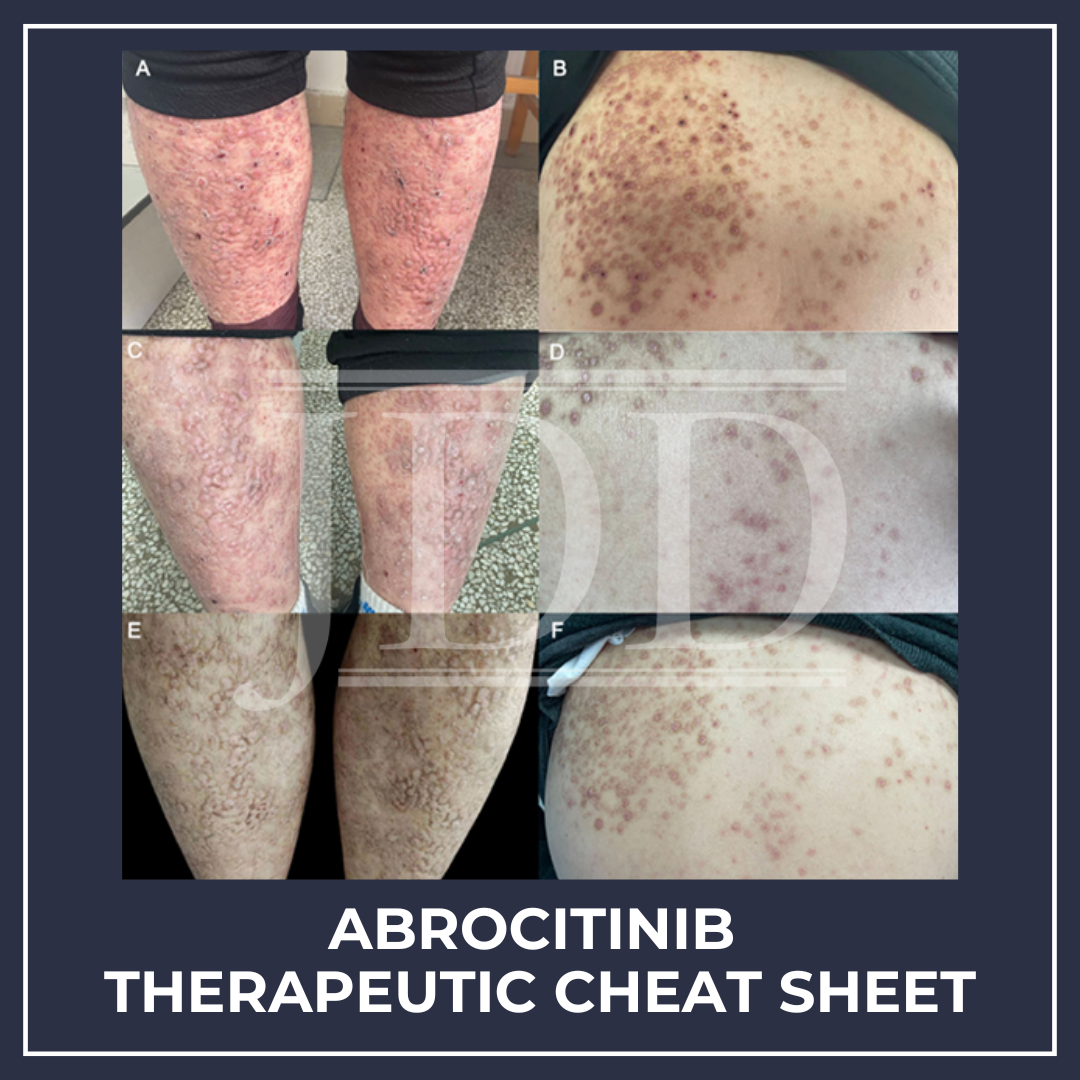
Abrocitinib is an oral, once-daily selective Janus kinase 1 (JAK1) inhibitor approved for moderate-to-severe atopic dermatitis. It can provide rapid improvement in pruritus and skin disease and is a useful treatment option for many patients. As an oral medication, it may also be preferred by patients who want to avoid injections. When prescribing abrocitinib, it is important to discuss laboratory monitoring and the black box warning associated with the class of JAK inhibitors. Overall, abrocitinib is a safe and effective treatment option with potential use across several dermatologic conditions.
We continue our “Therapeutic Cheat Sheet” series with a focused review of abrocitinib’s dermatologic applications, safety considerations, and practical prescribing pearls.
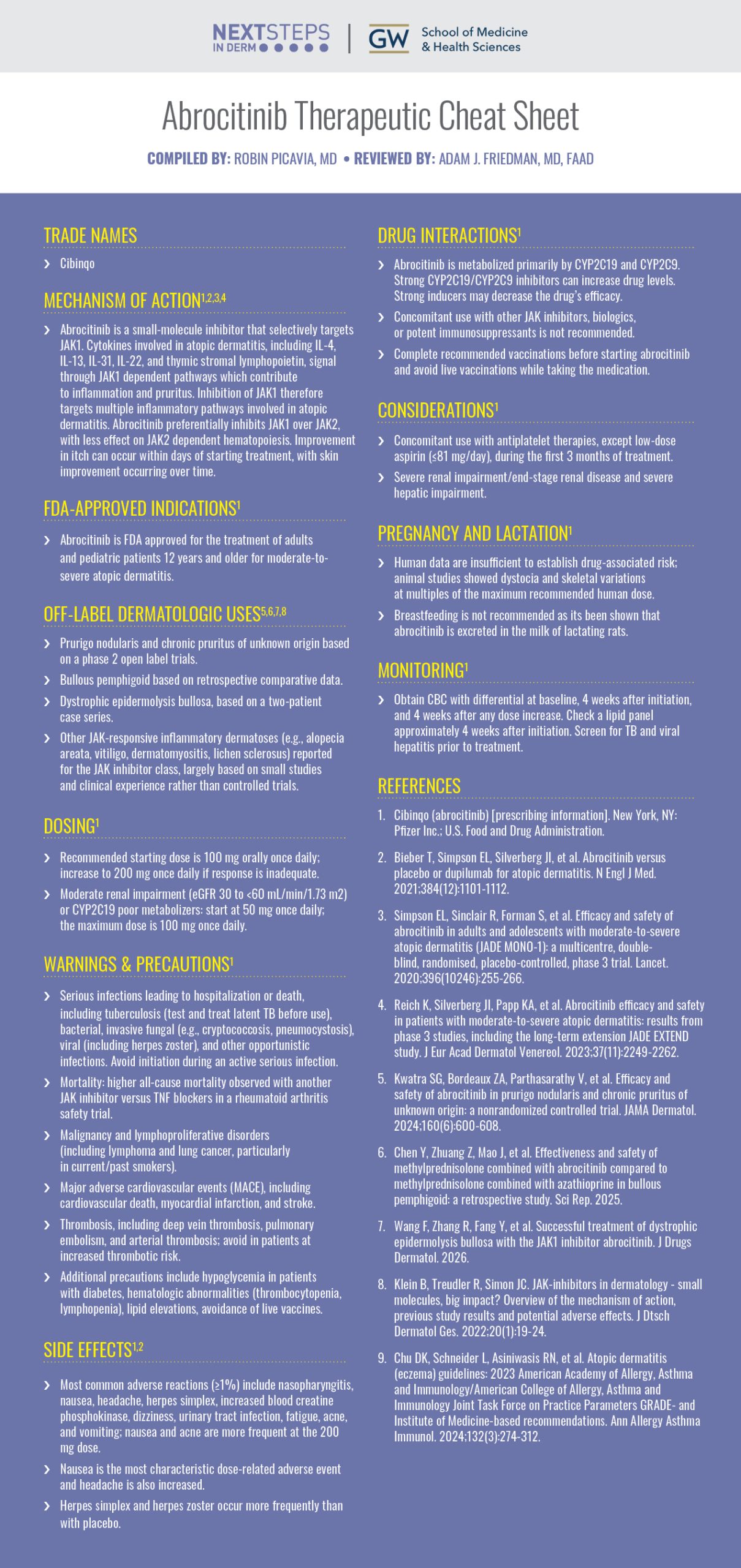
Abrocitinib Therapeutic Cheat Sheet
Compiled by: Robin Picavia, MD | Reviewed by: Adam J. Friedman, MD, FAAD
TRADE NAME
Cibinqo
MECHANISM OF ACTION1,2,3,4
Abrocitinib is a small-molecule inhibitor that selectively targets JAK1. Cytokines involved in atopic dermatitis, including IL-4, IL-13, IL-31, IL-22, and thymic stromal lymphopoietin, signal through JAK1 dependent pathways which contribute to inflammation and pruritus. Inhibition of JAK1 therefore targets multiple inflammatory pathways involved in atopic dermatitis. Abrocitinib preferentially inhibits JAK1 over JAK2, with less effect on JAK2 dependent hematopoiesis. Improvement in itch can occur within days of starting treatment, with skin improvement occurring over time.
FDA-APPROVED INDICATIONS1
Abrocitinib is FDA approved for the treatment of adults and pediatric patients 12 years and older for moderate-to-severe atopic dermatitis.
OFF-LABEL DERMATOLOGIC USES5,6,7,8
-
- Prurigo nodularis and chronic pruritus of unknown origin based on a phase 2 open label trials.
- Bullous pemphigoid based on retrospective comparative data.
- Dystrophic epidermolysis bullosa, based on a two-patient case series.
- Other JAK-responsive inflammatory dermatoses (e.g., alopecia areata, vitiligo, dermatomyositis, lichen sclerosus) reported for the JAK inhibitor class, largely based on small studies and clinical experience rather than controlled trials.
DOSING1
-
- Recommended starting dose is 100 mg orally once daily; increase to 200 mg once daily if response is inadequate.
- Moderate renal impairment (eGFR 30 to <60 mL/min/1.73 m2) or CYP2C19 poor metabolizers: start at 50 mg once daily; the maximum dose is 100 mg once daily.
WARNINGS AND PRECAUTIONS1
-
- Serious infections leading to hospitalization or death, including tuberculosis (test and treat latent TB before use), bacterial, invasive fungal (e.g., cryptococcosis, pneumocystosis), viral (including herpes zoster), and other opportunistic infections. Avoid initiation during an active serious infection.
- Mortality: higher all-cause mortality observed with another JAK inhibitor versus TNF blockers in a rheumatoid arthritis safety trial.
- Malignancy and lymphoproliferative disorders (including lymphoma and lung cancer, particularly in current/past smokers).
- Major adverse cardiovascular events (MACE), including cardiovascular death, myocardial infarction, and stroke.
- Thrombosis, including deep vein thrombosis, pulmonary embolism, and arterial thrombosis; avoid in patients at increased thrombotic risk.
- Additional precautions include hypoglycemia in patients with diabetes, hematologic abnormalities (thrombocytopenia, lymphopenia), lipid elevations, avoidance of live vaccines.
SIDE EFFECTS1,2
-
- Most common adverse reactions (≥1%) include nasopharyngitis, nausea, headache, herpes simplex, increased blood creatine phosphokinase, dizziness, urinary tract infection, fatigue, acne, and vomiting; nausea and acne are more frequent at the 200 mg dose.
- Nausea is the most characteristic dose-related adverse event and headache is also increased.
- Herpes simplex and herpes zoster occur more frequently than with placebo.
DRUG INTERACTIONS1
-
- Abrocitinib is metabolized primarily by CYP2C19 and CYP2C9. Strong CYP2C19/CYP2C9 inhibitors can increase drug levels. Strong inducers may decrease the drug’s efficacy.
- Concomitant use with other JAK inhibitors, biologics, or potent immunosuppressants is not recommended.
- Complete recommended vaccinations before starting abrocitinib and avoid live vaccinations while taking the medication.
CONTRAINDICATIONS1
-
- Concomitant use with antiplatelet therapies, except low-dose aspirin (≤81 mg/day), during the first 3 months of treatment.
- Severe renal impairment/end-stage renal disease and severe hepatic impairment.
PREGNANCY AND BREASTFEEDING1
-
- Human data are insufficient to establish drug-associated risk; animal studies showed dystocia and skeletal variations at multiples of the maximum recommended human dose.
- Breastfeeding is not recommended as its been shown that abrocitinib is excreted in the milk of lactating rats.
MONITORING1
-
- Obtain CBC with differential at baseline, 4 weeks after initiation, and 4 weeks after any dose increase. Check a lipid panel approximately 4 weeks after initiation. Screen for TB and viral hepatitis prior to treatment.
FURTHER READING
If you would like to read more about abrocitinib (Cibinqo), check out the following articles in the Journal of Drugs in Dermatology:
Successful Treatment of Dystrophic Epidermolysis Bullosa With the JAK1 Inhibitor Abrocitinib
Wang, F., Zhang, R., Fang, Y., et al. (2026). Journal of Drugs in Dermatology, published online April 2026
Abstract
JAK inhibitors are increasingly being utilized for the treatment of diseases beyond their classical indications, and the highly selective JAK1 inhibitor abrocitinib may represent a promising therapeutic option for dystrophic epidermolysis bullosa (DEB). The first case was a 39-year-old male with DEB in whom conventional therapy was ineffective; after one month of abrocitinib treatment, marked improvement in both pruritus and skin lesions was observed, with no adverse drug reactions during six months of therapy. The second case involved a 46-year-old female DEB patient in whom conventional therapy resulted in mild improvement of skin lesions but no significant relief of pruritus. These two cases provide comparative evidence suggesting the superior efficacy of abrocitinib relative to conventional therapies for DEB.
Post-Hyaluronic Acid Filler Reaction Treated With Abrocitinib: A Case Report
Lopez, M. H. P., Guenin, S. H., Laborada, J., & Lebwohl, M. G. (2024). Journal of Drugs in Dermatology, 23(1), 1355-1356. doi:10.36849/JDD.7271
Abstract
Post-hyaluronic acid filler nodules are uncommon, unpredictable complications that present a challenge to clinical therapy. This report describes a female in her fifties who developed edema and nodules 6 weeks after hyaluronic acid (HA) filler injection. After minimal improvement with oral steroids and intralesional hyaluronidase, a trial of oral abrocitinib was initiated, which yielded significant clinical improvement. Thus, abrocitinib may be a novel therapeutic option for delayed-onset nodules following injection of hyaluronic acid.
REFERENCES
-
- Cibinqo (abrocitinib) [prescribing information]. New York, NY: Pfizer Inc.; U.S. Food and Drug Administration.
- Bieber T, Simpson EL, Silverberg JI, et al. Abrocitinib versus placebo or dupilumab for atopic dermatitis. N Engl J Med. 2021;384(12):1101-1112.
- Simpson EL, Sinclair R, Forman S, et al. Efficacy and safety of abrocitinib in adults and adolescents with moderate-to-severe atopic dermatitis (JADE MONO-1): a multicentre, double-blind, randomised, placebo-controlled, phase 3 trial. Lancet. 2020;396(10246):255-266.
- Reich K, Silverberg JI, Papp KA, et al. Abrocitinib efficacy and safety in patients with moderate-to-severe atopic dermatitis: results from phase 3 studies, including the long-term extension JADE EXTEND study. J Eur Acad Dermatol Venereol. 2023;37(11):2249-2262.
- Kwatra SG, Bordeaux ZA, Parthasarathy V, et al. Efficacy and safety of abrocitinib in prurigo nodularis and chronic pruritus of unknown origin: a nonrandomized controlled trial. JAMA Dermatol. 2024;160(6):600-608.
- Chen Y, Zhuang Z, Mao J, et al. Effectiveness and safety of methylprednisolone combined with abrocitinib compared to methylprednisolone combined with azathioprine in bullous pemphigoid: a retrospective study. Sci Rep. 2025.
- Wang F, Zhang R, Fang Y, et al. Successful treatment of dystrophic epidermolysis bullosa with the JAK1 inhibitor abrocitinib. J Drugs Dermatol. 2026.
- Klein B, Treudler R, Simon JC. JAK-inhibitors in dermatology – small molecules, big impact? Overview of the mechanism of action, previous study results and potential adverse effects. J Dtsch Dermatol Ges. 2022;20(1):19-24.
- Chu DK, Schneider L, Asiniwasis RN, et al. Atopic dermatitis (eczema) guidelines: 2023 American Academy of Allergy, Asthma and Immunology/American College of Allergy, Asthma and Immunology Joint Task Force on Practice Parameters GRADE- and Institute of Medicine-based recommendations. Ann Allergy Asthma Immunol. 2024;132(3):274-312.
Did you enjoy this Therapeutic Cheat Sheet? You can find more here.