












Botulinum toxin is a mainstay of cosmetic dermatology practices, and its therapeutic benefits are well known. Migraines and axillary hyperhidrosis are two of the medical conditions where botulinum toxin can be an effective treatment. An original article published in the September Journal of Drugs in Dermatology explores an application of botulinum toxin that’s underdiscussed in dermatology: treating facial paralysis. The article outlines the therapeutic and functional benefits of botulinum toxin in facial paralysis, and provides a framework for comprehensive use.
To understand the sequalae of facial paralysis and the role of botulinum toxin in alleviating those effects, I interviewed the study’s authors: Roxane Scemla, MD, a family physician in Maui, Hawaii, and Hayes B. Gladstone, MD, a dermatologist and Mohs micrographic surgeon in Danville, Calif.
Using botulinum toxin to treat facial paralysis is not a commonly discussed topic in dermatology. What led you to conduct a narrative review?
Botulinum toxin treatments are usually associated with cosmetic rejuvenation. However, there are many medical conditions including facial palsy that are successfully treated with neuromodulators. Because of our respective training in otolaryngology-head and neck surgery before dermatology (Dr. Gladstone) and family medicine (Dr. Scemla), we frequently encountered this disfiguring condition. While botulinum toxin can be highly effective and rewarding, it is important to truly understand the mechanisms and sequelae of facial paralysis and the underlying anatomy.
What are some common misconceptions about facial paralysis, especially regarding dermatologic treatment?
Facial paralysis is often mistaken for a purely cosmetic problem defined by visible asymmetry, and “Bell’s palsy” is sometimes used as a label for any facial weakness. Facial palsy has multiple causes; Bell’s palsy is idiopathic and a diagnosis of exclusion. Assessment should consider the cause, timing, pattern, and functional effects before treatment. Botulinum toxin does not repair the facial nerve or reverse denervation. Used selectively, it can reduce muscle overactivity and synkinesis, relieve associated symptoms, and improve balance. Treating appearance alone, or weakening muscles without assessing their contribution to expression and function, may compromise useful movement.
Facial asymmetry is most noticeable in patients with facial paralysis. What are some other sequelae, including those that may not be apparent to the naked eye? How do these effects impact quality of life?
Beyond asymmetry, patients may experience incomplete eye closure or unwanted eye narrowing during movement, oral incompetence, difficulty with eating, drinking, speech, or articulation, synkinesis, tightness, painful contractions, hemifacial spasm, and autonomic symptoms such as gustatory tearing. These problems may be subtle at rest and become evident only during speaking, smiling, eating, or eye closure. They can interfere with daily function and social communication and are associated with meaningful psychosocial burden and reduced quality of life.
Your review led you to create a neuroaesthetic framework for evaluation and treatment of facial paralysis with botulinum toxin. What are key elements of your framework? Why is this framework needed?
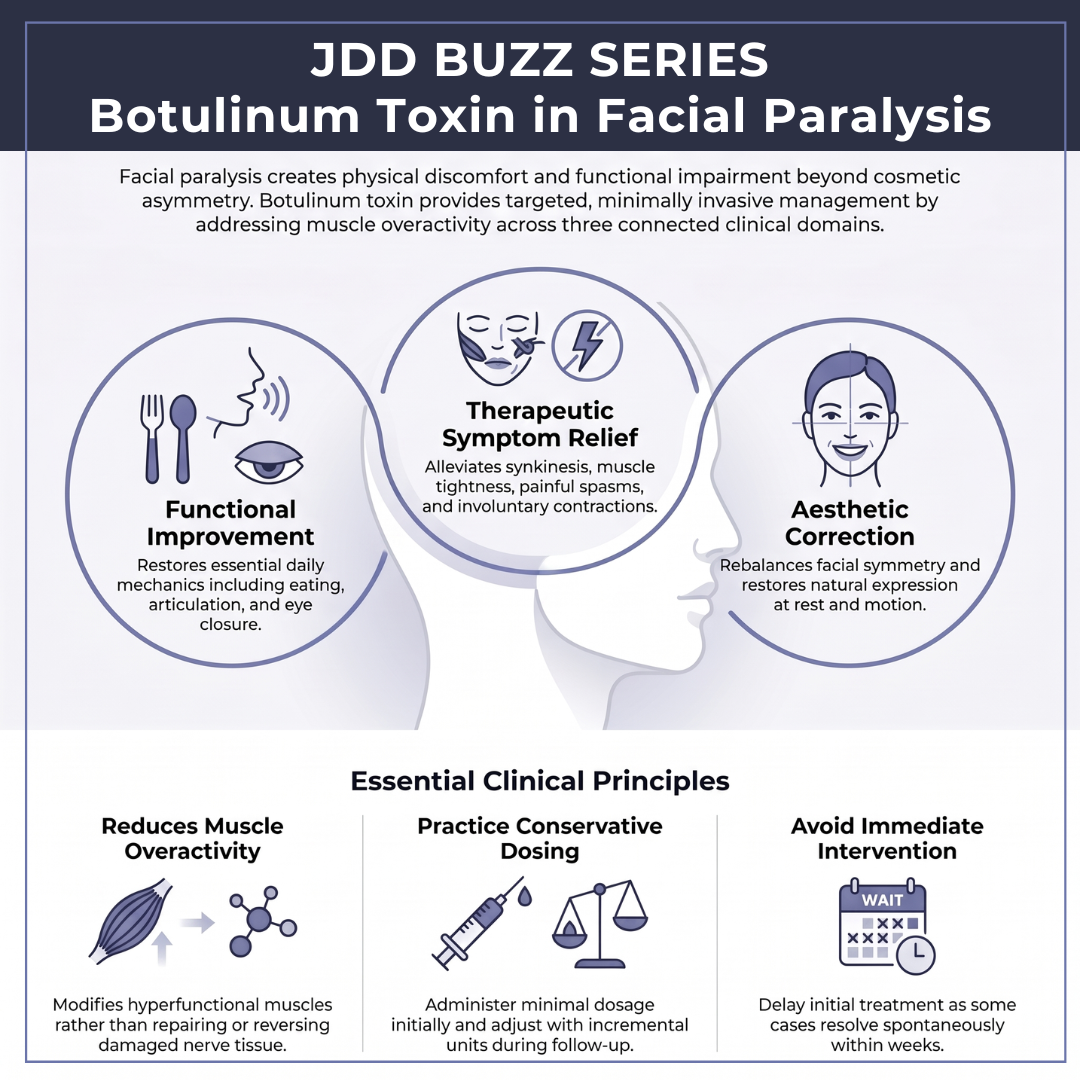
This paper provides an introductory neuroaesthetic framework to raise awareness of the complexity of facial paralysis, which extends beyond visible facial asymmetry. It emphasizes comprehensive management by organizing treatment around three connected domains: functional improvement, therapeutic symptom relief, and aesthetic correction. Our paper helps clinicians consider function, symptoms, and appearance together. Building on this framework, a separate step-by-step neuroaesthetic “algorithm” to guide clinicians through a structured evaluation and treatment approach has been developed by Dr. Scemla.
What role do you think dermatology clinicians should play in facial paralysis treatment?
Led by Jean and Alastair Carruthers and then by many others, dermatology clinicians have always played a pivotal role in the utilization of botulinum toxin for cosmetic enhancement and selected medical conditions such as axillary hyperhidrosis. As experts in soft tissue facial diagnosis and treatment, we want to empower patients to look their best, no matter what the etiology. Facial palsy is particularly compelling for dermatology clinicians since with a minimally invasive therapy, we can change their lives.
What else should dermatology clinicians know about using botulinum toxin for facial paralysis?
Understanding that, in some patients, facial paralysis may resolve without treatment in a matter of weeks. Therefore it is important not to immediately treat a facial palsy patient with botulinum toxin. In addition to understanding the anatomy and how the contralateral side of the face reacts, this type of treatment is very nuanced. Conservative botulinum toxin dosing is prudent since additional units can be injected at follow-up visits.
Did you enjoy this JDD Buzz expert commentary? You can find more here.