












The applied exam marks the culmination of years of training for most derm residents. Obtaining board certification signifies to patients that one is an expert in the field of dermatology and is more than capable of providing care independently. Although the overwhelming majority of residents pass, it’s difficult not to let your guard down while preparing. The stakes are simply too high not to give it your all when studying. This is probably because it is only offered once per year, and many residents have jobs and fellowships that are contingent upon passing this exam.
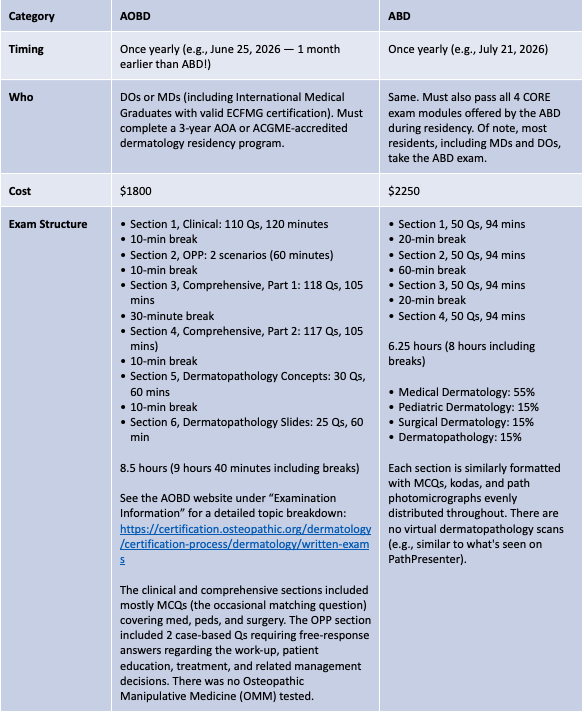
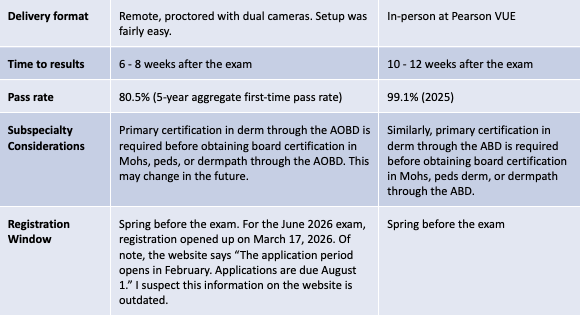
I recently took both the American Board of Dermatology (ABD) and American Osteopathic Board of Dermatology (AOBD) exams. Below, I compare the two exams and share post-exam reflections.
Post-Exam Thoughts
AOBD:
I took this exam one month prior to the ABD exam while still in residency. The early timing of this exam did make it difficult to cover as much of the study material as I would have liked.
Remote testing was initially a concern given the possibility of technical issues. Fortunately, I did not encounter any significant problems. One thing that made remote testing slightly challenging was that due to the limited screen real estate on my laptop, entire clinical photographs and complete answer choice lists could not always be viewed without scrolling. It was easy to make the mistake of not seeing an entire photo or all the answer choices before submitting an answer.
This exam tested more basic science and minutiae than I expected, as many current trainees are told that the exam has shifted away from such minutiae toward more clinically relevant knowledge and skills.
There were several questions with “NOT” or “EXCEPT” in the lead-in and “none of the above” or “all of the above” as answer choices. There were occasional spelling errors, along with a few questions containing outdated content.
There were fewer questions about biostatistics or coding than expected (perhaps none at all).
I was pleasantly surprised that no OMM was tested. However, it could be argued that without testing OMM, the exam would fail to justify its osteopathic distinctiveness and existence alongside the ABD exam.
ABD
I took this exam one month after taking the AOBD exam, on the same day as most dermatology residents nationwide. While the study period was still intense, I do believe it was probably less intense because a significant amount of energy was put into studying earlier for the AOBD exam.
I was surprised by how up-to-date some of the tested concepts were. For example, it tested indications for recent FDA-approved medications as well as therapies that are off-label but strongly supported based on recent literature that graduating residents could reasonably be expected to know (e.g., by attending conferences, participating in journal club, etc.).
There were many kodas on the exam, some accompanied by path photomicrographs to aid in clinicopathologic correlation, which were evenly distributed throughout the exam.
Similar to the AOBD exam, there were fewer biostatistics and coding questions than expected (if any).
As far as preparation for the exam, a standard residency curriculum should adequately prepare, assuming one has used Alikhan, DermQBank, and AAD Boards Prep Plus along the way. BoardsUniversity was especially helpful for the ABD exam, although I found it less helpful for the AOBD exam. There is no such thing as seeing too many kodas — some resources to consider include NEJM, Fitzpatrick, VisualDx, Krazy Kodachromes, The Full Spectrum of Dermatology Atlas, among others. There are also Quizlets and Anki decks with kodas that can be found online.
Did you enjoy this article? Find more on Navigating Residency here.