












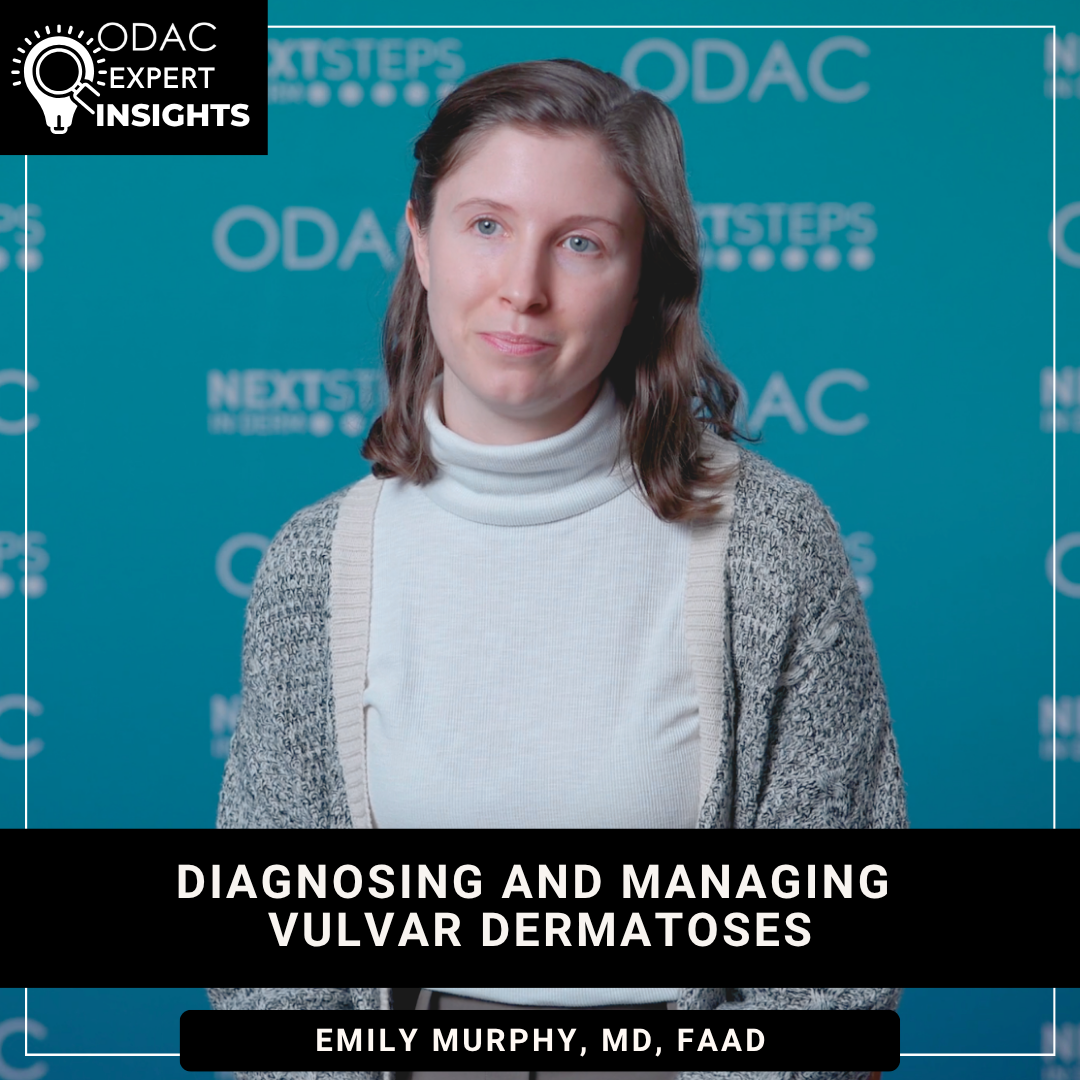
Emily Murphy, MD, FAAD, is committed to improving care for vulvar dermatoses, which is why she founded the Vulvar Health Program at the George Washington University School of Medicine & Health Sciences. In this Next Steps in Derm interview, in partnership with the ODAC Dermatology Conference, Dr. Murphy shares what her clinical experience has taught her about diagnosing and managing vulvar dermatoses. Hear her recommended treatment for lichen sclerosis and how to instruct patients in its use. Learn what working with gynecologists has taught her about how to care for patients who present with pain and itching. Additionally, find out what to consider in recalcitrant vulvar itch.
Further Reading
If you want to read more about vulvar dermatoses, check out the following articles published in the Journal of Drugs in Dermatology:
ABSTRACT
Background/Objectives: Lichen sclerosus (LS) is a chronic condition that warrants close follow-up due to the risk of scarring. The optimal long-term management of pediatric vulvar and perianal lichen sclerosus (PVPLS) is unknown. This study aimed to identify diagnostic, treatment, and maintenance regimens among pediatric dermatologists and pediatric/adolescent gynecologists, as well as assess provider confidence and desire for guidance on long-term PVPLS management.
Methods: A cross-sectional 35-question survey was administered through the Pediatric Dermatology Research Alliance (PeDRA) and the North American Society for Pediatric and Adolescent Gynecology (NASPAG) between 7/13/2021 and 8/30/2021 to ascertain PVPLS diagnostic and management regimens.
Results: Most responders were attending-level pediatric/adolescent gynecologists (46%) and pediatric dermatologists (41%). Although 85% of participants felt completely or very confident in diagnosing PVPLS, the majority (86%) desired further management guidelines. While the initial treatment was similar among providers, maintenance regimens and follow-up varied considerably, with only 42% recommending lifelong monitoring despite potential persistence into adulthood.
Conclusions: While initial treatment was similar among practitioners, there was variation by specialty in subsequent management and a lack of uniformity in long-term follow-up. Additional studies are needed to clarify the optimal management of PVPLS and to provide evidence-based guidelines regarding long-term follow-up.
Mohs Micrographic Surgery in Female Genital Cancers: A Systematic Review
ABSTRACT
Background: Mohs micrographic surgery (MMS) has shown promising efficacy in female genital cancers, including Extramammary Paget’s disease (EMPD), dermatofibrosarcoma protuberans (DFSP), squamous cell carcinoma (SCC), and basal cell carcinoma (BCC). However, limited consolidated research exists on the clinical outcomes following MMS in female genital cancers. The aim of this systematic review is to synthesize and evaluate recent literature on the application and utility of MMS in the management of female genital cancers.
Methods: A comprehensive search was conducted of the PubMed and EMBASE databases on October 16, 2024, using the keywords “Mohs surgery” or “Mohs micrographic surgery” and “female genital” or “vulvar cancer” or “vaginal cancer” or “genital cancer” or “vulva” or “vagina.” Studies were included if they directly discussed MMS for female genital cancers, particularly EMPD, DFSP, SCC, and BCC, with attention to clinical outcomes, were of the correct study type, and were published in peer-reviewed journals in English.
Results: Our results identified a 95% curative rate following MMS for EMPD, DFSP, SCC, and BCC, following analysis of 166 treated cases.
Conclusion: MMS provides superior outcomes as compared to traditional excisional approaches, potentially secondary to its precision-guided approach and histological analysis. Future studies should utilize larger patient cohorts and investigate rarer malignancies and combination therapies to optimize treatment guidelines for female genital cancers.
Did you enjoy this video interview? Find more here.