











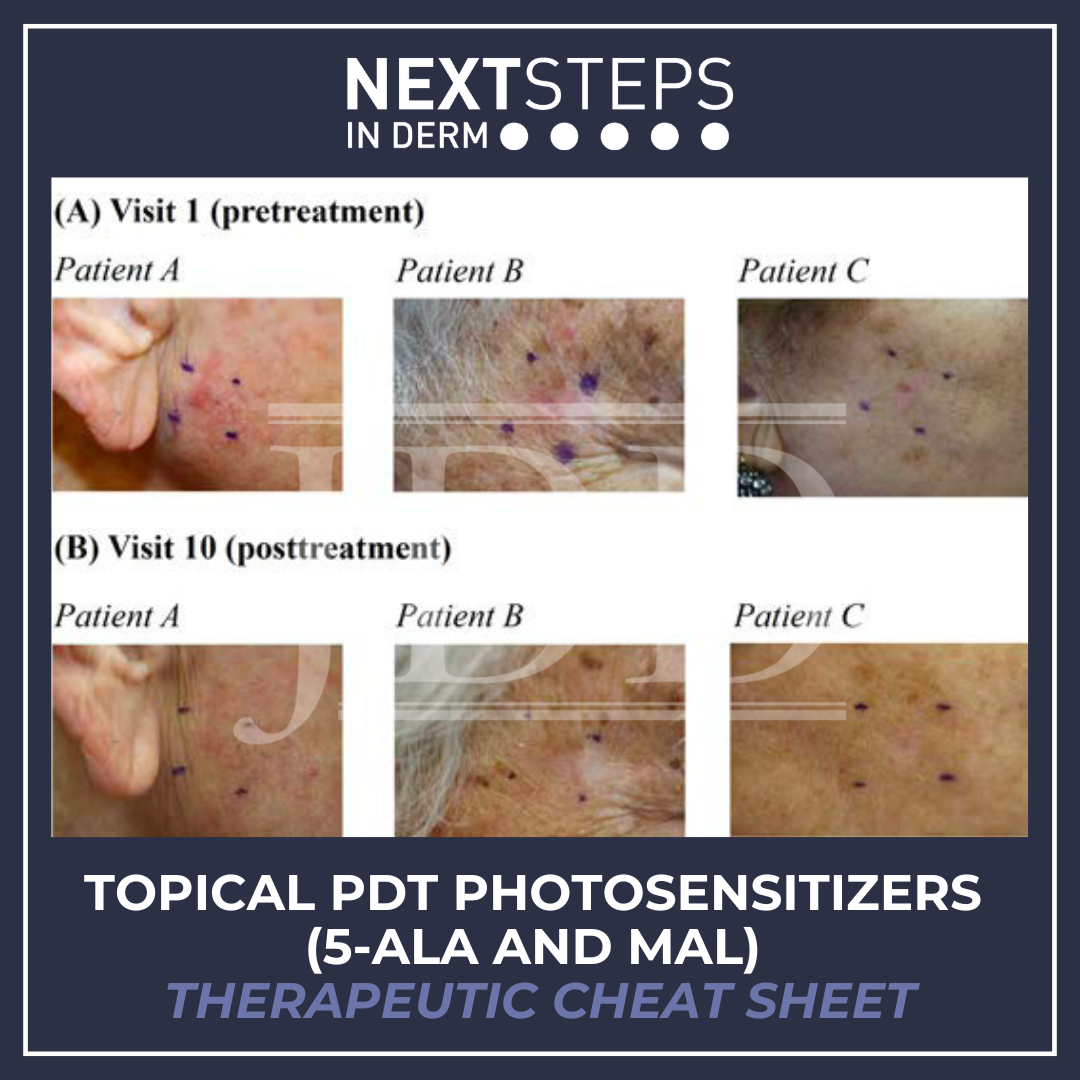
5-aminolevulinic acid (5-ALA) is an FDA-approved prodrug used in combination with light therapy for treatment of actinic keratosis and superficial basal cell carcinoma. It is a naturally occurring amino acid that is an intermediate of the heme biosynthesis pathway which cells convert into the photosensitizing metabolite protoporphyrin IX (PpIX). This compound has been applicable in two specific clinical scenarios due to its downstream accumulation of PpIX in preferentially neoplastic and hyperproliferative tissue: light-activated cellular apoptosis and tumor visualization. The first approval for 5-ALA came within dermatology with the approval of Levulin Kerastick in 1999, a blue-light activated 20% topical solution, and later with Ameluz, a 10% gel activated by red light. Methyl aminolevulinate (MAL) is the methyl ester of ALA and was approved in 2004 for the treatment of AKs and is still widely used outside the US. Additionally within the field of neurosurgery, 5-ALA was also described in 1998 to benefit in fluorescence-guided resection of high-grade gliomas, leading to FDA-approval in 2017 as an optical imaging agent for WHO grade 3-4 gliomas. We continue our series, Therapeutic Cheat Sheet, with a closer look at topical 5-ALA.
Topical PDT Photosensitizers (5-ALA and MAL) Therapeutic Cheat Sheet1,2
Compiled by: Shailey C. Shah, MD | Reviewed by: Adam Friedman, MD
TRADE NAME3,4
-
- LEVULAN KERASTICK® (aminolevulinic acid HCl for topical solution, 20%)
- AMELUZ® (aminolevulinic acid HCl topical gel, 10%)
- Metvix®/Metvixia (methyl aminolevulinate 16% or 160 mg/g cream)
MECHANISM OF ACTION5
-
- 5-ALA and MAL (methyl ester derivative of ALA) enter cells and the heme biosynthesis pathway for conversion into protoporphyrin IX (or PpIX, immediate precursor of heme)
- Final step in heme biosynthesis pathway requires ferrochelatase to insert Fe2+ into PpIX, forming heme. Usually a slow process, but in neoplastic and hyperproliferative cells, the pathway is dysregulated, causing faster buildup of PpIX in tissue
- Upon visible-light absorption and subsequent activation of PpIX, the metabolite reaches an excited state and transfers energy to molecular oxygen creating a singlet oxygen and reactive oxygen species (ROS)
- These ROS cause oxidative damage to cellular components killing target cells through apoptosis, necrosis, and autophagy
- Methyl ester makes MAL more lipophilic, giving deeper and more selective penetration into skin, which is why it is often used with deeper-penetrating red wavelength light therapy
FDA-APPROVED FOR3,4
-
- Levulan Kerastick (ALA 20% solution) – Minimal to moderately thick actinic keratoses (AKs) of the face, scalp, or upper extremities.
- Approved for use with BLU-U Blue Light Photodynamic Therapy Illuminator
- Formulation: plastic tube with two glass ampules — one with 1.5 mL solution vehicle, the other with dry ALA HCl solid — crushed and mixed to form the 20% solution
- Ameluz (ALA 10% gel) – Mild to moderate actinic keratoses (AKs) on the face and scalp and superficial basal cell carcinomas (sBCC) in adults.
- Approved for use with photodynamic therapy (PDT) using BF-RhodoLED, a narrowband, red light illumination source
- Formulation: 10% gel (white-to-yellowish), supplied in 2-gram tubes
- Metvix/Metvixia (MAL 16% or 160 mg/g cream)
- FDA approved in 2004 for thin-to-moderately-thick AKs of the face and scalp but was withdrawn from the US market in 2012 for commercial reasons; it continues to be widely used in Europe, Australia, Canada, and Latin America for AK, Bowen disease, and superficial/nodular BCC.
- Levulan Kerastick (ALA 20% solution) – Minimal to moderately thick actinic keratoses (AKs) of the face, scalp, or upper extremities.
OFF-LABEL DERMATOLOGIC USES6-12
-
- Facial Flat Warts
- Genital Condyloma Acuminata
- Acne Vulgaris
- Hypertrophic Scars
- Hidradenitis Suppurativa
- Genital Vitiligo
- **ALA-derived protoporphyrin IX absorbs strongly in both the blue (~410 nm, the Soret band) and red (~635 nm) ranges, so ALA can be photoactivated by either wavelength. HOWEVER, FDA approval required fixed drug-plus-device pairing, with Kerastick to blue light and Ameluz to red light devices. Using either for the alternative light source is considered off label.
INSTRUCTIONS FOR USE13,14
Both the Levulan Kerastick and Ameluz are provider-administered photosensitizers for photodynamic therapy (PDT). Standard FDA-approved PDT protocols include specific incubation and light illumination times. However, numerous alternative protocols have been developed and studied with comparable efficacy, improved patient tolerability, and more streamlined/shorter procedures.
Levulan Kerastick (aminolevulinic acid HCl for topical solution, 20%)
-
- STEP 1: Clean/degrease the skin with alcohol.
- STEP 2: Crush Kerastick containing ampules of both ALA dry solid and solution, to mix.
- STEP 3: Apply the solution directly to the target lesions by dabbing gently with the wet applicator tip. Enough solution should be applied to uniformly wet the lesion surface, including the edges without excess running or dripping.
- STEP 4: Incubate under light-blocking occlusion (per protocol)
- STEP 5: Illuminate with Blue Light PDT (per protocol)
Ameluz (aminolevulinic acid HCl topical gel, 10%)
-
- STEP 1: Clean/degrease the skin with alcohol, then gently roughen all lesions.
- STEP 2:
- Lesion-directed treatment: Apply gel approximately 1 mm thick to one or more individual AK lesions and include approximately 5 mm of the surrounding healthy skin.
- Field-directed treatment: Apply gel approximately 1 mm thick to the treatment field. Additionally, cover approximately 5 mm of the surrounding healthy area
- STEP 3: Allow gel to dry for 10 minutes before applying light-blocking occlusive dressing.
- STEP 4: Incubate under light-blocking occlusion (per protocol), then remove dressing and wipe off any remaining gel
- STEP 6: Illuminate with the Red Light PDT (per protocol)
PDT Protocols:
-
- Longer incubation times raise complete clearance (23.5% at 0.5 h vs 73.5% at 4 h with red light at 37 J/cm²) but also increased local skin reactions (26% at 0.5 h vs 66% at 4 h).
- A 2026 narrative review concluded that short- and no-incubation “painless” protocols achieve clearance comparable to conventional PDT with significantly improved tolerability and streamlined workflow, though larger trials are still needed to standardize them.
- Bullock TA, Maytin EV. Painless Photodynamic Therapy: Emerging Protocols and Light Delivery Systems for the Treatment of Actinic Keratoses. Photodermatol Photoimmunol Photomed. 2026 Jan;42(1):e70068. doi: 10.1111/phpp.70068. PMID: 41351497.
- Choosing Red light vs Blue Light:
- Blue light (~405–420 nm)
- Is absorbed most strongly by protoporphyrin IX (its Soret peak) but penetrates only ~1–2 mm, so it delivers intense, efficient activation confined to the epidermis.
- Ideal for thin, superficial actinic keratoses.
- Red light (~630–635 nm)
- Hits a weaker PpIX absorption peak and is a less efficient activator, but longer wavelengths scatter less and are absorbed less by hemoglobin/melanin, so red penetrates deeper (>2 mm, up to ~4–6 mm)
- Better for thicker, hyperkeratotic, or field disease and off-label superficial skin cancers.
- For typical thin-to-moderate AKs, efficacy is comparable between wavelengths, so lesion depth, device availability, and tolerability drive the choice.
- Blue light (~405–420 nm)
| Incubation time | Illumination time/dose | ||
| Red Light PDT | *Standard Red Light Protocol | 3 hours with occlusion | ~10 minutes; Auto-calculated by lamp |
| Shorter-incubation “painless” Red Light15 | 30 minutes | 37 J/cm
~7-10 mins |
|
| Low irradiance/reduced fluence16 | 3 hours | Same total dose (37 J/cm²) at ~25% irradiance, longer time | |
| Continuous low-level (Phosistos fabric device, P-PDT)17 | 30 minutes | Continuous low-irradiance light for a longer, sustained session | |
| Modified high-dose painless PDT (M-PDT)18 | 30 minutes | Red light at doubled total dose (288 vs 144 J/cm²); the higher dose extends illumination time relative to conventional PDT | |
| Daylight (red-spectrum) PDT | None | 2-hour daylight light-exposure | |
| Blue Light PDT | *Standard Blue Light Protocol | 14–18 hours (face/scalp) or 3 hours with occlusion (upper extremities). | 1000-second (16 minutes 40 seconds) |
| “Conventional” PDT | 1 hour | 1000-second (16 minutes 40 seconds) | |
| “Simultaneous” Blue Light19 | None | 30, 45, or 60 minutes | |
| No-incubation double-cycle protocol20 | None | Two back-to-back 16 min 40 s cycles (33 min 20 s total). | |
*Only FDA-approved protocols. All others are off-label.
ADMINISTRATION CONSIDERATIONS13,14
-
- Levulan Kerastick
- If for any reason the patient cannot be given illuminator treatment during the prescribed time after applying topical solution, advise patient to wear appropriate protective apparel (e.g., wide-brimmed hat, long sleeve shirt, gloves) to shade the treated actinic keratoses from sunlight or other bright light sources until at least 40 hours after the application of topical solution.
- Ameluz
- Physical measures such as cooling with an air stream or nebulized water may help reduce pain during illumination.
- If for any reason, the lesions cannot be illuminated within 3 hours after application, rinse off the gel with saline and water. For 2 days, protect the lesion sites and surrounding skin from sunlight or prolonged or intense light (e.g., tanning beds, sun lamps).
- Do not exceed an application area of 60 cm², and do not use more than 6 grams (3 tubes) at one time.
- Retreat lesions that have not completely resolved 3 months after the initial treatment.
- Both provider and patient should wear protective eyewear
- Post-treatment photoprotection: Advise the patient to avoid sunlight and prolonged or intense light exposure on the treated and surrounding skin for approximately 48 hours after treatment.
- Levulan Kerastick
SIDE EFFECTS3,4
-
- The most common side effects are local application site-reactions that are expected with response to phototoxic PDT therapy and generally resolve within days to a few weeks
- Application-site stinging/burning – reported by at least 50% of Levulan-treated subjects; usually subsides within 1 minute to 24 hours after light is turned off. Can be managed with local cooling, pauses, or analgesia.
- Other – Erythema, edema, scaling/crusting, itching, erosion, hypo-/hyperpigmentation, oozing/vesiculation, and dryness
- Less Common/Rare – Wheals, pustules, ulceration, bleeding, blistering, tenderness, dysesthesia
- Systemic (uncommon) – with Ameluz – headache, chills, eyelid edema, transient amnestic episodes and hypersensitivity (including anaphylaxis) are labeled precautions
- The most common side effects are local application site-reactions that are expected with response to phototoxic PDT therapy and generally resolve within days to a few weeks
GENERAL PRECAUTIONS3,4,21,22:
-
- After application of 5-ALA, treated skin becomes photosensitive and requires protection for 40 hours after initial application
- Sunscreen does not protect against visible-light phototoxicity, need to use physical barriers (wide-brimmed hat, long sleeves, gloves).
- Avoid concomitant photosensitizing drugs – St. John’s wort, griseofulvin, thiazide diuretics, sulfonylureas, phenothiazines, sulfonamides, quinolones, and tetracyclines – for 24 hours before and after 5-ALA use
- Contraindicated in
- Patients with acute or chronic porphyria due to risk of uncontrolled phototoxicity and potential ineffectiveness
- Patients with hypersensitivity to porphyrins or ALA (for Ameluz specifically, hypersensitivity to soybean phosphatidylcholine)
- Patients with photodermatoses
- There is a risk of HSV/VZV reactivation following PDT therapy
- For topical use only – not for ophthalmic, oral, or intravaginal use; avoid contact with mucosal surfaces
- Pediatrics – safety and effectiveness are not established
- After application of 5-ALA, treated skin becomes photosensitive and requires protection for 40 hours after initial application
PREGNANCY AND BREASTFEEDING3,4
-
- Pregnancy Category C
- No data collected from animal reproduction studies, studies in pregnant women, or of levels of metabolites in breastmilk. As per FDA, should be given to a pregnant woman only if clearly needed.
Further Reading
If you would like to learn more about topical 5-ALA, check out the following articles in the Journal of Drugs in Dermatology:
Nestor MS, Chaudry A, Vanaria RJ, Bhupalam V.
The objective of this study was to evaluate the efficacy, safety, and tolerability of aminolevulinic acid photodynamic therapy (ALA-PDT) for the treatment of facial cutaneous squamous cell carcinoma in situ (SCCis). A single-center, investigator-initiated, open-label study enrolled 32 adults with biopsy-confirmed facial SCCis. Patients received two treatments with topical 20% aminolevulinic acid followed by blue light exposure, administered 28 ± 3 days apart. Lesions were subsequently excised 8 weeks after the second treatment for histopathologic assessment. At study completion, all 30 patients who completed the study achieved complete histological clearance (100%). Clinical clearance was also achieved in all patients, with 40% achieving clearance by day 49 and the remainder by day 69. Local skin reactions, primarily erythema and flaking/scaling, were generally mild and resolved over time. Only 1 patient experienced temporary hyperpigmentation. Pain scores remained low, with a mean score of 2.71/10. Two patients experienced adverse events that were considered unrelated to treatment. ALA-PDT with 20% aminolevulinic acid and blue light achieved 100% histological and clinical clearance with minimal adverse effects, suggesting that it may be a safe, effective, and cosmetically favorable noninvasive alternative to surgical treatment for facial SCCis.
J Drugs Dermatol. 2026;25(5):454-459.
Yousefian F, Ismaili A, Sachdeva S, et al.
The objective of this mini review was to compare conventional photodynamic therapy (cPDT) with “painless” photodynamic therapy (pPDT) for the treatment of actinic keratosis (AK), with a particular focus on treatment efficacy and patient discomfort. Conventional PDT typically involves a longer incubation period before illumination, which results in increased accumulation of protoporphyrin IX and can cause significant pain and inflammation during treatment. In contrast, “painless” PDT minimizes or eliminates the incubation period and uses longer exposure to lower-intensity light. Across the studies reviewed, painless PDT demonstrated similar AK clearance rates compared with conventional PDT while substantially improving patient comfort. The reduction in pain appears to be related to decreased protoporphyrin IX accumulation resulting from the shorter incubation period. Both red- and blue-light PDT appear to have similar efficacy for AK, although each has distinct practical advantages and disadvantages. Overall, painless PDT represents a promising alternative to conventional PDT, particularly for patients who are unable to tolerate the pain associated with standard treatment. However, larger randomized trials are needed to establish standardized protocols and confirm long-term efficacy.
J Drugs Dermatol. 2025;24(5):502-506.
References:
-
- Ozog DM, Rkein AM, Fabi SG, Gold MH, Goldman MP, Lowe NJ, et al. Photodynamic therapy: a clinical consensus guide. Dermatol Surg. 2016;42(7):804-827. doi:10.1097/DSS.0000000000000800.
- Eatz TA, Eichberg DG, Lu VM, Di L, Komotar RJ, Ivan ME. Intraoperative 5-ALA fluorescence-guided resection of high-grade glioma leads to greater extent of resection with better outcomes: a systematic review. J Neurooncol. 2022;156(2):233-256. doi:10.1007/s11060-021-03901-9.
- U.S. Food and Drug Administration. Levulan Kerastick (aminolevulinic acid hydrochloride) prescribing information [Internet]. Silver Spring (MD): U.S. Food and Drug Administration; 2009 [cited 2026 Sep 15]. Available from: https://www.accessdata.fda.gov/drugsatfda_docs/label/2009/020965s006lbl.pdf
- U.S. Food and Drug Administration. [Prescribing information] [Internet]. Silver Spring (MD): U.S. Food and Drug Administration; 2026 [cited 2026 Sep 15]. Available from: https://www.accessdata.fda.gov/drugsatfda_docs/label/2026/208081s040lbl.pdf
- Austin E, Wang JY, Ozog DM, Zeitouni N, Lim HW, Jagdeo J. Photodynamic therapy: overview and mechanism of action. J Am Acad Dermatol. 2026;94(6):1619-1632. doi:10.1016/j.jaad.2025.02.037.
- Yang YL, Sang J, Liao NX, et al. Off-label photodynamic therapy for recalcitrant facial flat warts using topical 5-aminolevulinic acid. Lasers Med Sci. 2016;31:929-936. doi:10.1007/s10103-016-1925-8.
- Zhao Z, Jama AA, Gao H, Lu Y. Clinical observation of laser combined with 5-aminolevulinic acid photodynamic therapy for female vulva condyloma acuminatum. J Obstet Gynaecol Res. 2023;49(8):2010-2014. doi:10.1111/jog.15679.
- Kacerovska D, Pizinger K, Kumpova M, Cetkovska P. Genital warts treated by photodynamic therapy. Skinmed. 2007;6(6):295-297. doi:10.1111/j.1540-9740.2007.06352.x.
- Gold MH. 5-Aminolevulinic acid photodynamic therapy versus methyl aminolevulinate photodynamic therapy for inflammatory acne vulgaris. J Am Acad Dermatol. 2008;58(2 Suppl):S60-S62. doi:10.1016/j.jaad.2006.09.021.
- Zhou ZW, Chen XD, Wu XY. 5-ALA PDT successfully treats facial hidradenitis suppurativa-induced severe hypertrophic scar. Photodiagnosis Photodyn Ther. 2019;28:343-345. doi:10.1016/j.pdpdt.2019.10.008.
- Reshetylo S, Narla S, Bakker C, Freeman T, Farah RS, Hamzavi IH, et al. Systematic review of photodynamic therapy for the treatment of hidradenitis suppurativa. Photodermatol Photoimmunol Photomed. 2023;39(1):39-50. doi:10.1111/phpp.12812.
- Gao T, Feng Z, Ye J, Chen M, Guan X, Wan Y, et al. Topical 5-aminolevulinic acid photodynamic therapy for genital vitiligo. Photodiagnosis Photodyn Ther. 2024;50:104405. doi:10.1016/j.pdpdt.2024.104405.
- Drugs.com. Levulan Kerastick dosage guide [Internet]. [cited 2026 Sep 15]. Available from: https://www.drugs.com/dosage/levulan-kerastick.html
- Drugs.com. Ameluz gel dosage guide [Internet]. [cited 2026 Sep 15]. Available from: https://www.drugs.com/dosage/ameluz-gel.html
-
- Aggarwal I, Puyana C, Chandan N, Jetter N, Tsoukas M. Field Cancerization Therapies for the Management of Actinic Keratosis: An Updated Review. Am J Clin Dermatol. 2024.
- Gholam P, Bosselmann I, Enk AH, Dick J. Low irradiance compared with conventional photodynamic therapy in the treatment of actinic keratoses. Photodermatol Photoimmunol Photomed. 2019.
- Mordon S, Vignion-Dewalle AS, Abi-Rached H, Thecua E, Lecomte F, Vicentini C, Deleporte P, Béhal H, Kerob D, Hommel T, Duhamel A, Szeimies RM, Mortier L. The conventional protocol vs. a protocol including illumination with a fabric-based biophotonic device (the Phosistos protocol) in photodynamic therapy for actinic keratosis: a randomized, controlled, noninferiority clinical study. Br J Dermatol. 2020 Jan;182(1):76-84. doi: 10.1111/bjd.18048. Epub 2019 Aug 1. PMID: 31021404.
- Li J, Zhang Y, Zhang G, Zhang L, Zhou Z, Wang P, et al. Modified painless photodynamic therapy for facial multiple actinic keratosis in China: A prospective split-face control study. Lasers Surg Med. 2023; 55: 871–879. https://doi.org/10.1002/lsm.23728
- Kaw U, Ilyas M, Bullock T, Rittwage L, Riha M, Vidimos A, Hu B, Warren CB, Maytin EV. A regimen to minimize pain during blue light photodynamic therapy of actinic keratoses: Bilaterally controlled, randomized trial of simultaneous versus conventional illumination. J Am Acad Dermatol. 2020 Apr;82(4):862-868. doi: 10.1016/j.jaad.2019.09.010. Epub 2019 Sep 13. PMID: 31525441; PMCID: PMC8036906.
- Gandy J, Labadie B, Bierman D, Zachary C. Photodynamic Therapy Effectively Treats Actinic Keratoses Without Pre-Illumination Incubation Time. J Drugs Dermatol. 2017 Mar 1;16(3):275-278. PMID: 28301624; PMCID: PMC6241219.
- Nobbe S, Trüeb RM, French LE, Hofbauer GFL. Herpes simplex virus reactivation as a complication of photodynamic therapy. Photodermatol Photoimmunol Photomed. 2011;27:51-52. doi:10.1111/j.1600-0781.2010.00552.x.
- Bradley M, Muzumdar S, Shahriari N, Rothe MJ, Falcone M. A rare case of herpes zoster ophthalmicus after photodynamic therapy. Int J Womens Dermatol. 2020;6(5):454-455. doi:10.1016/j.ijwd.2020.09.003. Erratum in: Int J Womens Dermatol. 2021;7(5 Pt B):868. doi:10.1016/j.ijwd.2021.09.012.
Did you enjoy this Therapeutic Cheat Sheet? You can find more here.