












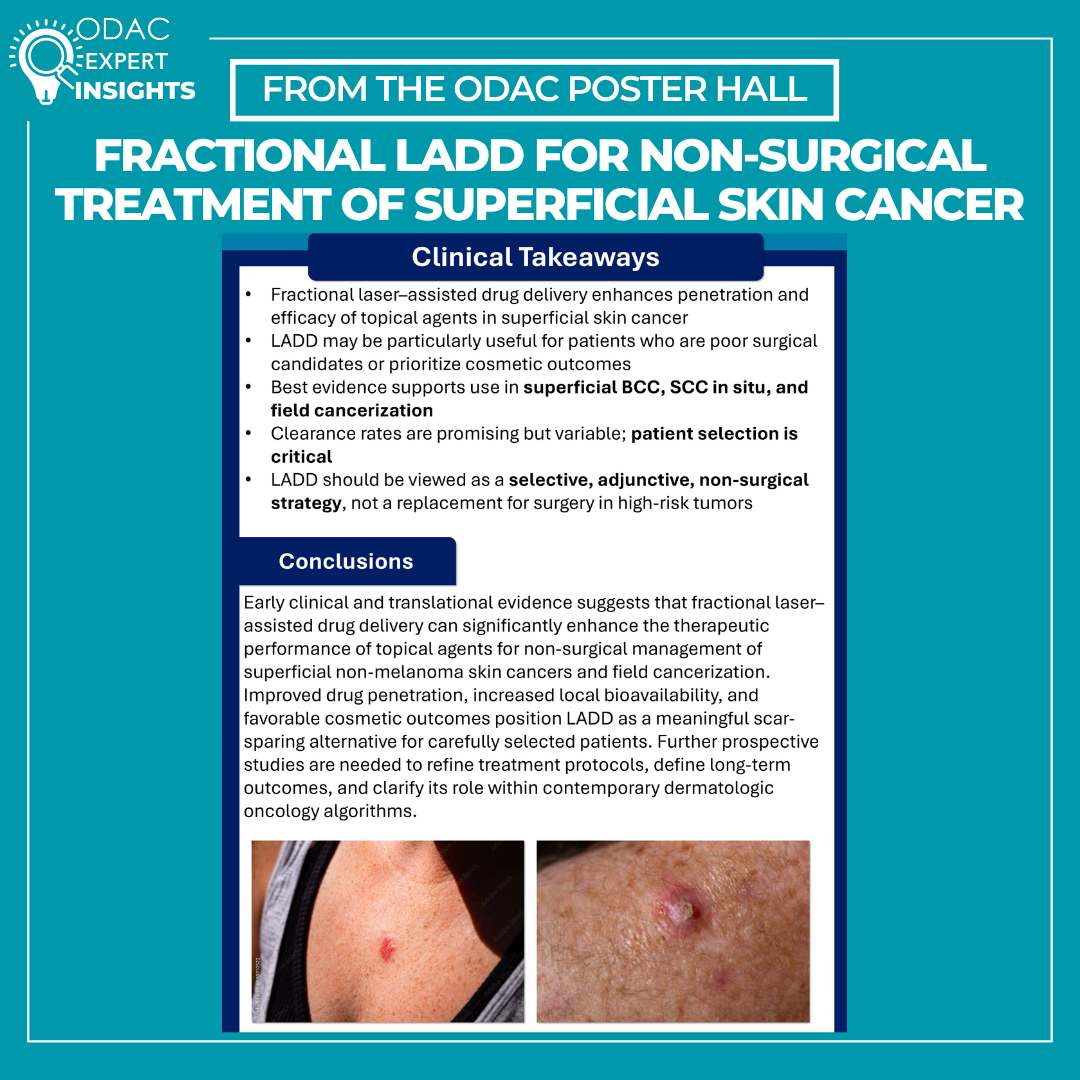
Surgery is the gold standard for skin cancer treatment, but sometimes surgery isn’t the best option. Perhaps the patient isn’t healthy enough or the patient simply refuses to go under the knife. Topical therapy is an alternative, but patient compliance is a concern. Enter fractional laser-assisted drug delivery (LADD): a non-surgical approach that enhances penetration of topical treatments, leading to skin cancer clearance with positive cosmetic results.
A poster presented at the ODAC Dermatology Conference outlines the results of a literature review on fractional LADD as a skin cancer treatment option. I interviewed two of the poster’s authors, Anna Delay, BA, with the Touro University College of Osteopathic Medicine-California, and Alina G. Bridges, DO, FAAD, with Northwell.
Surgical excision and Mohs micrographic surgery remain the gold standard of skin cancer treatment. What’s the need for nonsurgical options?
Nonsurgical options are needed for patients in whom surgery is not feasible, or contraindicated. Specific indications include large keratinocyte carcinomas where surgery carries functional complications (such as facial palsy), patients with multiple lesions, those with bleeding tendencies or cardiac problems, elderly patients who refuse surgical treatment, and situations where self-application of topical therapy is not possible.
The NCCN Guidelines and American Academy of Dermatology guidelines recommend considering nonsurgical approaches such as photodynamic therapy, topical medications, radiation therapy, and active surveillance when surgery is not appropriate. For low-risk superficial basal cell carcinomas and squamous cell carcinoma in situ, nonsurgical modalities can achieve reasonable clearance rates while offering advantages in cosmetic outcomes.
While surgical approaches often offer the most effective means for accomplishing cure, considerations of function, cosmesis, and patient preference may lead to choosing alternative treatments as primary therapy to achieve optimal overall results. In patients with superficial basal cell skin cancer or epidermally limited cutaneous squamous cell carcinoma, nonsurgical modalities may be particularly appropriate.
What led you to study fractional laser-assisted drug delivery (LADD) as a skin cancer treatment option?
The primary driver for studying fractional LADD was the limited efficacy of conventional topical therapies due to insufficient drug penetration through the stratum corneum barrier. The protective barrier provided by the stratum corneum limits transcutaneous drug bioavailability to as low as 1% to 5%.Traditional topical therapies for skin cancer, such as 5-fluorouracil and imiquimod, have suboptimal clearance rates attributed to this insufficient intracutaneous penetration.
Ablative fractional lasers create microscopic vertical channels of ablation surrounded by layers of coagulated tissue, providing a mechanism to overcome the epidermal barrier. This technology evolved from the introduction of fractional photothermolysis and has been refined to enhance drug uptake without increasing systemic adverse events. The growing interest reflects clinicians and patients who are increasingly seeking effective, directed, lower-risk interventions for indications that traditionally required higher doses of topical or systemic medication.
The effectiveness of topical drugs for treatment of non-melanoma skin cancer is greatly reduced by insufficient penetration to deep skin layers, and ablative fractional lasers are known to enhance topical drug uptake by generating narrow microchannels through the skin. This approach addresses the major rate-limiting step for drug absorption, which is passage through the stratum corneum.
You conducted a literature review. What were you looking for and what did you find?
Literature reviews on LADD examined preclinical drug uptake data, clinical efficacy, safety profiles, and cosmetic outcomes. Key findings include:
Preclinical Evidence: All preclinical trials documented enhanced topical drug uptake into skin after ablative fractional laser treatment Studies demonstrated that fractional CO₂ laser pretreatment leads to rapid drug uptake in deep skin layers (up to 1500 μm), with a sixfold enhancement in peak cisplatin concentrations versus non-laser-treated controls and maximum 5-FU deposition within one hour that exceeded peak deposition in non-laser-exposed skin after 5 days of topical exposure.
Clinical Evidence: The highest level of evidence (Level IB) was reached for actinic keratoses treated with methylaminolevulinate photodynamic therapy, with 5 randomized controlled trials substantiating superior and long-lasting efficacy versus conventional PDT. Ablative fractional laser improved 12-month follow-up clearance rates of photodynamic therapy from 45.0-51.0% to 78.5-84.8% for actinic keratosis and from 50.0-55.3% to 87.0-87.5% for Bowen’s disease.
For basal cell carcinoma, laser-assisted combination chemotherapy with cisplatin and 5-FU achieved 94% histological clearance at 3 months and 79% clearance at 12 months for low-risk lesions. The JAMA Dermatology clinical practice guidelines found sufficient evidence to strongly recommend that LADD is safe and effective for treatment of actinic keratoses, actinic cheilitis, and cutaneous squamous cell carcinoma in situ.
Of the 48 published studies of ablative fractional LADD that met inclusion criteria, 4 were cosmetic studies, 21 were oncologic, and 23 were medical (not cosmetic/oncologic). Thirty-four studies (63.0%) were deemed to have low risk of bias, 17 studies (31.5%) had moderate risk, and 3 (5.5%) had serious risk.
How does fractional LADD compare in efficacy with surgical excision and Mohs surgery?
Surgical excision and Mohs micrographic surgery demonstrate significantly superior efficacy compared with fractional laser–assisted drug delivery (LADD), with reported recurrence rates approximately 2–6 times lower for surgical approaches. In basal cell carcinoma, LADD has been associated with up to a sixfold higher recurrence rate compared with surgery. Similarly, in squamous cell carcinoma in situ, recurrence rates following LADD are approximately 2.5–6 times higher than those observed with surgical management. A major limitation of LADD contributing to these outcomes is the lack of histologic margin control.
What are some of the other benefits of fractional LADD for skin cancer?
Beyond enhanced drug penetration, fractional LADD offers multiple clinical advantages:
Improved Treatment Efficiency: LADD provides reduced treatment durations, shortened incubation times, and replacement of cumbersome, patient-dependent treatment regimens with quick, in-office procedures. Maximum drug deposition occurs within 1 hour of ablative fractional laser delivery compared to days with conventional topical application.
Superior Cosmetic Outcomes: Studies consistently report favorable cosmetic results, with 94% of patients and 79% of physicians rating cosmesis as “good” or “excellent” at 3 months. At 12 months follow-up, cosmetic outcomes remained similarly rated, with scarring resolving in the majority of patients (76%). Laser therapy offers good cosmetic outcomes and reduced morbidity compared to surgery, particularly valuable for cosmetically sensitive areas.
Enhanced Safety Profile: Although chemotherapy uptake extends to deep skin layers, no systemic exposure to cisplatin or 5-FU was detected in patient blood. Adverse events are most often transient and mild (crusting, erythema, post-inflammatory hyperpigmentation, burning sensation). LADD is safe in adults and adolescents with all Fitzpatrick skin types and in patients with immunosuppression.
Clinical Versatility: LADD is particularly suited for cases of multiple lesions, instances where self-application is not possible, or when in-office, non-surgical therapy is preferred over extended courses of at-home therapy. The technique has been successfully employed in the treatment of non-melanoma skin cancer including field cancerization.
How should your findings impact the future of skin cancer treatment?
Fractional LADD represents a promising complementary treatment modality that should be integrated into the therapeutic armamentarium for select skin cancer cases, though it does not replace surgery as the gold standard.
Clinical Integration: LADD should be considered for low-risk superficial basal cell carcinomas, squamous cell carcinoma in situ, actinic keratoses, and actinic cheilitis, particularly when surgery is contraindicated, not feasible, or not preferred by patients. It offers an effective option for patients with multiple lesions, those in cosmetically sensitive areas, or when patient compliance with prolonged at-home topical regimens is challenging.
Research Priorities: Future research should focus on optimizing LADD techniques, addressing safety concerns, and exploring novel drug formulations. Specific needs include larger randomized controlled trials with longer follow-up periods, standardization of laser parameters, determination of optimal drug formulations, and evaluation for deeper or more nodular lesions. Additional research is needed for immunosuppressed populations and to clarify the role of non-laser modalities like microneedling.
Limitations to Address: Current challenges include limited penetration depth, potential tissue damage, cost of LADD systems, lack of margin control, and variable results that restrict broader use. The degree of unpredictability in response and drug tissue levels due to variable pharmacokinetics when drugs are delivered through the skin requires further investigation.
Future Developments: Promising directions include ablative fractional laser-assisted immune activation, changing drug administration routes of systemic therapies, utilizing drug chemo-combinations, and developing smaller, less costly ablative fractional laser devices to facilitate translation. Although surgical management continues to be superior to laser therapy for the management of high-risk and cosmetically sensitive tumors, laser therapy may be an acceptable alternative for low-risk lesions on the trunk and extremities. With continued advancements in laser technology and pharmaceutical science, LADD has the potential to revolutionize the field of dermatology and enhance patient care.
Additional authors of the poster include:
Alex Silberzweig, BA, Zucker School of Medicine at Hofstra/Northwell
Alexander T. Velaoras, BS, Drexel University College of Medicine
Kelly Frasier, DO, MS, Northwell