











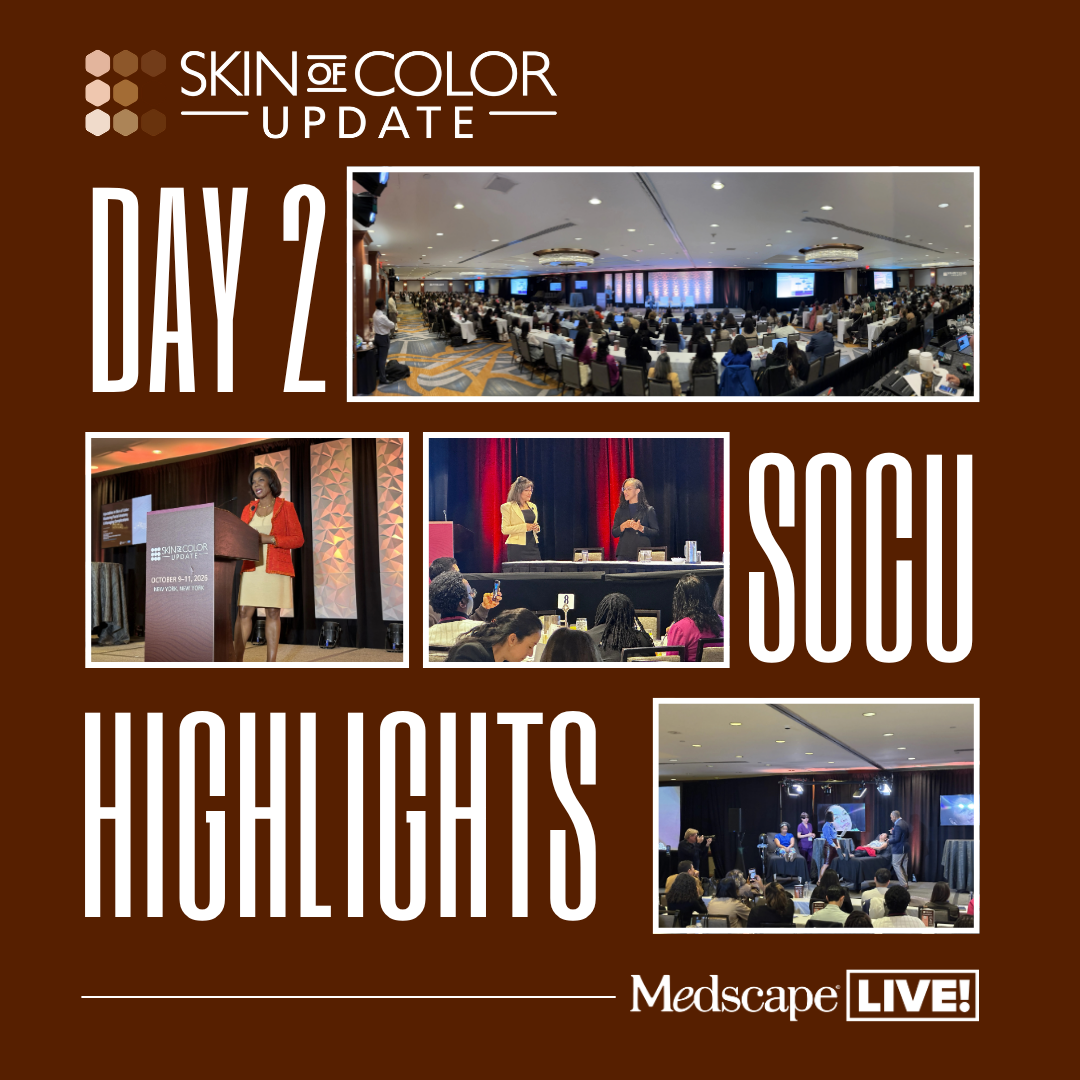
Following a high-energy kickoff, Day 2 of the 17th Annual Skin of Color Update (SOCU 2026) delivered a masterclass in complex inflammatory dermatoses, cutting-edge hair and scalp algorithms, and practical surgical management of keloids and nail emergencies.
Co-Chairs Andrew F. Alexis, MD, MPH, FAAD, and Eliot F. Battle, MD, welcomed attendees back to the main stage for another action-packed day of clinical pearls, live polling, and expert panel debates.
Day 2 at a Glance
Yesterday’s agenda brought deep clinical insights and practice-changing updates across three major focus areas:
-
-
Session IV: Inflammatory Skin Conditions—Part 2 (Psoriasis, AD, CSU & Prurigo Nodularis)
A look at immunometabolic disease drivers, why achieving PASI 100 early prevents long-term post-inflammatory hyperpigmentation, the 3–4x higher risk of psoriatic arthritis in scalp/nail disease, and how combining GLP-1 agonists with biologics boosts skin and joint clearance.
-
Session V: Hair Disorders in Skin of Color
Essential diagnostic differentiation between scarring (CCCA vs. LPP) and non-scarring alopecias, the critical rule that “time is follicles,” low-dose oral minoxidil (LDOM) dosing strategies, and the link between vertex androgenetic alopecia and cardiovascular risk in Black men.
-
Session VI: Keloids, Nail Disease, and Autoimmune Blistering
Why surgical excision of keloids without immediate post-op radiation (within 48–72 hours) and multimodal anti-inflammatory therapy leads to near-100% recurrence, why nail lichen planus is a true dermatologic emergency, and how to tailor biologics for nail matrix vs. nail bed psoriasis.
-
Below are the detailed daily hot takes and clinical summaries from each session of Day 2!
Session IV: Inflammatory Skin Conditions—Part 2: Treatment Advances, Real‑World Pearls, and Case Discussions
The Big Picture
Managing chronic inflammatory dermatoses in skin of color—ranging from psoriasis and atopic dermatitis to chronic spontaneous urticaria and prurigo nodularis—requires clinicians to look beyond PASI/EASI scores and target systemic immunometabolic drivers, pigmentary burdens, high-impact anatomical sites, and patient-centered treatment goals.
Key Pearls
-
- Psoriasis & High-Impact Sites [03:20–07:15]: Scalp and nail involvement are more prevalent, more severe, and carry a 3–4x higher risk of psoriatic arthritis (PsA) in Black and Asian populations. Clinicians must perform full-body exams to prevent undertreatment. Dedicated skin of color studies (e.g., VISIBLE trial) demonstrate that guselkumab yields ~60% complete scalp clearance after 3 doses.
- Emerging Psoriasis Therapeutics: The newly approved oral macrocyclic peptide icotrokinra (targeting IL-23R) offers 50% PASI 90 efficacy with a placebo-like safety profile. Furthermore, extended half-life IL-23p19 antibodies (e.g., Orca-001) demonstrate 60% PASI 100 rates with as few as 1–2 injections per year.
- Immunometabolic Psoriasis Management: Recurrent psoriasis flares in patients on high-efficacy biologics are often driven by weight gain and metabolic systemic inflammation rather than secondary drug failure. Adding tirzepatide to ixekizumab therapy produces 40% greater skin clearance and 60% greater ACR joint improvement in PsA.
- Atopic Dermatitis Phenotypes & Depigmentation: In skin of color, AD presents with lichenoid papules, follicular accentuation, and prominent post-inflammatory hyperpigmentation or true depigmentation (from mechanical melanocyte destruction due to severe excoriation). Targeted Type 2 biologic/JAK therapies resolve underlying inflammation before secondary pigmentary sequelae develop.
- Psoriasis & High-Impact Sites [03:20–07:15]: Scalp and nail involvement are more prevalent, more severe, and carry a 3–4x higher risk of psoriatic arthritis (PsA) in Black and Asian populations. Clinicians must perform full-body exams to prevent undertreatment. Dedicated skin of color studies (e.g., VISIBLE trial) demonstrate that guselkumab yields ~60% complete scalp clearance after 3 doses.
Session V: Hair Disorders in Skin of Color—Clinical Updates, Practical Pearls, and Case‑Driven Care
The Big Picture
Managing hair disorders in skin of color requires rapid clinical recognition, precise trichoscopy and biopsy to differentiate scarring from non-scarring alopecias, and culturally competent communication to eliminate mistrust, shame, and delayed diagnosis. Early intervention is paramount because “time is follicles” in scarring alopecia, while low-dose oral minoxidil (LDOM) and targeted anti-androgen therapy continue to redefine treatment algorithms for non-scarring hair loss.
Key Pearls
-
- Early Recognition & Differentiating CCCA vs. LPP: Central centrifugal cicatricial alopecia (CCCA) and lichen planopilaris (LPP) can present with nearly identical vertex follicular dropout. Biopsy is critical: LPP often exhibits patchier progression, prominent burning sensations, loss of body hair, and requires aggressive oral immunosuppression (hydroxychloroquine, methotrexate, or MMF).
-
- Practical Dosing for Low-Dose Oral Minoxidil (LDOM): For non-scarring and scarring alopecias, start women at 1.25 mg daily and men at 2.5 mg daily. In male androgenetic alopecia, 2.5 mg daily produces equivalent efficacy to 5.0 mg daily with significantly fewer side effects (hypertrichosis, lower extremity edema, dizziness).
-
- Frontal Fibrosing Alopecia (FFA) & Cultural Literacy: FFA presents with a characteristically smooth anterior hairline, eyebrow loss, and lichen planus pigmentosus (LPPgm). Do not mistake FFA or ophiasis-pattern alopecia areata for traction alopecia. Clinicians must understand culturally specific styling practices (sew-ins, quick weaves, sisterlocks, lemonade braids) to counsel patients effectively on tension-free alternatives.
-
- Androgenetic Alopecia & Cardiovascular Risks: In Black men, vertex-predominant androgenetic alopecia demonstrates a strong correlation with underlying cardiovascular disease. Clinicians evaluating vertex thinning in this population should consider screening for systemic metabolic and cardiovascular risk factors.
Session VI: Practical Approaches to Keloids, Nail Disease, and Autoimmune Blistering in Skin of Color
The Big Picture
Managing complex inflammatory, scarring, and blistering disorders in skin of color requires aggressive multimodal protocols, long-term monitoring, and high clinical suspicion to prevent irreversible structural damage and diagnostic delays.
Key Pearls
-
- Keloids as a Systemic Fibroproliferative Disease: Keloids represent an exaggerated wound-healing response with high symptom burdens (itch in ~75%, pain/allodynia in ~50%). Surgical excision alone carries a 45–100% recurrence rate; optimal control requires post-op radiation within 48–72 hours combined with multimodal anti-inflammatory therapy (e.g., intralesional 5-FU/triamcinolone, flurandrenolide tape, or oral pentoxifylline).
-
- Multimodal Systemic Therapy for Severe Keloids: For patients with multiple or highly recalcitrant keloids, oral agents targeting inflammatory and fibrotic pathways—such as oral pentoxifylline (400 mg TID) or pulse dexamethasone (4 mg on 2 consecutive days per week for up to 12 weeks)—can halt progression and ease severe symptoms.
-
- Diagnostic Delays in Nail Psoriasis & Lichen Planus: In darker skin types, isolated nail psoriasis is often diagnosed with significant delay (~59 months vs. 24 months in lighter skin types) and presents with higher severity (NAPSI scores) and secondary pigmentary signs. Nail lichen planus is a true dermatologic emergency: early systemic intervention is required to prevent permanent pterygium and anonychia.
-
- Nail Matrix Injections & Biologic Selection: Matrix intralesional triamcinolone injections (diluted in 1% lidocaine using distraction techniques) effectively control focal nail psoriasis. For widespread nail disease, secukinumab shows high efficacy for matrix-predominant changes (pitting, trachyonychia), while ixekizumab excels in nail bed-predominant changes (onycholysis, oil drop patches).
Read the Day 1 Recap here.
AI Editorial Disclosure:
This summary was generated using AI-assisted transcription and synthesis of live presentation recordings from Skin of Color Update 2026 . This content is intended for educational purposes only for healthcare professionals and should not replace clinical judgment.