












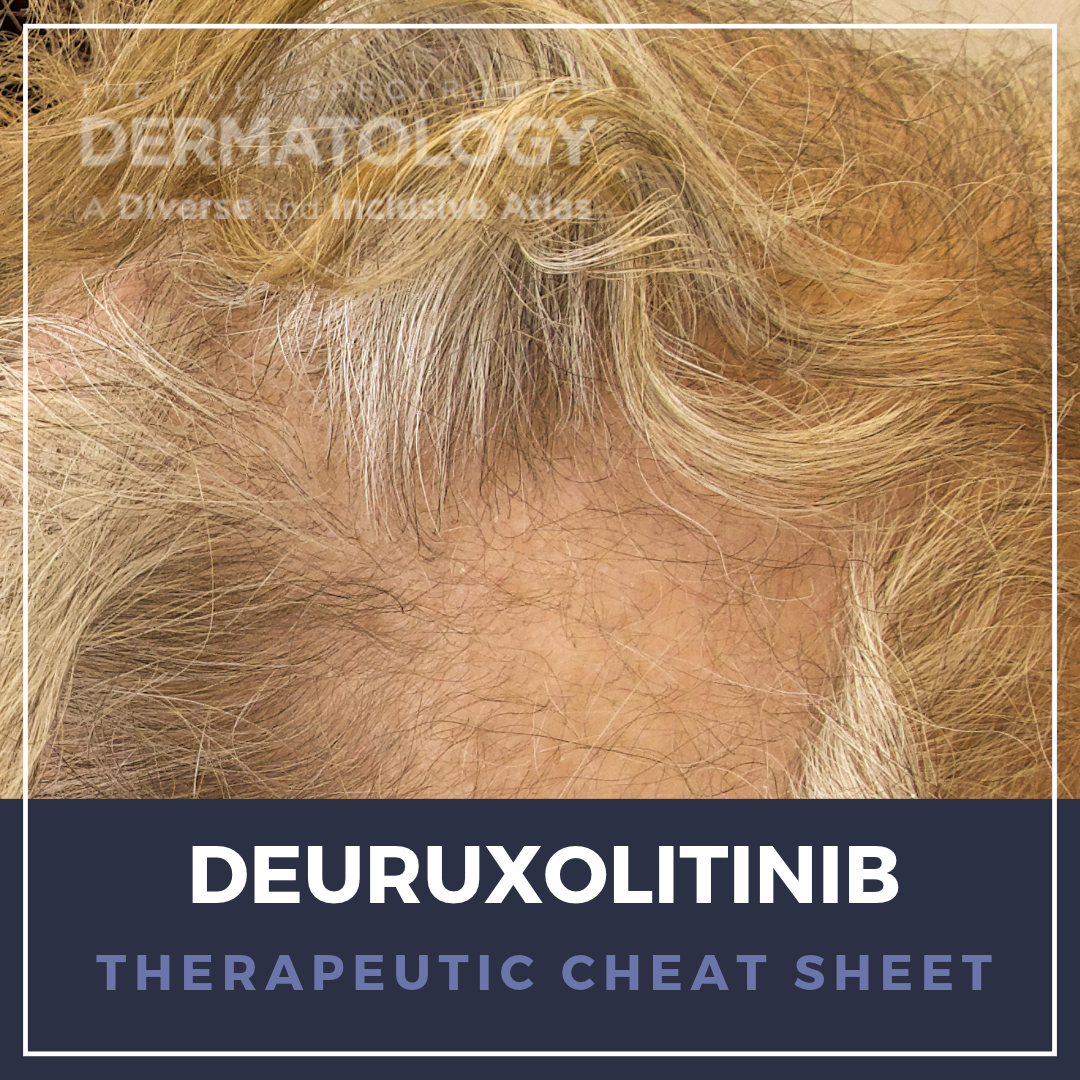
Deuruxolitinib is an oral Janus kinase (JAK) inhibitor approved for the treatment of severe alopecia areata in adults, which is defined as having a Severity of Alopecia Tool (SALT) score of 50 or higher. Deuruxolitinib selectively inhibits JAK1 and JAK2, targeting inflammatory signaling pathways implicated in autoimmune hair follicle destruction. Unlike other FDA-approved JAK inhibitors for alopecia areata, deuruxolitinib requires CYP2C9 genotyping before treatment initiation because of potentially dangerous drug accumulation in CYP2C9 poor metabolizers. We continue our Therapeutic Cheat Sheet Series with a closer look at deuruxolitinib.
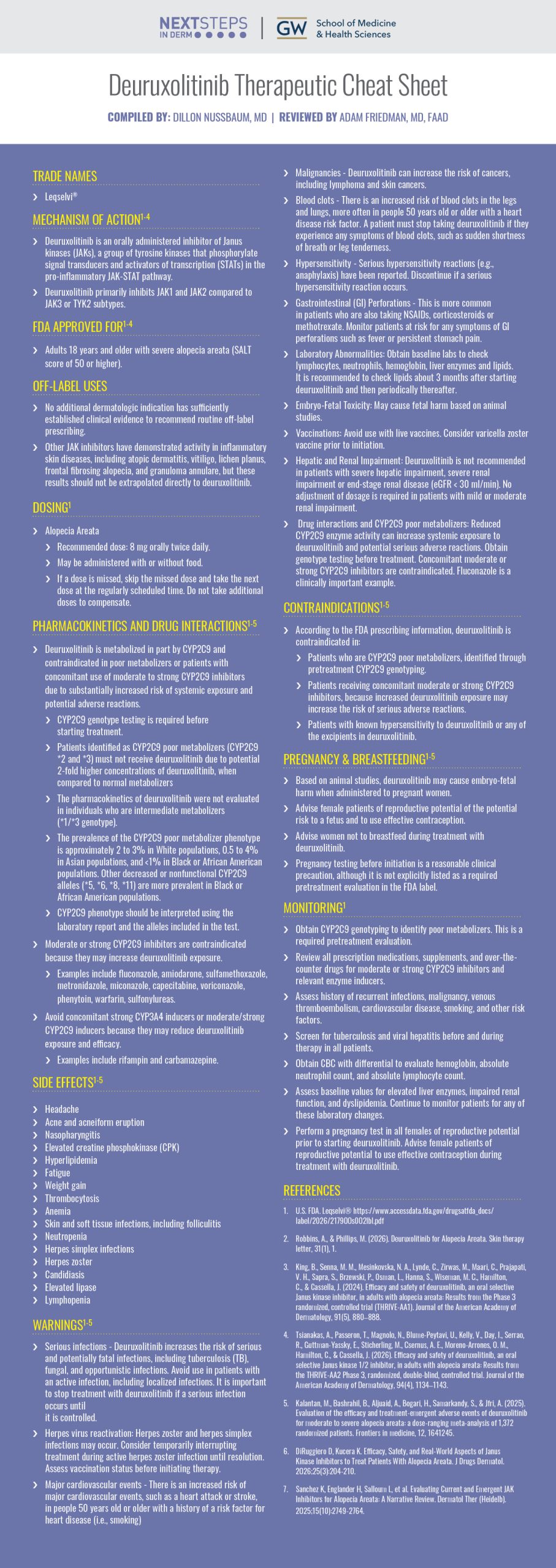
Deuruxolitinib Therapeutic Cheat Sheet
Compiled by Dillon Nussbaum, MD, Reviewed by Adam Friedman, MD, FAAD
TRADE NAME
-
- Leqselvi®
MECHANISM OF ACTION1-4
-
- Deuruxolitinib is an orally administered inhibitor of Janus kinases (JAKs), a group of tyrosine kinases that phosphorylate signal transducers and activators of transcription (STATs) in the pro-inflammatory JAK-STAT pathway.
- Deuruxolitinib primarily inhibits JAK1 and JAK2 compared to JAK3 or TYK2 subtypes.
FDA APPROVED FOR1-4
-
- Adults 18 years and older with severe alopecia areata (SALT score of 50 or higher).
OFF-LABEL USES
-
- No additional dermatologic indication has sufficiently established clinical evidence to recommend routine off-label prescribing.
- Other JAK inhibitors have demonstrated activity in inflammatory skin diseases, including atopic dermatitis, vitiligo, lichen planus, frontal fibrosing alopecia, and granuloma annulare, but these results should not be extrapolated directly to deuruxolitinib.
DOSING1
-
- Alopecia Areata
- Recommended dose: 8 mg orally twice daily.
- May be administered with or without food.
- If a dose is missed, skip the missed dose and take the next dose at the regularly scheduled time. Do not take additional doses to compensate.
- Alopecia Areata
PHARMACOKINETICS AND DRUG INTERACTIONS1-5
-
- Deuruxolitinib is metabolized in part by CYP2C9 and contraindicated in poor metabolizers or patients with concomitant use of moderate to strong CYP2C9 inhibitors due to substantially increased risk of systemic exposure and potential adverse reactions.
- CYP2C9 genotype testing is required before starting treatment.
- Patients identified as CYP2C9 poor metabolizers (CYP2C9 *2 and *3) must not receive deuruxolitinib due to potential 2-fold higher concentrations of deuruxolitinib, when compared to normal metabolizers
- The pharmacokinetics of deuruxolitinib were not evaluated in individuals who are intermediate metabolizers (*1/*3 genotype).
- The prevalence of the CYP2C9 poor metabolizer phenotype is approximately 2 to 3% in White populations, 0.5 to 4% in Asian populations, and <1% in Black or African American populations. Other decreased or nonfunctional CYP2C9 alleles (*5, *6, *8, *11) are more prevalent in Black or African American populations.
- CYP2C9 phenotype should be interpreted using the laboratory report and the alleles included in the test.
- Moderate or strong CYP2C9 inhibitors are contraindicated because they may increase deuruxolitinib exposure.
- Examples include fluconazole, amiodarone, sulfamethoxazole, metronidazole, miconazole, capecitabine, voriconazole, phenytoin, warfarin, sulfonylureas.
- Avoid concomitant strong CYP3A4 inducers or moderate/strong CYP2C9 inducers because they may reduce deuruxolitinib exposure and efficacy.
- Examples include rifampin and carbamazepine.
SIDE EFFECTS1-5
-
- Headache
- Acne and acneiform eruption
- Nasopharyngitis
- Elevated creatine phosphokinase (CPK)
- Hyperlipidemia
- Fatigue
- Weight gain
- Thrombocytosis
- Anemia
- Skin and soft tissue infections, including folliculitis
- Neutropenia
- Herpes simplex infections
- Herpes zoster
- Candidiasis
- Elevated lipase
- Lymphopenia
WARNINGS1-5
-
- Serious infections – Deuruxolitinib increases the risk of serious and potentially fatal infections, including tuberculosis (TB), fungal, and opportunistic infections. Avoid use in patients with an active infection, including localized infections. It is important to stop treatment with deuruxolitinib if a serious infection occurs until it is controlled.
- Herpes virus reactivation: Herpes zoster and herpes simplex infections may occur. Consider temporarily interrupting treatment during active herpes zoster infection until resolution. Assess vaccination status before initiating therapy.
- Major cardiovascular events – There is an increased risk of major cardiovascular events, such as a heart attack or stroke, in people 50 years old or older with a history of a risk factor for heart disease (i.e., smoking)
- Malignancies – Deuruxolitinib can increase the risk of cancers, including lymphoma and skin cancers.
- Blood clots – There is an increased risk of blood clots in the legs and lungs, more often in people 50 years old or older with a heart disease risk factor. A patient must stop taking deuruxolitinib if they experience any symptoms of blood clots, such as sudden shortness of breath or leg tenderness.
- Hypersensitivity – Serious hypersensitivity reactions (e.g., anaphylaxis) have been reported. Discontinue if a serious hypersensitivity reaction occurs.
- Gastrointestinal (GI) Perforations – This is more common in patients who are also taking NSAIDs, corticosteroids or methotrexate. Monitor patients at risk for any symptoms of GI perforations such as fever or persistent stomach pain.
- Laboratory Abnormalities: Obtain baseline labs to check lymphocytes, neutrophils, hemoglobin, liver enzymes and lipids. It is recommended to check lipids about 3 months after starting deuruxolitinib and then periodically thereafter.
- Embryo-Fetal Toxicity: May cause fetal harm based on animal studies.
- Vaccinations: Avoid use with live vaccines. Consider varicella zoster vaccine prior to initiation.
- Hepatic and Renal Impairment: Deuruxolitinib is not recommended in patients with severe hepatic impairment, severe renal impairment or end-stage renal disease (eGFR < 30 ml/min). No adjustment of dosage is required in patients with mild or moderate renal impairment.
- Drug interactions and CYP2C9 poor metabolizers: Reduced CYP2C9 enzyme activity can increase systemic exposure to deuruxolitinib and potential serious adverse reactions. Obtain genotype testing before treatment. Concomitant moderate or strong CYP2C9 inhibitors are contraindicated. Fluconazole is a clinically important example.
CONTRAINDICATIONS1,5
According to the FDA prescribing information, deuruxolitinib is contraindicated in:
-
- Patients who are CYP2C9 poor metabolizers, identified through pretreatment CYP2C9 genotyping.
- Patients receiving concomitant moderate or strong CYP2C9 inhibitors, because increased deuruxolitinib exposure may increase the risk of serious adverse reactions.
- Patients with known hypersensitivity to deuruxolitinib or any of the excipients in deuruxolitinib.
PREGNANCY & BREASTFEEDING1,5
-
- Based on animal studies, deuruxolitinib may cause embryo-fetal harm when administered to pregnant women.
- Advise female patients of reproductive potential of the potential risk to a fetus and to use effective contraception.
- Advise women not to breastfeed during treatment with deuruxolitinib.
- Pregnancy testing before initiation is a reasonable clinical precaution, although it is not explicitly listed as a required pretreatment evaluation in the FDA label.
MONITORING1
-
- Obtain CYP2C9 genotyping to identify poor metabolizers. This is a required pretreatment evaluation.
- Review all prescription medications, supplements, and over-the-counter drugs for moderate or strong CYP2C9 inhibitors and relevant enzyme inducers.
- Assess history of recurrent infections, malignancy, venous thromboembolism, cardiovascular disease, smoking, and other risk factors.
- Screen for tuberculosis and viral hepatitis before and during therapy in all patients.
- Obtain CBC with differential to evaluate hemoglobin, absolute neutrophil count, and absolute lymphocyte count.
- Assess baseline values for elevated liver enzymes, impaired renal function, and dyslipidemia. Continue to monitor patients for any of these laboratory changes.
- Perform a pregnancy test in all females of reproductive potential prior to starting deuruxolitinib. Advise female patients of reproductive potential to use effective contraception during treatment with deuruxolitinib.
FURTHER READING
If you would like to learn more about deuruxolitinib in dermatology, check out the following articles:
DiRuggiero, D. & Kucera, K.
Alopecia areata (AA) is an autoimmune disease characterized by nonscarring hair loss on the scalp and body, leading to a reduced quality of life and psychosocial burden for patients. The only US Food and Drug Administration–approved treatments for severe AA are the Janus kinase inhibitors (JAKis) baricitinib, ritlecitinib, and deuruxolitinib. Herein, we discuss the efficacy, safety, and real-world aspects of JAKi treatment for patients with AA for an advanced practice provider audience. We review the clinical characteristics and diagnosis of AA and discuss treatment expectations for patients using JAKis.
J Drugs Dermatol. 2026 Mar 1;25(3):204-210.
Evaluating Current and Emergent JAK Inhibitors for Alopecia Areata: A Narrative Review
Sanchez, K., Englander, H., Salloum, L., Gregoire, S., Biba, U., Ershadi, S., & Mostaghimi, A.
Alopecia areata (AA) is an autoimmune condition characterized by non-scarring hair loss on the scalp, face, and body, affecting approximately 2% of the global population. Current treatments, including topical corticosteroids, topical immunotherapies, and systemic immunosuppressants, often demonstrate inconsistent efficacy and raise concerns about long-term safety, emphasizing the need for safer and more effective therapies. Janus kinase (JAK) inhibitors have emerged as a promising treatment option, offering a targeted approach by addressing the immune-mediated mechanisms driving hair follicle destruction in AA. Recent clinical advances have led to FDA approval of three JAK inhibitors-baricitinib, ritlecitinib, and deuruxolitinib-based on pivotal trials showing significant hair regrowth. Baricitinib has demonstrated durable efficacy, with 35-40% of patients achieving a Severity of Alopecia Tool (SALT) score ≤ 20 at 36 weeks. Ritlecitinib similarly reported 23% of patients achieving a SALT score ≤ 20 at week 24. Deuruxolitinib has also shown efficacy with 31% of patients achieving a SALT score ≤ 20 at 24 weeks. Off-label use of JAK inhibitors like tofacitinib and ruxolitinib have also demonstrated efficacy in limited studies. This review aims to consolidate and summarize the latest clinical evidence and trial data on JAK inhibitors for AA, providing an up-to-date resource for clinicians and researchers to guide evidence-based management and optimize therapeutic outcomes.
Dermatol Ther (Heidelb). 2025;15(10):2749-2764.
References
-
- U.S. FDA. Leqselvi® https://www.accessdata.fda.gov/drugsatfda_docs/label/2026/217900s002lbl.pdf
- Robbins, A., & Phillips, M. (2026). Deuruxolitinib for Alopecia Areata. Skin therapy letter, 31(1), 1.
- King, B., Senna, M. M., Mesinkovska, N. A., Lynde, C., Zirwas, M., Maari, C., Prajapati, V. H., Sapra, S., Brzewski, P., Osman, L., Hanna, S., Wiseman, M. C., Hamilton, C., & Cassella, J. (2024). Efficacy and safety of deuruxolitinib, an oral selective Janus kinase inhibitor, in adults with alopecia areata: Results from the Phase 3 randomized, controlled trial (THRIVE-AA1). Journal of the American Academy of Dermatology, 91(5), 880–888.
- Tsianakas, A., Passeron, T., Magnolo, N., Blume-Peytavi, U., Kelly, V., Day, I., Serrao, R., Guttman-Yassky, E., Sticherling, M., Csernus, A. E., Moreno-Arrones, O. M., Hamilton, C., & Cassella, J. (2026). Efficacy and safety of deuruxolitinib, an oral selective Janus kinase 1/2 inhibitor, in adults with alopecia areata: Results from the THRIVE-AA2 Phase 3, randomized, double-blind, controlled trial. Journal of the American Academy of Dermatology, 94(4), 1134–1143.
- Kalantan, M., Bashrahil, B., Aljuaid, A., Bogari, H., Samarkandy, S., & Jfri, A. (2025). Evaluation of the efficacy and treatment-emergent adverse events of deuruxolitinib for moderate to severe alopecia areata: a dose-ranging meta-analysis of 1,372 randomized patients. Frontiers in medicine, 12, 1641245.
- DiRuggiero D, Kucera K. Efficacy, Safety, and Real-World Aspects of Janus Kinase Inhibitors to Treat Patients With Alopecia Areata. J Drugs Dermatol. 2026;25(3):204-210.
- Sanchez K, Englander H, Salloum L, et al. Evaluating Current and Emergent JAK Inhibitors for Alopecia Areata: A Narrative Review. Dermatol Ther (Heidelb). 2025;15(10):2749-2764.
Did you enjoy this Therapeutic Cheat Sheet? You can find more here.