











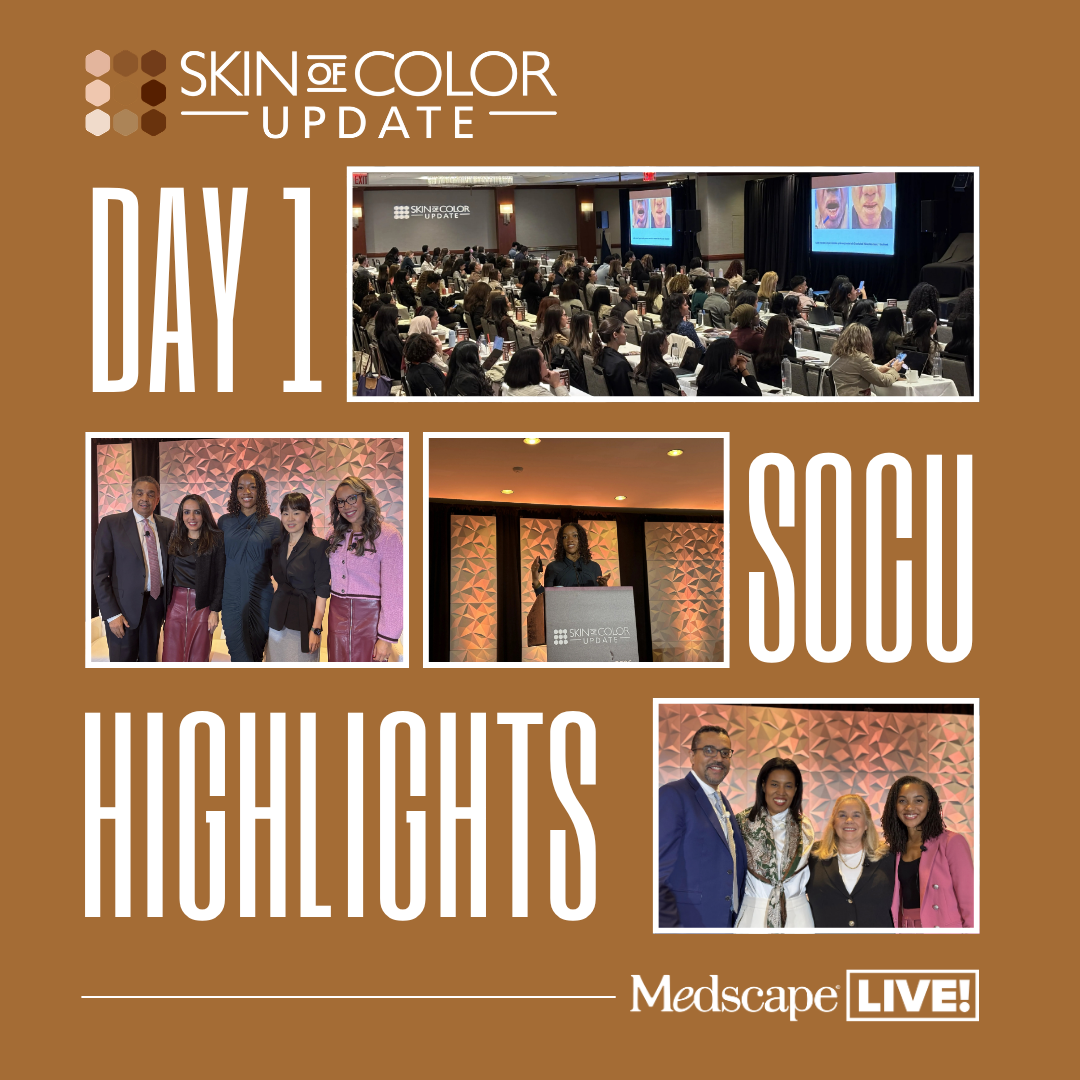
Day 1 of the 17th Annual Skin of Color Update (SOCU 2026) opened with a historic sense of community, reflection, and relentless dedication to advancing dermatologic care for patients with skin of color.
Co-Chairs Andrew F. Alexis, MD, MPH, FAAD, and Eliot F. Battle, MD, welcomed attendees from across the globe—spanning Europe, the Caribbean, the UK, and across the United States—marking 17 years since the conference was founded.
“We began 17 conferences ago with a simple idea that has grown into something much larger. We believe that people with skin of color deserve the same depth of research, clinical expertise, innovation, and attention that we expect throughout every area of dermatology. Today, Skin of Color Update is much more than a conference—it is a true community.”
— Eliot F. Battle, MD
Day 1 at a Glance
Yesterday’s sessions set an ambitious, fast-paced agenda packed with breakthrough therapeutic updates, paradigm-shifting approaches to chronic inflammatory diseases, and histology-guided laser physics:
Session I: New Horizons in Skin of Color: Drug Updates & GLP‑1 Therapy
An overview of major FDA approvals—including bemotrizinol (the first new OTC sunscreen filter in 26 years), remibrutinib (a novel oral BTK inhibitor), and icotrokinra (an oral macrocyclic peptide targeting IL-23)—alongside groundbreaking clinical data on combining GLP-1 receptor agonists with biologics to target systemic immunometabolic inflammation in psoriasis and hidradenitis suppurativa.
Session II: Inflammatory Skin Conditions—Part 1 (Acne, Rosacea & HS)
Expert strategies for preventing permanent sequelae. Key highlights included the novel ALTER paradigm for unmasking rosacea in deeply pigmented skin, early window-of-opportunity interventions in HS, and multi-targeted topical approaches to resolve acne and post-inflammatory hyperpigmentation simultaneously.
Session III: Lasers & Devices in Skin of Color
A deep dive into moving beyond Fitzpatrick skin phototypes toward evaluating individual skin biology, melanosome distribution, and histology. Highlights included 1927 nm thulium laser targeting for dermal melanophages in PIH (~300 µm depth), deep focal-point technology, and laser-assisted drug delivery (LADD) using 5-FU/steroid suspensions for keloids and bimatoprost for post-inflammatory hypopigmentation.
Below are the detailed daily “Hot Takes” and clinical summaries from each session of Day 1. Stay tuned throughout today for our Day 2 coverage!
Session I: New Horizons in Skin of Color: Drug Updates & GLP‑1 Therapy
The Big Picture
The landscape of dermatologic therapeutics in skin of color is evolving at an unprecedented pace. From historic FDA approvals in inflammatory conditions to the revolutionary paradigm shift of integrating GLP-1 receptor agonists into inflammatory disease regimens, modern management is moving beyond treating skin in isolation to targeting systemic immunometabolic pathways.
Key Pearls
-
- Historic Monograph & Drug Approvals: The addition of bemotrizinol to the US OTC sunscreen monograph marks the first new sunscreen filter added in 26 years, offering superior, non-whitening, photostable UVA protection crucial for compliance in skin of color. Recent drug approvals like remibrutinib (a novel oral BTK inhibitor for CSU and symptomatic dermographism), icotrokinra (the first oral macrocyclic peptide inhibiting IL-23), and brepocitinib (an oral TYK2/JAK1 inhibitor for adult dermatomyositis) deliver biologic-level efficacy in oral delivery systems.
- Pediatric Label Extensions : Treatment options for pediatric patients with skin of color expanded dramatically, including ruxolitinib 1.5% cream (atopic dermatitis, ages 2–11), roflumilast 0.05% cream (atopic dermatitis, ages 2–5), secukinumab (hidradenitis suppurativa, ages 12+), dupilumab (CSU, ages 2–11), and baricitinib (severe alopecia areata in adolescents 12+, with signals of potentially higher efficacy than in adults).
- GLP-1s + Biologics in Psoriatic Disease: Obesity should be framed as an active driver of immunometabolic systemic inflammation rather than a personal failure or mere comorbidity. Adding tirzepatide to ixekizumab therapy yielded 40% greater skin clearance in plaque psoriasis and 60% greater improvement in psoriatic arthritis.
- Reframing Hidradenitis Suppurativa & GLP-1 Mechanisms : Adipose tissue is metabolically active, secreting proinflammatory cytokines (TNF-α, IL-6, IL-1β). GLP-1 agonists not only reduce mechanical friction through weight loss but also directly downregulate key inflammatory cascades (TNF-α, NF-κB, C-reactive protein) in HS.
Session II: Inflammatory Skin Conditions—Part 1: Disease State Updates, Pearls, and Case-Based Approaches to Diagnosis & Treatment
The Big Picture
Managing follicular inflammatory conditions—acne, rosacea, and hidradenitis suppurativa (HS)—in patients with skin of color demands a proactive, early-intervention framework to prevent permanent sequelae such as post-inflammatory hyperpigmentation (PIH), keloidal scarring, and physical/psychological distress.
Key Pearls
-
- Acne & Sequelae Management: Acne is the #1 dermatologic diagnosis in Black, Hispanic/Latino, and Asian populations. “PIH” is often a misnomer because subclinical active inflammation persists; early, multi-targeted therapy (such as fixed triple combinations like clindamycin/adapalene/BPO or clascoterone + retinoids) is vital to control acne and pigment simultaneously.
- Rosacea Diagnosis via ALTER Paradigm: Rosacea is significantly underdiagnosed in skin of color due to low suspicion and difficulty visualizing subtle central facial erythema. Dr. Baldwin introduced the ALTER paradigm: Ask questions (burning, stinging, product intolerance), Look for non-classical signs (edema, ocular inflammation, phymatous change), Tools (dermoscopy, dioscopy), Educate on barrier repair, and Recommend non-whitening sunscreen.
- Hidradenitis Suppurativa “Window of Opportunity”: The average delay to HS diagnosis is 7–10 years. Screening patients with two or more recurrent “boils” in six months allows clinicians to initiate targeted biologics early. Oral antibiotics should be viewed as short-term flare management rather than chronic disease-modifying therapy.
- Minimizing Irritation to Prevent Iatrogenic PIH: Irritant contact dermatitis from aggressive regimens induces secondary PIH. Prioritize high-tolerability vehicles, consider barrier repair for 1–2 weeks prior to starting active topicals, and avoid harsh physical exfoliants.
Session III: Lasers & Devices in Skin of Color: Fundamentals, Safety, and Challenging Cases
The Big Picture
Safely and effectively treating patients with skin of color using energy-based devices requires moving beyond surface Fitzpatrick skin typing to evaluating underlying skin biology, melanosome distribution, and histological depth. Mastering core laser physics—longer wavelengths, extended pulse durations, aggressive cooling, and low fluences—allows clinicians to deliver targeted thermal energy while sparing the epidermis and mitigating post-inflammatory pigmentary adverse events.
Key Pearls
-
- Skin Biology vs. Skin Color: Fitzpatrick skin typing is an incomplete surrogate for safety. In darker skin tones, larger, individually dispersed melanosomes distributed throughout higher epidermal layers increase competitive laser absorption before energy reaches dermal targets. Utilizing 1064 nm Nd:YAG, micro-second pulse durations, and deep focal-point technologies minimizes epidermal heating.
- Histology-Guided Device Selection for Scars: Mechanical-only modalities (microneedling) and non-ablative RF microneedling provide strong dermal remodeling while minimizing epidermal thermal injury. For deep ice-pick scars (~2 mm depth), chemical reconstruction of skin scars (CROSS) using 100% TCA via ultra-fine 0.5 mL insulin syringe needles reaches deep dermal collagen bundles without spillover.
- Optimizing Pigment & PIH Clearance: Histological studies confirm that melanophages in post-inflammatory hyperpigmentation (PIH) reside at an average depth of ~300 µm from the skin surface. A 1927 nm thulium fractional laser delivers ideal superficial epidermal-dermal junction targeting with high water absorption. For lentigines, aim for faint endpoint whitening using picosecond lasers rather than opaque whitening to avoid thermal damage.
- Laser-Assisted Drug Delivery (LADD) for Keloids & Hypopigmentation : Fractional CO2 ablative laser channels allow liquid suspensions (5-FU and triamcinolone) to penetrate thick keloid tissue. For post-laser hypopigmentation, combining non-ablative fractional lasers with topical prostaglandin F2α analogs (bimatoprost) stimulates melanocyte repigmentation.
Day 1 set a high bar, demonstrating how rapidly our understanding of therapeutics, immunometabolic drivers, and histology-guided procedures in skin of color is expanding. But we are just getting started!
Stay tuned to Next Steps in Dermatology as we bring you live updates and daily “Hot Takes” from Day 2 of the 17th Annual Skin of Color Update.
AI Editorial Disclosure:
This summary was generated using AI-assisted transcription and synthesis of live presentation recordings from Skin of Color Update 2026 . This content is intended for educational purposes only for healthcare professionals and should not replace clinical judgment.